
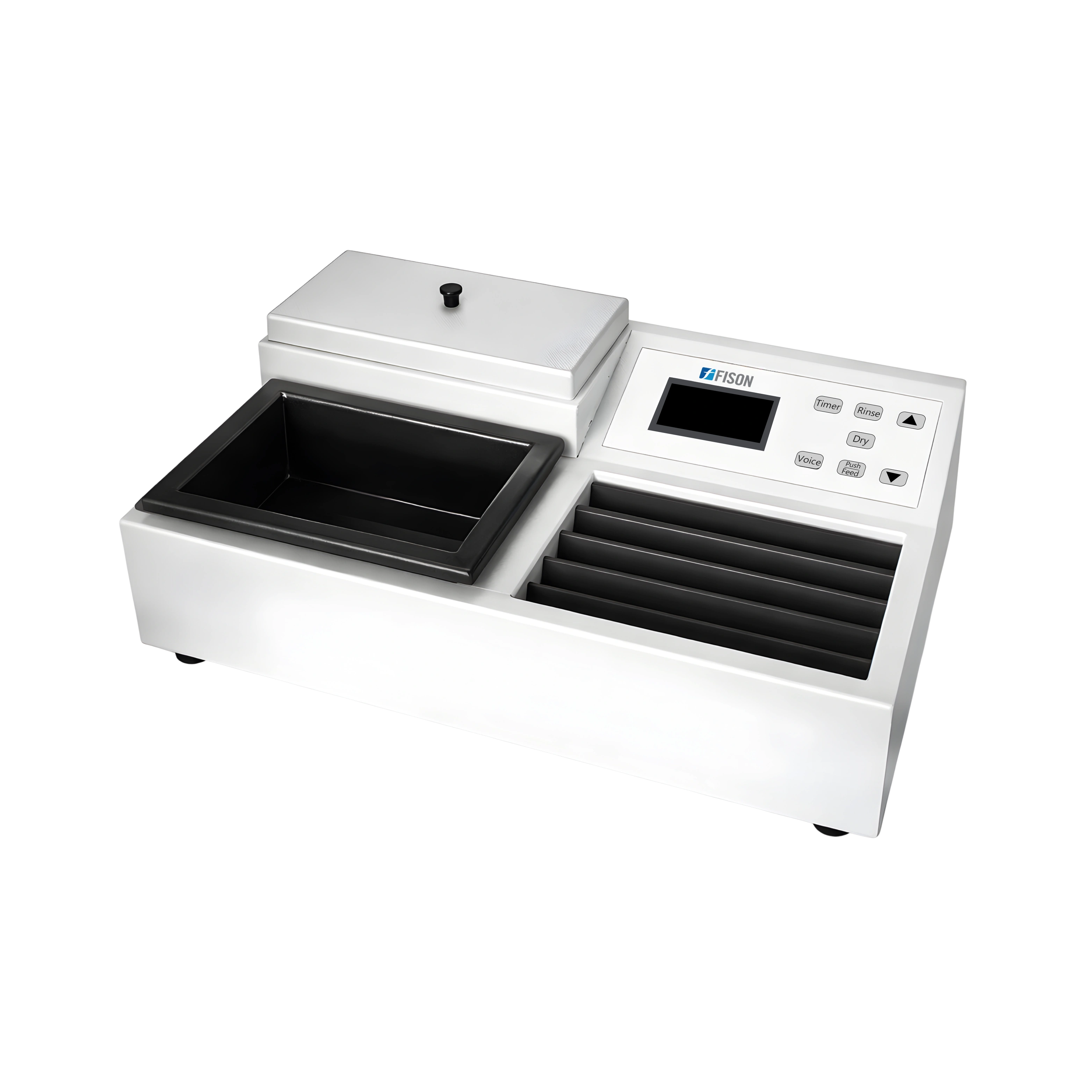
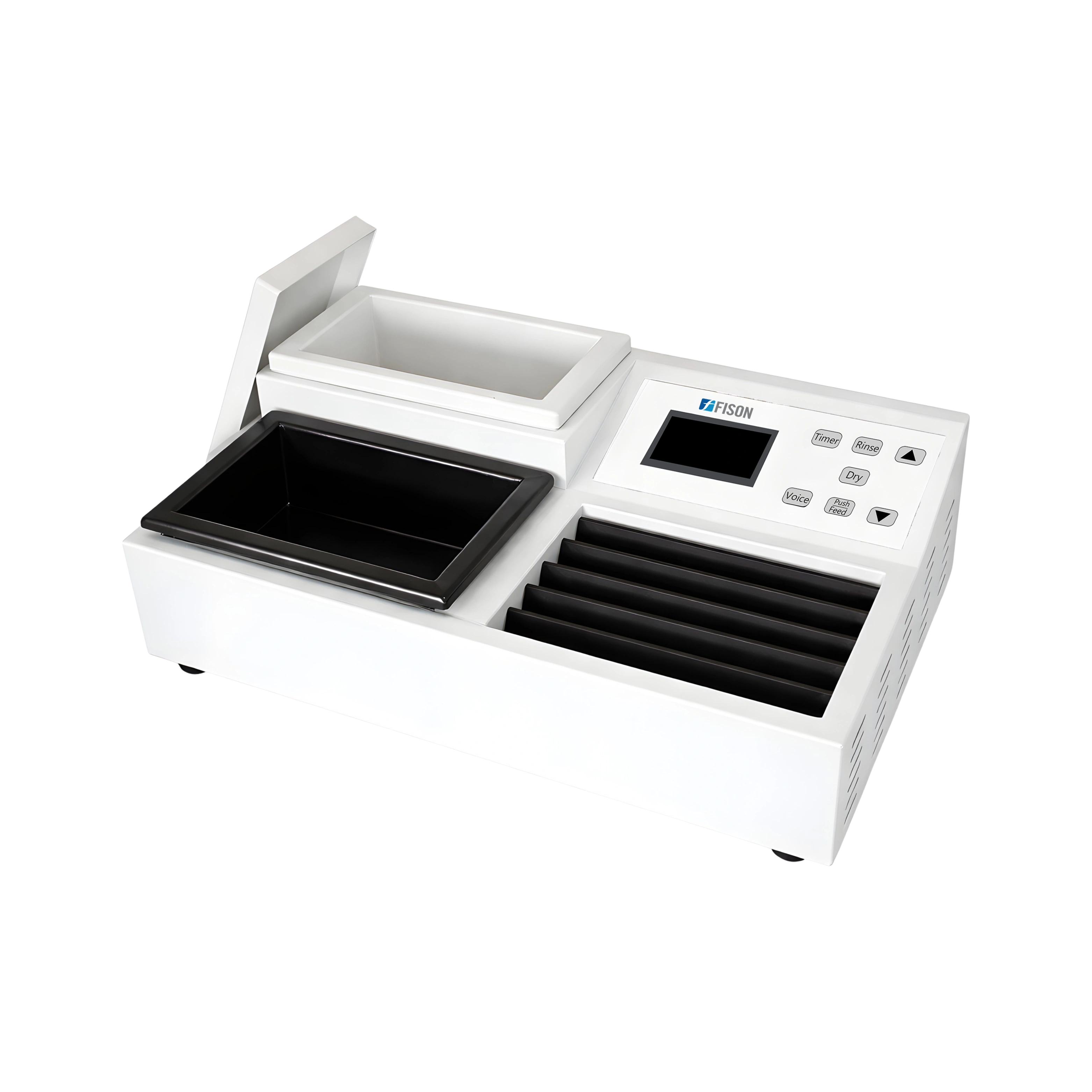
Tissue Flotation Workstation FM-TFW-A101 is a modular workstation designed with a 40-slide capacity for paraffin wax slide drying. It has a baking sheet room with a holding capacity of 30 to 40 sheets for efficient paraffin section processing. Our workstation consists of three areas- a water-flattening bath, a slide-drying bench, and a multipurpose tray. Its independent temperature control is ideal for histology and pathology laboratories for reliable performance.
$792.00
| Temperature Setting Range | 30°C to 90°C |
| Slide Capacity | 40 slide |
| Dyeing Racks | 3 racks of 30 to 40 sheets |
| Baking Tray Capacity | 3 staining racks or 2×250ml beakers |
| Drying Slot Angle | 60° |
| Timer Function | Audible alarms |
| Fishing tank | Black enamel polymer bleaching |
| Water Bath Dimension(W×D×H) | 190×140×70mm |
| Overall Dimension(W×D×H) | 510×340×220mm |
| Package Dimension(W×D×H) | 550×340×220mm |
| Net Weight | 11kg |
| Gross Weight | 13.5kg |
High-Contrast Enamel Bath
Black Enamel Polymer Bleaching Tank
Corrugated Slide Drying Slot
Spacious Baking Chamber
Audible Alarms for Process Control
Our Tissue Flotation Workstation FM-TFW-A101 is used for precise flattening, drying, and baking of paraffin tissue sections in histopathology, pathology, and biomedical research laboratories. It supports high-throughput slide preparation with reliable temperature control for consistent results.
1: What is the purpose of the Tissue Flotation Workstation FM-TFW-A101 in histology labs?
The Tissue Flotation Workstation FM-TFW-A101 is used to flatten and dry paraffin-embedded tissue sections after microtomy. It ensures uniform expansion of sections for accurate slide mounting. This is crucial for producing high-quality slides in histopathology diagnostics.
2: How does the modular design of the Tissue Flotation Workstation FM-TFW-A101 benefit lab workflows?
The Tissue Flotation Workstation FM-TFW-A101 features independently controlled zones: water bath, drying bench, and baking tray. This allows simultaneous processing steps with precise temperature settings. It increases efficiency and supports high-volume sample handling.
3: What is the temperature range of the Tissue Flotation Workstation FM-TFW-A101?
The Tissue Flotation Workstation FM-TFW-A101 offers adjustable temperatures from 30°C to 90°C across all three modules. This range supports optimal section flattening, drying, and wax melting. Automatic temperature control ensures consistency and safety.
4: How many slides can the Tissue Flotation Workstation FM-TFW-A101 process at once?
The Tissue Flotation Workstation FM-TFW-A101 can handle up to 40 slides in the drying area. The baking chamber holds 3 dyeing racks or 2 × 250 mL beakers. This capacity is ideal for high-throughput laboratory environments.
5: Is the Tissue Flotation Workstation FM-TFW-A101 suitable for wax melting tasks?
Yes, the Tissue Flotation Workstation FM-TFW-A101 includes a baking chamber that accommodates beakers for wax melting. It can hold 2 × 250 mL beakers alongside slide racks. This multi-use function supports complete slide preparation workflows.
Tissue Flotation Workstations are specialized laboratory equipment designed for handling paraffin–embedded tissue sections during the slide preparation process. These typically consist of a heated water bath that allows freshly cut tissue ribbons to be gently floated and unfolded before being mounted onto a glass slide. Our Tissue Flotation Workstation features precise temperature control, an anti-corrosive surface, and ergonomic design to ensure optimal visibility and user comfort. These workstations are essential for producing high-quality, artifact-free slides, making them indispensable tools in both clinical diagnostics and research laboratories.