
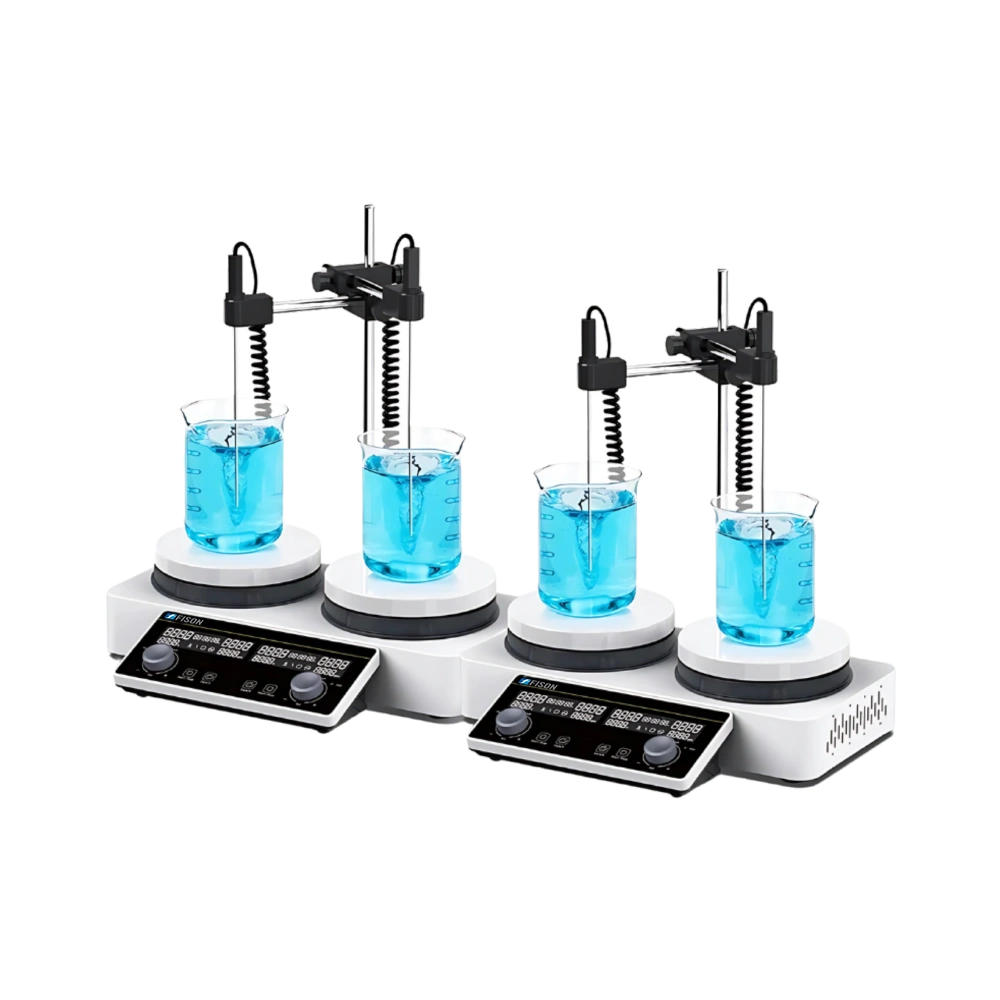
Hotplate Magnetic Stirrer FM-HMS-D102 provides a temperature control range from room temperature to 330°C. It supports a speed range of 100 to 1500 rpm, allowing flexible stirring for various laboratory needs. It is equipped with a PID temperature control system to ensure accurate and consistent heating. It has an LCD display screen that offers clear visibility of all operating parameters for easy monitoring and control.
$2,878.00
| Temperature Control Range | RT to 330 °C |
| Speed Range | 100 to 1500 rpm |
| Max Stirring H20 Volume | 5 × 4 L |
| Timing Range | 1 to 99h59min |
| Motor Type | DC Brushless Motor |
| Power Consumption | 3600 W |
| Power Supply | AC220 : 50 Hz |
| Dimension | φ150 mm |
Hotplate Magnetic Stirrer FM-HMS-D102 is ideal for mixing, heating, and maintaining uniform solutions in laboratory settings. It supports precise temperature and speed control, making it suitable for chemical synthesis, sample preparation, and research experiments.
1: Can the Hotplate Magnetic Stirrer FM-HMS-D102 handle multiple samples simultaneously without compromising performance?
Yes, it supports a maximum stirring capacity of 5 × 4 L, allowing multiple containers to be stirred at the same time. Its high-efficiency heating system and DC brushless motor maintain uniform speed and temperature across all samples.
2: How does the dust-proof mesh and heat dissipation design of the Hotplate Magnetic Stirrer FM-HMS-D102 enhance its lifespan?
The dust-proof mesh prevents particle buildup inside the unit, protecting internal components, while the strategically placed heat dissipation holes reduce the risk of overheating, ensuring longer operational life and consistent performance.
3: Is the Hotplate Magnetic Stirrer FM-HMS-D102 suitable for long-duration experiments?
Yes, the device offers a programmable timing range from 1 hour to 99 hours 59 minutes, making it ideal for long-term processes such as continuous stirring, solvent evaporation, or compound synthesis without requiring manual supervision.
4: How does the PID temperature control system in the Hotplate Magnetic Stirrer FM-HMS-D102 benefit my laboratory applications?
The PID temperature control system ensures precise and consistent heating by automatically adjusting the power output based on real-time temperature readings. This minimizes fluctuations, which is especially important for experiments that require stable thermal conditions over extended periods.