
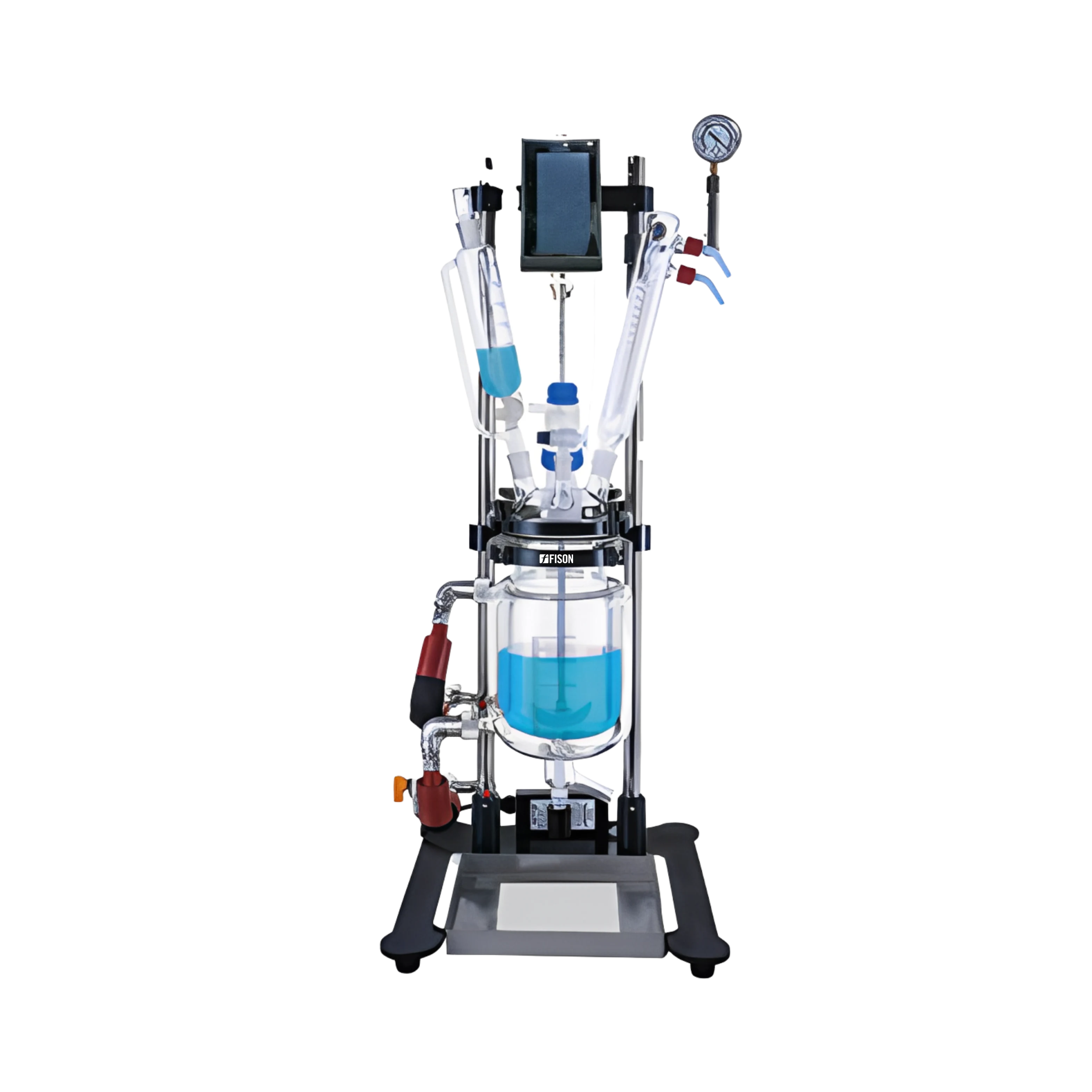
Double Layer Glass Reactor FDGR-A103 features a 5-liter vessel with an 800 ml jacket, offering precise thermal control for sensitive reactions. Its durable glass design ensures chemical resistance. The transparent build allows clear visibility of ongoing processes, while the digital display supports accurate monitoring. Ideal for synthesis, distillation, and crystallization, it provides reliable performance for laboratory and research use.
$1,915.00
| Glass vessel volume | 5 L |
| Jacket volume | 800 ml |
| Stirring motor power | 120 W |
| Stirring speed | 50 to 1100 rpm |
| Screen | Stirring speed, timer, temperature |
| Timer range | 0 to 99h59min |
| Temperature range | –80℃ to +250℃ |
| Glass vessel lid diameter | Ø205 mm |
| Temperature accuracy | ±1℃ |
| Vacuum degree | 0.098 MPa |
| Dimensions (W × D × H) | 450×450×1200mm |
| Weight | 28 kg |
Double Layer Glass Reactor FM-DGR-A103 is widely used in chemical synthesis, pilot scale research, drug discovery, and academic laboratories requiring high-precision control.
1: Can the 800 ml jacket handle both heating and cooling media interchangeably without affecting thermal efficiency?
Yes, the jacket is engineered for dual operation with both heating and cooling circulators, maintaining stable thermal transfer and ensuring precise control across a wide temperature range.
2: How does the reactor minimize risks of thermal stress during prolonged high-temperature operations?
The borosilicate glass construction of the vessel is designed to resist sudden temperature fluctuations, reducing thermal stress and ensuring durability during extended experiments.
3: Is the digital monitoring system capable of integrating with external data logging devices for continuous recording?
Yes, the integrated digital display can be connected to compatible data logging systems, enabling researchers to track and store operational parameters for process analysis and repeatability.
Double layer Glass Reactors are equipped with a borosilicate glass vessel designed for precise laboratory scale synthesis, distillation, and concentration. Their double layer jacketed structure allows efficient heating or cooling by circulating liquid, ensuring stable temperature control across a wide range of reactions. Their system supports smooth stirring under vacuum or atmospheric conditions, making them suitable for diverse chemical and pharmaceutical processes.