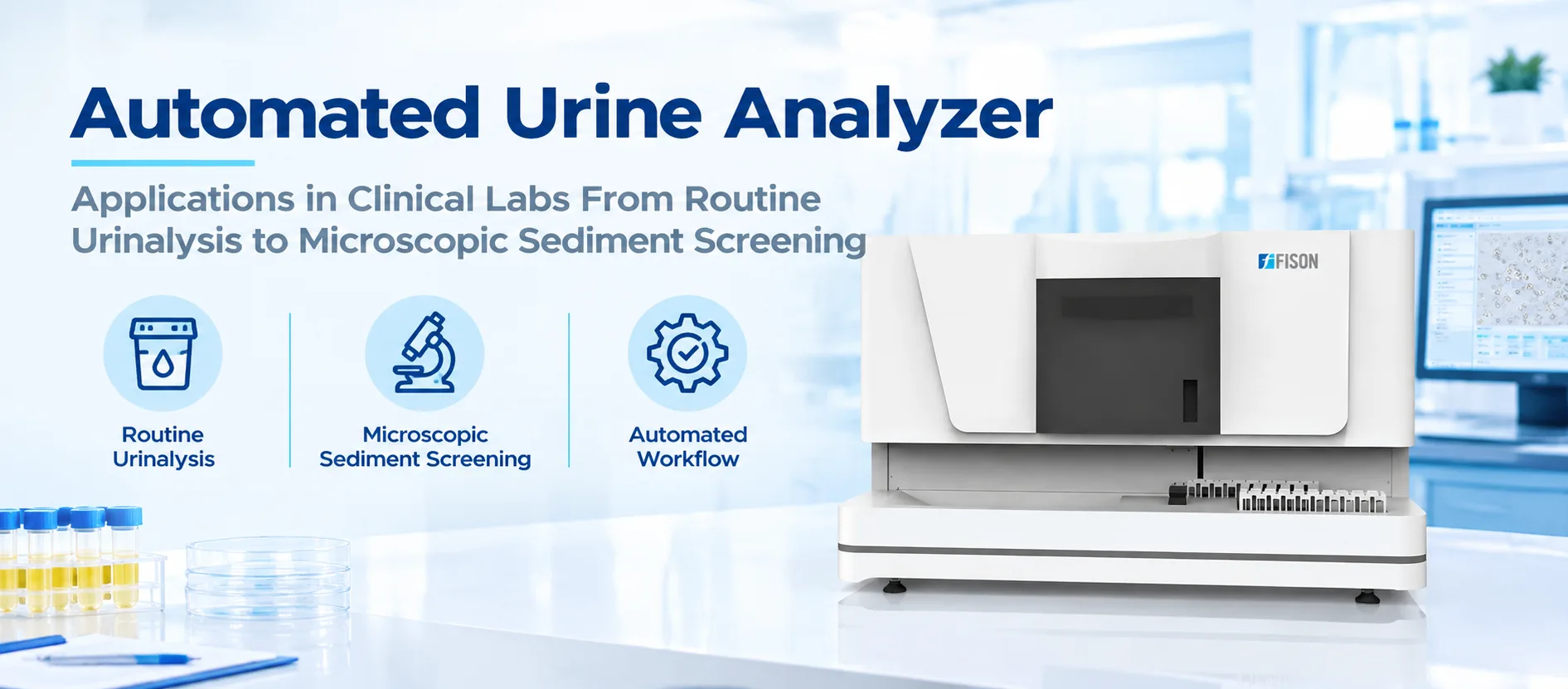
Urinalysis combines chemistry, physical checks, and microscopy to give a broad view of kidney and urinary tract health. This explains how an Fison Automated Urine Analyzer brings those steps together, where it is used, and what to check before choosing one.
Why Urinalysis Moved Beyond the Manual Bench
A complete urinalysis looks at urine in three ways: chemistry results from a test strip, physical properties such as color and specific gravity, and a microscopic look at the cells and particles in the sample. Done by hand, each step is a separate task, and microscopy usually means spinning the sample in a centrifuge and reviewing slides one at a time.
An Automated Urine Analyzer brings these steps into one instrument. The Automated Urine Analyzer reads test strips, measures physical properties, and images the sample in a counting chamber, then combines everything into a single report. That makes it an automated urinalysis machine that covers chemistry and microscopy in the same run.
How Chemistry, Physical, and Microscopy Modules Work Together
The Automated Urine Analyzer principle rests on three measurement modules that work on the same sample. Because chemistry and microscopy run together, results for one sample arrive as one combined report.
Strip Chemistry
Test strips from the strip tank react with the sample, and a colorimeter reads the color change to report chemistry results.
Physical Properties
An RGB sensor checks color and turbidity, a refractometer measures specific gravity, and an electrode measures conductivity.
Machine Vision Microscopy
The sample enters a multi-channel counting chamber, where automated morphological microscopy captures full-view field images and segmented images of the particles present.
The microscopy module works on native urine, so no centrifugation step is needed. This lets the automated urine microscopy analyzer screen the urine sediment content directly from the sample tube, acting as a urine particle analyzer alongside the chemistry reader.
What Automation Changes in the Urinalysis Lab
Compared with reading strips by eye and reviewing slides manually, a fully Automated Urine Analyzer changes daily work in these ways.
High Chemistry Throughput
The chemistry module processes hundreds of tests per hour, keeping routine urinalysis moving.
Continuous Loading
The Automated Urine Analyzer sample loader holds dozens of tubes, so staff can add samples while testing continues.
No Centrifugation
Microscopy runs on native urine, removing the spin step from the workflow.
Chemistry and Microscopy Together
An integrated chem-micro system runs both tests on one sample at the same time, which helps when screening for kidney disorders.
Image-Based Reports
Reports include diagrams and images, so staff can review what the Automated Urine Analyzer saw.
RBC Morphology
In cases of hematuria, red blood cell morphological analysis adds detail about the cells present.
Large Strip Tank
A high-capacity strip tank on the Automated Urine Analyzer reduces how often test strips must be reloaded.
Barcode and LIS Link
A built-in barcode reader and bidirectional LIS and HIS interface keep sample identity and results connected.
Clinical Uses from Routine Screening to Sediment Review
An Automated Urine Analyzer test supports routine urinalysis and the detection of infections, kidney disorders, and hematuria in hospitals and clinical laboratories.
Routine Urinalysis
Hospitals and clinical laboratories run continuous routine urinalysis, where an Automated Urine Analyzer machine handles chemistry and microscopy in one pass.
Urinary Tract Infection Detection
Combined chemistry and microscopy results support the detection of urinary tract infections during routine urinalysis.
Kidney Disorder Screening
Physical, chemical, and microscopic findings together help clinical laboratories screen for kidney disorders.
Hematuria and RBC Morphology
When blood appears in urine, RBC morphological analysis gives hospitals and research centers added detail about the red cells present.
Catalogs may list the same instrument as a Urine Analyzer machine, an automated urinalysis machine, or simply a urine machine automatic model. Whatever the name, compare how chemistry and microscopy are combined. The range of Automated Urine Analyzers shows how these features come together.
Manual Urinalysis and Automated Testing Compared
| Factor | Manual Urinalysis | Automated Urine Analyzer |
|---|---|---|
| Strip reading | By eye against a color chart | Colorimeter |
| Specific gravity and color | Separate checks | Refractometer and RGB sensor |
| Microscopy preparation | Centrifuge and slide | Native urine in a counting chamber |
| Microscopy review | Manual field by field | Machine vision with full-view images |
| Result handling | Handwritten | Stored and sent through LIS and HIS |
Common Selection Mistakes to Avoid
Judging Speed by Chemistry Alone
Chemistry throughput is much higher than combined chemistry and microscopy throughput. Size the Automated Urine Analyzer for how many samples need microscopy.
Overlooking Sample Volume
Each Automated Urine Analyzer needs a minimum urine volume per tube. Check that your collection routine provides enough sample.
Forgetting Consumables
Test strips, calibrators, and urine chemistry quality control materials are supplied separately. Plan stock and storage before installation.
Ignoring Data Connectivity
A bidirectional LIS and HIS link with barcode reading avoids manual entry. Confirm it matches your lab information system.
Exploring the Urine Analyzer Category
Automated Urine Analyzers sit within a wider group of clinical analyzers that also includes automatic chemistry analyzers and electrolyte analyzers. Clinical labs and research centers comparing automated urinalysis analyzers usually weigh chemistry and microscopy throughput, sample loading, centrifugation needs, image output, result storage, and LIS connectivity.
Whether you run routine screening or detailed microscopy review, you can explore the full Automated Urine Analyzer lineup to compare features, or browse other laboratory instruments on the Fison home page.
Review Automated Urinalysis in Detail
Compare throughput, microscopy features, and connectivity options.
Explore Automated Urine Analyzers