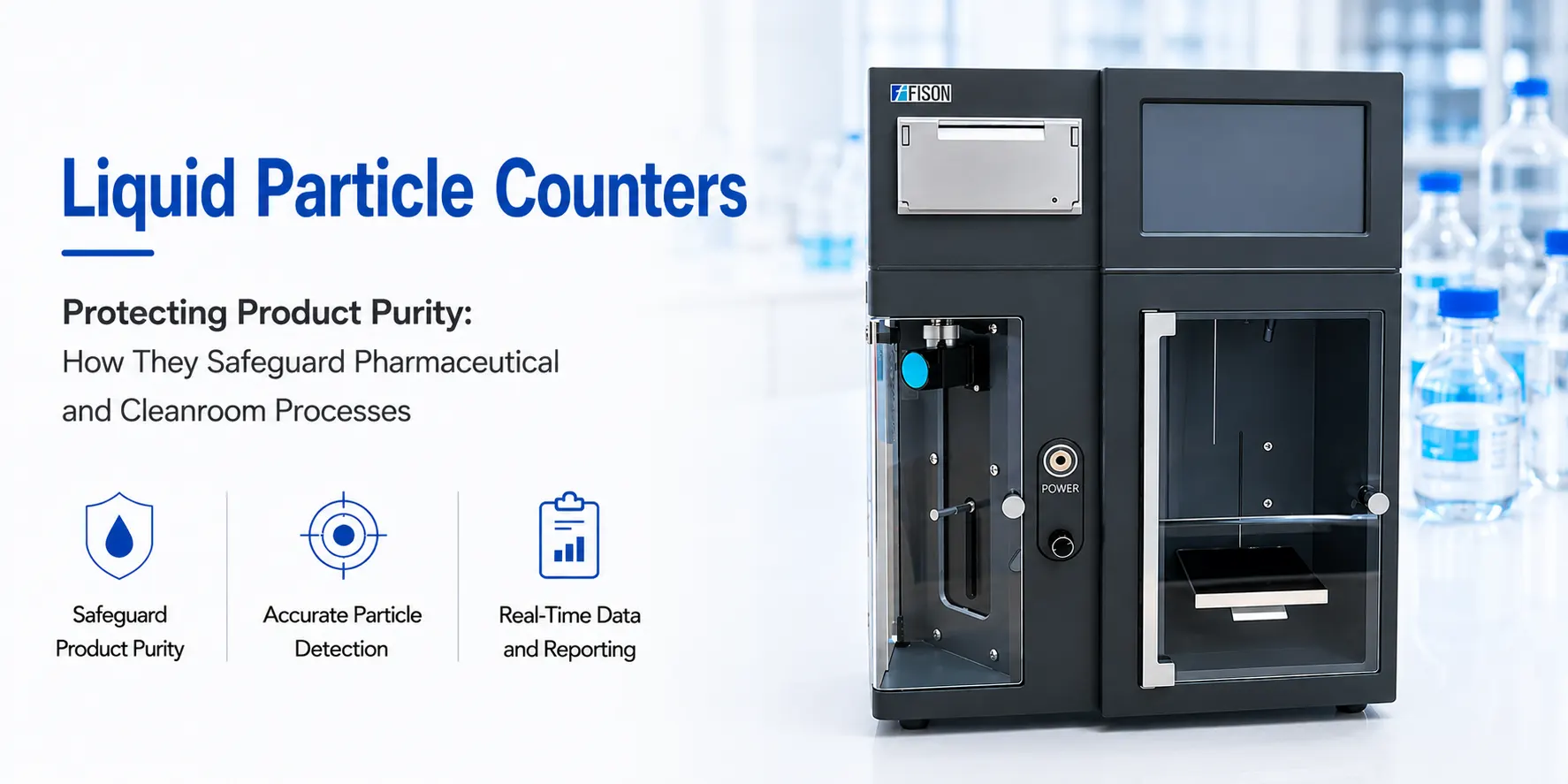
Laboratories, hospitals, research centres and advanced facilities producing or handling injectable products, cleanroom utility water or rinse samples rely on A Fison Liquid Particle Counter to catch contamination long before it becomes visible to the eye. This article looks at how these instruments work, where they fit into a wider contamination monitoring setup, and what to check before choosing one.
Why Invisible Contamination Still Needs Direct Measurement
A liquid can look completely clear and still carry a meaningful count of particulate matter well below what the human eye can resolve. Fibers, glass fragments, rubber particles from stoppers and airborne dust that settles into an open container during processing can all end up suspended in a liquid without changing its appearance at all.
Because visual inspection cannot catch this kind of Liquid Particle contamination reliably, facilities working with injectable products or sensitive rinse samples need a direct measurement method rather than relying on how a batch looks under normal lighting. A particle counting system fills that gap by counting and sizing particles the eye would never notice.
How a Liquid Particle Counter Works: Principle Behind Light Obscuration
A Liquid Particle Counter draws a sample through a narrow flow cell where a focused light beam, typically from a laser diode, crosses the fluid path. As each particle passes through that beam, it blocks or scatters a portion of the light, and a detector on the other side registers the resulting drop in light intensity. The size of that drop corresponds to the particle's size, while the number of drops over a given sample volume gives the particle count.
Sample Draw
Light Beam Sensing
Particle Detection
Size & Count Result
A Liquid Particle Analyzer built this way reports results across multiple size channels at once, showing how many particles fall above each size threshold rather than a single overall count.
Portable and Automatic Liquid Particle Counters: Matching Format to Testing Volume
A portable, handheld unit suits occasional spot checks, such as verifying a single rinse sample or troubleshooting an unexpected result during a production run. It needs an operator to draw and load each sample individually, which works fine for infrequent testing but becomes slow once sample counts grow.
An automatic Liquid Particle Counter with a multi-bottle sampler instead works through a full rack of samples on its own, drawing, testing and moving to the next bottle without an operator present for each one. Facilities weighing portable against automatic formats can compare sample volume, sensor sensitivity and sampler capacity on the Liquid Particle Counter category page before choosing a configuration.
Where the Liquid Particle Counter Fits in the Wider Contamination Monitoring Equipment Category
A Liquid Particle Counter belongs to a broader group of contamination monitoring equipment that also includes airborne Particle Counters and endotoxin testing systems used across pharmaceutical and cleanroom settings. Within this group, facilities typically compare sensor sensitivity range, sample volume and flow rate, the number of sizing channels reported simultaneously, and how well an instrument handles viscous or bubble-prone liquids.
Reviewing the full Liquid Particle Counting system range is a practical starting point for lining up these factors before narrowing a shortlist.
For facilities exploring contamination monitoring equipment beyond liquid testing, the Fison home page lists the wider catalogue of laboratory and hospital equipment the brand carries.
Practical Uses of a Liquid Particle Counter in Pharmaceutical and Research Settings
A Liquid Particle Counter in pharmaceutical industry settings covers more ground than final product release testing alone, once a facility looks at each stage where particulate matter could enter a process.
Pharmaceutical manufacturers run a Liquid Particle Counter test on injectable products before release, confirming particulate levels stay within the range a formulation needs to meet. The same equipment supports cleaning validation, checking rinse water from equipment and containers for residual particulate before the next batch begins. Hospital pharmacy compounding areas use similar testing on prepared products handled in a cleanroom setting, while research centres rely on particle counts during filtration studies, tracking how effectively a filter removes particulate across different pore sizes.
Selection Mistakes to Watch For When Choosing a Liquid Particle Counter Instrument
A handful of recurring missteps show up during evaluation, and most only become clear once the instrument is already in routine use:
- Mismatching sensor sensitivity to product viscosity. A sensor built for thin, aqueous samples can struggle with viscous formulations, producing readings that do not reflect the true particle count.
- Skipping a calibration routine. Liquid Particle Counter calibration against known reference particles catches sensor drift before it affects routine results.
- Choosing the wrong sample volume or flow rate. Testing methods often specify a minimum sample volume, and a unit that cannot meet that volume efficiently slows down routine testing.
- Overlooking bubble interference. Air bubbles in carbonated or recently agitated samples can register as particles, inflating counts unless the method accounts for degassing.
- Ignoring cleaning and carryover between samples. Residual particulate from a prior sample can contaminate the next reading if the flow cell is not flushed properly between tests
Ready to Compare Liquid Particle Counter Options?
Sensor sensitivity, sample format and sizing channels differ meaningfully between models, and reviewing them together helps match an instrument to actual testing needs rather than a rough estimate.
View Liquid Particle Counter Options