Understanding Contamination in Hydraulic Fluids
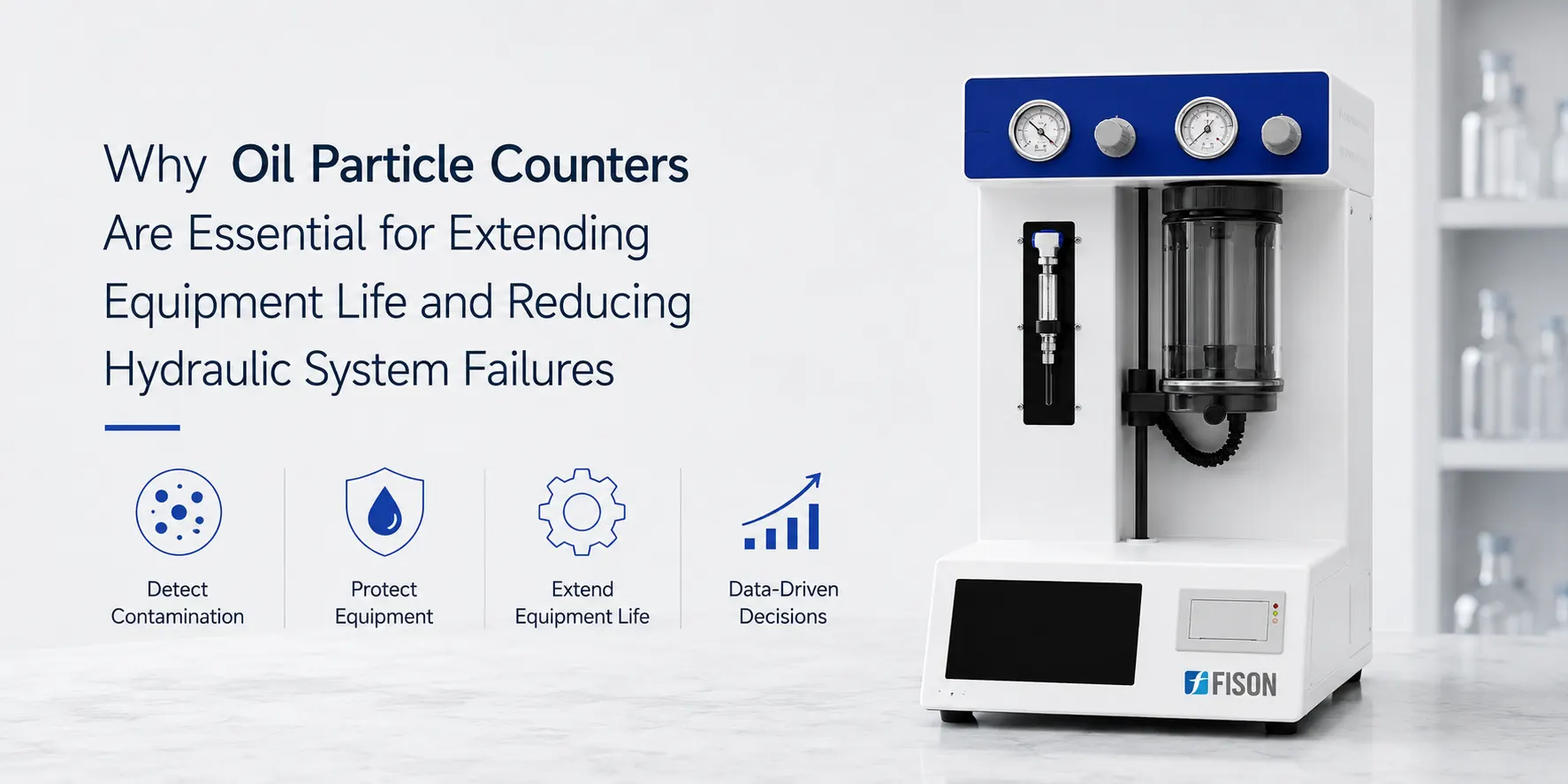
Hydraulic systems depend on clean fluid to move loads smoothly and without unplanned wear. Solid contaminants such as dust, metal fragments, and fibers enter oil through breathers, seals, and worn components, gradually reducing performance and shortening the working life of pumps, valves, and actuators. An Fison Oil particle Counter measures the concentration and size distribution of these particles, giving laboratories and maintenance teams objective data to catch contamination before it causes measurable wear.
Unlike visual inspection or occasional filter checks, a particle counter for oil analysis produces a repeatable count across defined size ranges, so a facility can track how contamination changes between sampling intervals rather than relying on a single snapshot.
Illustrative diagram placeholder — contamination pathway into a hydraulic reservoir
How Laser-Based Particle Counting Works
Illustrative diagram placeholder — laser sensing cell and light-blockage principle
Most modern instruments size and count particles using light blockage or scattering as oil passes through a narrow sensing cell. A Laser-based Oil Particle Counter directs a beam of light across this flow path; each particle that crosses the beam interrupts or scatters a portion of the light, and the resulting signal is converted into a particle size and a running count.
This method allows an oil particle sensor to report contamination across several size ranges in a single pass, without separate sample preparation for each channel. Flow rate, cell geometry, and fluid opacity all influence how accurately the sensor resolves particle size, which is why matching the sensing method to the fluid type matters as much as the count result itself.
Practical Use Cases Across Hydraulic and Process Systems
Hydraulic Maintenance
A Hydraulic Oil Particle Counter reading is used to schedule filter changes, confirm that new fluid meets a facility's own cleanliness targets before it is added to a system, and validate that flushing after a repair actually removed residual debris.
Lab and Research Testing
Research centres and advanced labs apply oil particle count testing equipment to lubricant studies, wear-debris trending on rotating machinery, and incoming inspection of drums before storage.
Facility Plant Equipment
Hospital engineering teams monitor hydraulic elevators, medical air compressors, and similar plant equipment, where a rising particle count often signals a developing mechanical issue before an audible fault appears.
Common Selection Mistakes to Avoid
Overlooking flow rate compatibility
A sensor sized for a low-flow lab sample loop will not read accurately if it is connected to a high-flow industrial line, and the opposite mismatch can starve the sensing cell of sample.
Ignoring fluid viscosity and opacity range
Dark, high-viscosity oils behave differently in a sensing cell than light hydraulic fluid, and an instrument selected without checking its usable viscosity range will produce inconsistent counts.
Choosing the wrong size channel range
Some applications need fine resolution at smaller particle sizes, while others only need broad trending; picking channels that do not match the failure modes of the equipment limits how useful the data becomes.
Skipping periodic calibration checks
Sensing cells drift over time with sample exposure, and a program that never revisits calibration will slowly lose the ability to compare readings across sampling periods.
Exploring the Oil Analysis Instrument Category
An Oil Particle Counter sits within a wider group of oil condition monitoring instruments, alongside viscometers, moisture sensors, and acid number test kits, all used to build a fuller picture of fluid health rather than particle count alone. When comparing options within this category, procurement teams typically look at flow rate range, usable viscosity range, available size channels, portability, and how results are logged or exported for trending.
Fison's Oil Particle Counter category page lays out the full range of configurations available for lab and field use, and the wider instrumentation range can be browsed from the Fison home page for labs evaluating equipment across more than one fluid analysis category.
Selecting the Right Oil Particle Sensor for Your Application
Beyond the working principle, the practical fit of an instrument depends on how it will be used day to day. A portable oil particle sensor suits field sampling on mobile hydraulic equipment, while a benchtop or online unit fits better in a lab that processes many samples or monitors a system continuously.
Data handling matters just as much as the sensing method: look at how counts are displayed, whether results can be exported for trend charts, and how the Oil Particle Counter machine reports out-of-range readings so a technician can act quickly. Teams weighing these factors across models can compare the current Oil Particle Counter lineup to match sensing method, channel range, and output format to their own sampling routine.