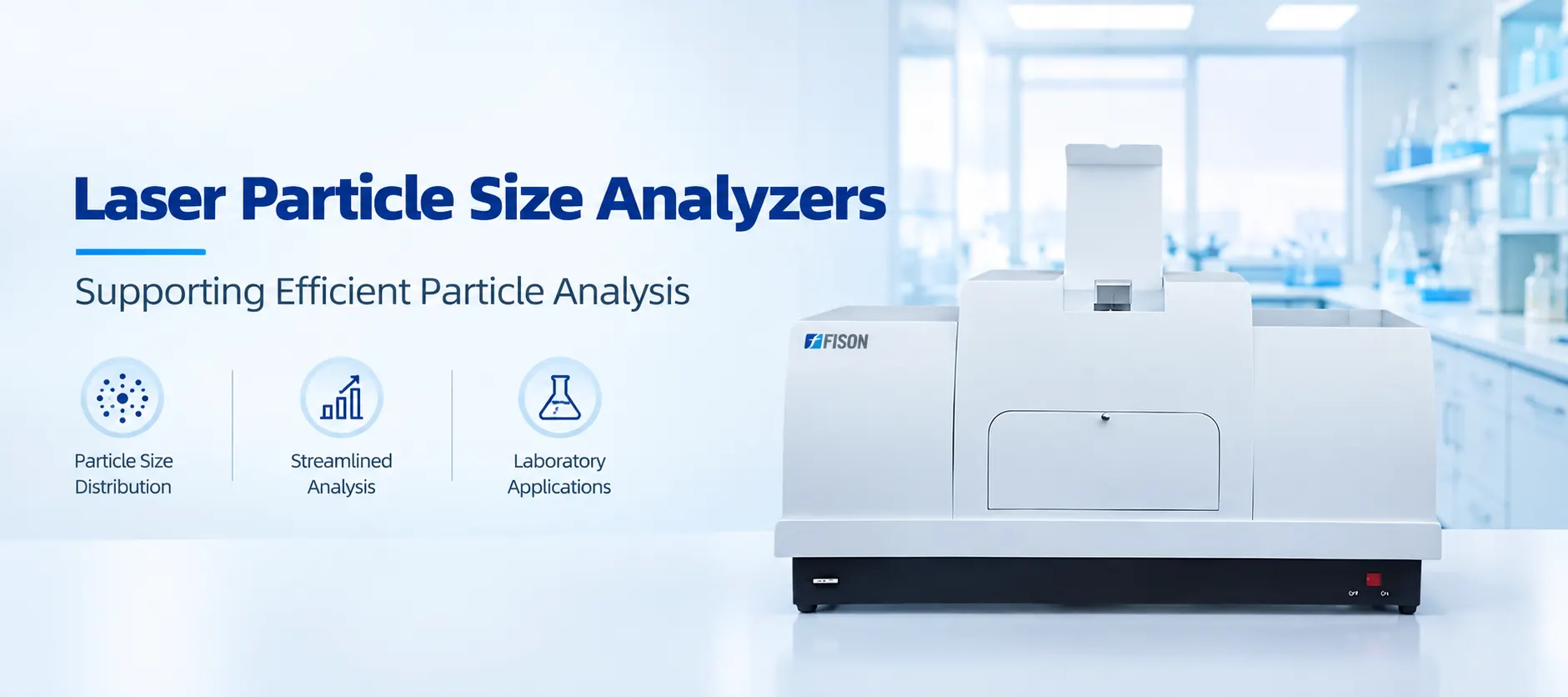
Sample preparation, optics and data interpretation all shape a measurement. This article explains how a Fison Laser Particle Size Analyzer works, where research centres, hospital laboratories and QC laboratories apply it, and which choices most often lead to poor results.
Why Particle Size Shapes Material Behaviour
Powders, suspensions and emulsions rarely behave according to their chemistry alone. Grain size influences dissolving rate, flowability, packing density, surface area and reactivity, which is why laser particle size analysis appears in development reports and routine release checks in the analytical laboratory.
A single average hides too much. Particle size distribution analysis describes the full spread of a sample, usually summarised as D10, D50 and D90 values, so a coarse tail or an excess of fines becomes visible before it disturbs a process. A Laser Particle Size Analyzer reports that distribution for the research laboratory, the hospital laboratory and the QC laboratory alike, and laser diffraction particle size data lets a laboratory compare batches.
Working Principle: How Scattered Light Reveals Size
The laser diffraction particle size analyzer working principle rests on a simple physical relationship. A laser beam passes through dispersed particles, and each particle scatters light into a characteristic pattern. Large particles scatter at narrow angles with high intensity, while small particles scatter at wider angles with lower intensity. A Laser Particle Analyzer applies this behaviour.
A Laser Particle Analyzer records this angular pattern through detection channels, and Fison models provide up to 97 of them. Software then converts the pattern into a particle size distribution analysis result. Understanding the laser particle size analyzer principle helps laboratory staff judge why sample properties and the dispersion method influence laser particle size measurement, since laser particle size analysis reports an equivalent spherical diameter.
Laser Diffraction Particle Size Analyzer Range and Dispersion
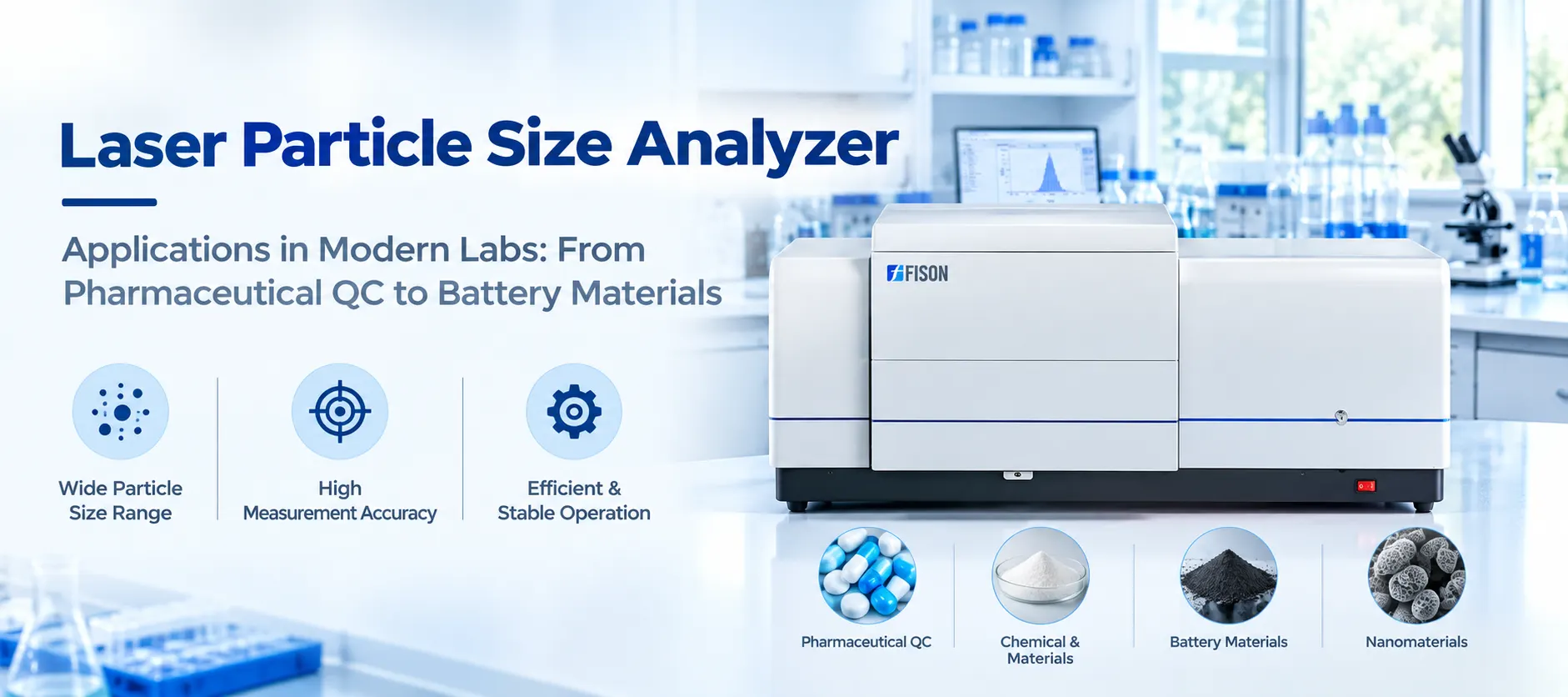
Laser particle size analyzer equipment is described by its measuring range, its detection channels and its dispersion types. Fison lists wet dispersion from 0.01 µm to 2000 µm and dry dispersion from 0.1 µm to 2000 µm, with measurement ranges reaching 3000 µm across the models.
Wet, dry and spray dispersion cover different sample forms, so a laboratory can match the Laser Particle Analyzer to its own powders, suspensions and sprays. Each laser particle size analyzer for lab use should be judged on range, dispersion and channels together.
Applications Across Modern Laboratories
Laser particle size measurement suits pharmaceutical, battery, hospital, ceramic, food and environmental work, from fine powders to emulsions and sprays. Laboratories matching sample types to a laser particle size analyzer can review a Laser Diffraction Particle Size Analyzer for its measuring range and its wet, dry and spray dispersion options.
Pharmaceutical QC
Milled active ingredients, inhalation powders and injectable suspensions depend on controlled size, so pharmaceutical QC laboratories track it with a laser particle size analyzer.
Battery Materials
Cathode and graphite anode powders are monitored because size and spread affect packing density, slurry coating and electrode uniformity in battery materials research using laser particle size measurement.
Hospital and Clinical Research
Hospital laboratories and clinical research teams check the size of emulsions and suspensions with a Laser Particle Analyzer during formulation studies.
Ceramics and Cement
Sintering behaviour in ceramic powders and the fineness of cement both follow the particle size distribution analysis result.
Food and Cosmetics
Food emulsions, milk powders and cosmetic creams are tracked to keep texture and stability consistent, and laser particle size analysis shows batch drift.
Environmental and Spray Studies
Environmental research on soil, sediment and dust powders, along with spray droplet work, uses laser particle size analysis to describe settling and dispersion behaviour.
Preparing the Sample Before Laser Particle Size Measurement
Most disappointing results begin before the beam is switched on. A representative sub-sample and a dispersant that wets the particles without dissolving them are the usual starting points in any laser particle size analysis workflow, whether the sample is a pharmaceutical powder, a battery slurry or a food emulsion.
Repeat measurements of the same dispersion show whether the sample is stable. If the median drifts downward over successive runs, agglomerates may still be separating, and the sample preparation method needs adjusting before the laser particle size analyzer reports a result.

Wet, Dry and Spray Dispersion Side by Side
Choosing a dispersion type on a laser particle size analyzer changes how the sample is handled in the lab.
| Aspect | Wet dispersion | Dry dispersion | Spray dispersion |
|---|---|---|---|
| Typical samples | Suspensions, emulsions and fine powders | Free-flowing powders and granules | Sprays and droplet plumes |
| Listed measuring range | 0.01 µm to 2000 µm | 0.1 µm to 2000 µm | Within the range of the chosen model |
| Main consideration | Dissolving or swelling in the liquid | Particle breakage during dispersion | Stable spray delivery during the run |
Common Laser Particle Size Analyzer Selection Mistakes
Laser particle size analyzer choice is often made from a brochure range rather than from the sample. These patterns cause the most rework.
- Judging a laser diffraction particle size analyzer by size range alone. A wide stated range says little about behaviour at the fine or coarse end, where distribution tails matter most.
- Ignoring dispersion fit. Powders, suspensions and sprays call for wet, dry or spray dispersion respectively, and a mismatch distorts laser particle size analysis.
- Overlooking sample properties. Optical properties of the material influence laser particle size measurement results, so record them in the method.
- Expecting one technique to cover all samples. Laser diffraction particle size analysis reports an equivalent spherical diameter, so needle-like shapes, or materials outside the instrument range, may call for microscopy or a nanoparticle size analyzer as a complement.
- Overlooking data analysis features. Particle size distribution analysis and reporting tools save time once several operators share the same laser particle size analyzer.
- Omitting method verification. A reference material measured at intervals shows whether laser particle size analysis stays consistent over time.
Exploring the Wider Particle Characterisation Category
The laser particle size analyzer belongs to a broader family of laboratory equipment for particle work. Related Fison categories include the nanoparticle size analyzer, the zeta potential analyzer, the particle counter and powder analysis instruments.
When laboratories evaluate a laser particle size analyzer against neighbours, they weigh measuring range, dispersion types, the number of detection channels and data analysis features. Each item affects how well a laser particle size analyzer fits a specific material rather than a general specification sheet.
The complete range of laser particle size analyzer models is available on the Fison laser particle size analyzer category page, and the wider lab equipment portfolio can be reached through the Fison home page.