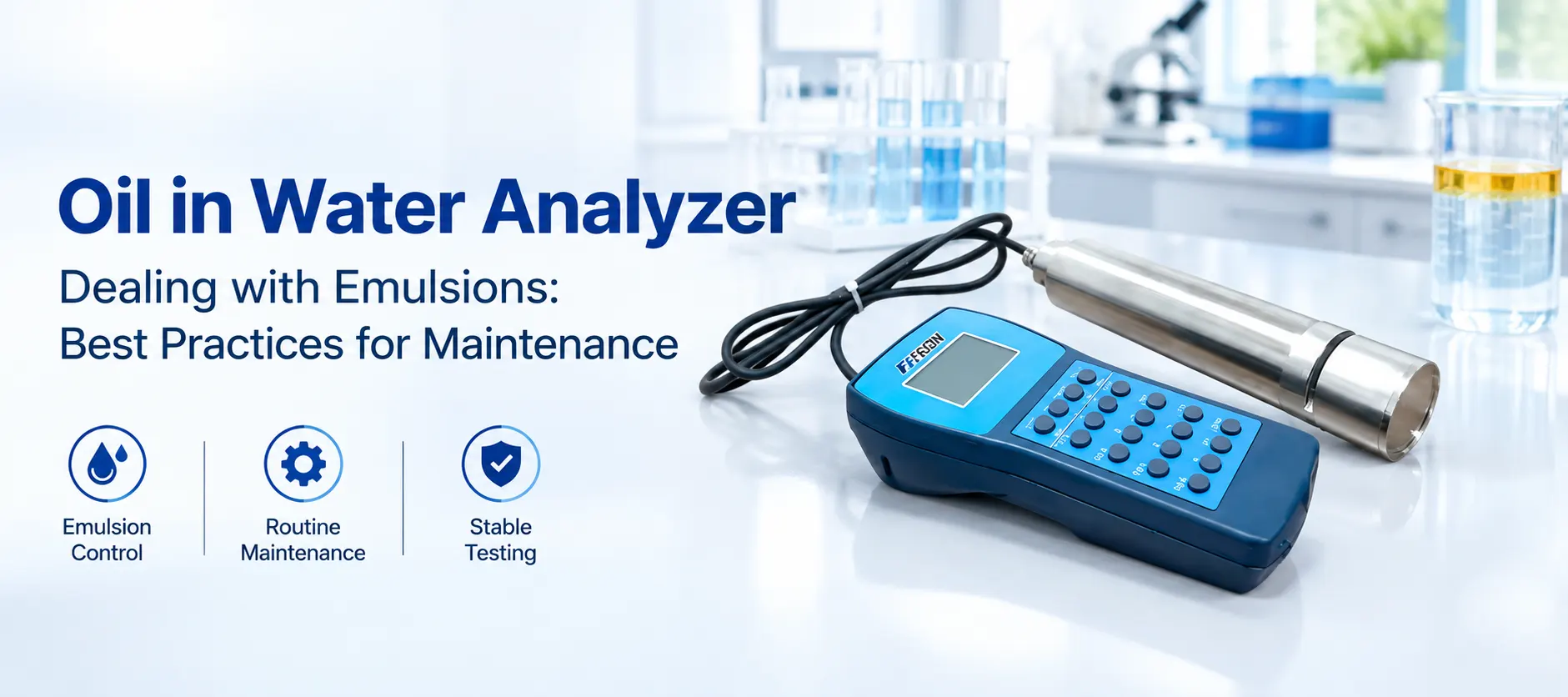
A practical look at why emulsified samples behave differently under fluorescence detection, and the upkeep habits that keep an Fison Oil In Water Analyzer reading close to the true concentration in the sample.
Why Emulsions Complicate Oil-in-Water Measurement
Grasping the Oil in Water Analyzer principle before reviewing maintenance steps makes it much easier to see why emulsion handling deserves special attention. Free-floating oil droplets rise, cluster, and fluoresce in a fairly predictable way once excited by ultraviolet light, which is the basic physics an Oil in Water Analyzer relies on. An emulsion behaves differently. Surfactants, shear from pumps, or dissolved chemical additives can hold oil in much finer droplets that stay suspended rather than separating out, and that same chemistry can change how efficiently those droplets fluoresce. The result is a sample that visually looks similar to a clean discharge stream but carries a meaningfully different optical signature once it reaches the flow cell.
This is one reason routine checks on Fison's Oil in Water Analyzer range pay close attention to sample conditioning steps ahead of detection, not only the detector itself. Skipping that conditioning step is a common source of readings that drift from lab reference values even when the instrument itself is functioning normally.
How the Instrument Reads an Oil Concentration
Most continuous and portable units in this category, including a typical Oil in Water Analyzer, follow a four-stage measurement sequence. Each stage introduces its own maintenance considerations, which is worth understanding before troubleshooting a reading that looks off.
Sample Draw & Conditioning
A pump draws a representative sample into the flow path, where extraction or gentle agitation helps present the oil fraction consistently to the detector.
UV Excitation
An ultraviolet light source illuminates the sample cell, causing aromatic compounds within the oil to fluoresce at a characteristic wavelength.
Fluorescence Detection
A photodetector captures the emitted light and converts its intensity into an electrical signal proportional to the oil present in the sample.
Concentration Calculation
Onboard software converts the signal against a stored calibration curve and displays the reading, typically in parts per million.
Some technical documentation shortens the full term to an oil water analyzer, though the underlying sequence stays the same regardless of which label a given manufacturer uses. Understanding the oil in water analyzer working principle at this level of detail also makes it easier to tell whether an unusual reading points to a genuine process upset or simply a fouled window.
Maintenance Habits Built Around Emulsion Handling
Because emulsified samples are harder on the optical path than clean discharge water, maintenance for this category tends to focus on a few specific habits rather than a generic cleaning schedule.
Optical windows should be inspected and wiped more often than the default interval suggests whenever a site regularly handles emulsified or high-turbidity streams, since a thin oil film on the window reduces the light reaching the sample and skews the reading low. The extraction or conditioning path, where fitted, benefits from periodic flushing so residues from broken emulsions do not accumulate and bias subsequent samples. Calibration should also be checked against a reference oil that matches the actual product being measured, because fluorescence yield varies between crude types and refined products, and a curve built on one oil type will not translate cleanly to another. Finally, seals and tubing exposed to solvents used in extraction-based designs should be checked for swelling or hardening on a fixed interval, since degraded seals introduce air bubbles that register as false spikes. Lab technicians new to this equipment often start by reviewing the oil in water analyzer working principle before troubleshooting alarms, since most false alarms trace back to a conditioning or optical step rather than a genuine contamination event.
Facilities running a Portable Oil in Water Analyzer for spot checks should apply the same discipline even though the unit sees less continuous exposure; infrequent use does not protect an optical window from a single heavily emulsified grab sample. A handheld oil in water analyzer used at multiple sample points across a single shift can also accumulate residue faster than a fixed unit sampling one consistent stream, simply because it encounters a wider range of sample conditions.

Where This Measurement Gets Used
Refineries rely on this measurement to confirm produced water and process wastewater stay within discharge limits before it leaves site. Offshore platforms use compact, vibration-tolerant units to monitor produced water overboard discharge in real time, which is where a rugged Handheld Oil in Water Analyzer is often chosen for its ability to double as a lab-bench check against the online unit. Power plants apply the same fluorescence principle to boiler feedwater and cooling water circuits, where even trace oil carryover can affect heat transfer surfaces over time. Marine vessels use it to verify ballast and bilge water discharge ahead of release, a use case where portability and quick response both matter.
Some of these same sites also track the inverse condition with a separate Water in Oil Analyzer, which measures water droplets suspended in a hydrocarbon carrier such as lubricant or fuel rather than oil suspended in water. The optical principle is related, but the sample chemistry and calibration reference are different, so the two should not be treated as interchangeable instruments. Laboratory teams supporting these programs often keep both a water in oil analyzer and its oil-side counterpart on the bench, since environmental and process testing can call for either measurement depending on which stream is being investigated. Documentation sometimes labels the oil-side unit simply as an oil water analyzer, and a lab technician should recognize that shorthand refers to the same fluorescence-based instrument rather than a separate product line.
This spread of oil-in-water application areas reflects how widely fluorescence-based contamination monitoring now extends across industrial and laboratory water-testing programs. Each new application tends to follow the same underlying detection principle, adapted to a different water stream rather than a different measurement technology, which is why lab personnel trained on one installation typically adapt quickly to another.
Common Selection Mistakes
- Assuming Portability Equals Accuracy. A compact, battery-run unit is convenient for spot checks, but some designs trade off optical stability for size. Confirm that any portable oil in water analyzer under consideration has been validated on emulsified samples, not only on clean reference samples.
- Overlooking Oil-Type Calibration. A unit calibrated to a single reference oil can read significantly off on a different crude or refined product. Ask what reference oils an oil in water analyzer manufacturers' calibration data actually covers before assuming broad accuracy.
- Underestimating Fouling Frequency. High-turbidity or heavily emulsified streams foul optical windows faster than the default maintenance interval assumes, leading to a slow, easy-to-miss downward drift in readings.
- Ignoring Detection Range Alignment. Choosing a unit based on a manufacturer's typical range rather than the site's actual discharge limit can leave a facility measuring outside its most meaningful concentration window.
- Confusing Measurement Methods. Fluorescence-based readings are not always directly comparable to gravimetric or infrared laboratory numbers, and treating them as interchangeable during audits or regulatory reporting can create confusion later.
The Wider Category This Instrument Belongs To
An oil in water analyzer sits within a broader group of process water quality instruments used to track contamination before discharge or reuse, alongside turbidity monitors, total suspended solids meters, and other optical process analyzers. Within this group, evaluators typically compare detection principle (fluorescence, infrared absorption, or light scattering), sample handling requirements, response time, and how easily a unit integrates with existing plant control systems. Evaluators should also compare how transparent different oil in water analyzer manufacturers are about which reference oils sit behind their published accuracy figures. The oil in water analyzer principle covered earlier applies across this whole group of fluorescence-based instruments, whether the unit sits fixed in a pipeline or moves between sample points on a cart.
Readers wanting to see how Fison approaches this category, alongside the company's wider laboratory and process instrumentation lineup, can review the oil in water analyzer category to compare configurations side by side before narrowing down a choice.