Why Trace Metal Detection Still Runs Through This Technique
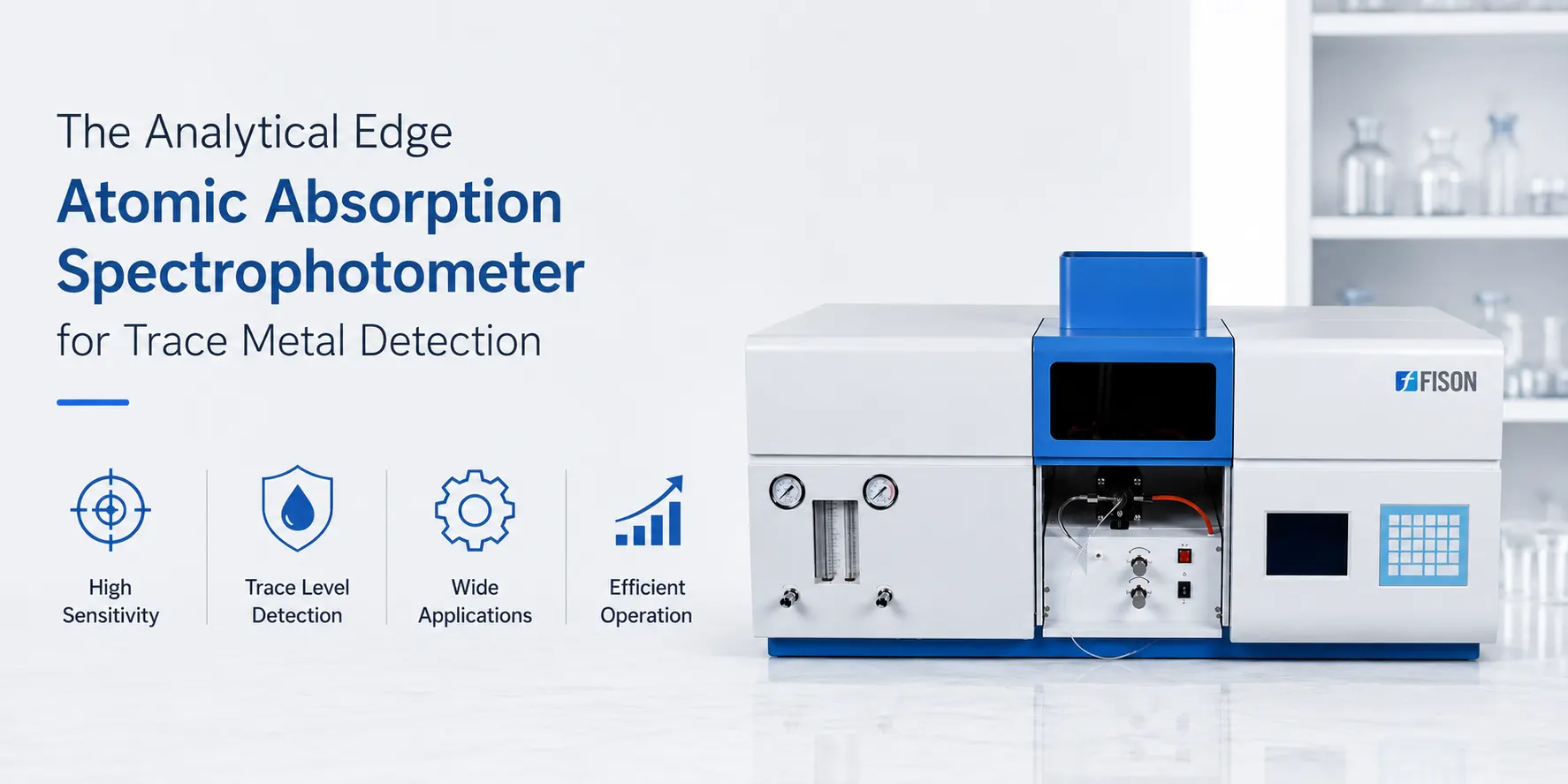
Long after newer elemental methods entered the market, the Fison Atomic Absorption Spectrophotometer remains a fixture in laboratories that need element-specific answers rather than a broad scan. It measures how much light of a particular wavelength is absorbed by free atoms of a target metal in a flame or graphite furnace, and converts that absorbance into a concentration value. Hospitals track lead and cadmium in blood or urine, environmental labs monitor heavy metals in effluent, and food-testing labs screen for arsenic or mercury residues, all using the same underlying absorbance principle applied to different sample matrices. Teams comparing instruments for this kind of work often start their search from the Atomic Absorption Spectrophotometer range, where configurations for flame-only and flame-plus-furnace analysis sit side by side.
How an Atomic Absorption Spectrophotometer Reads a Sample
Light Source
Atomized Sample
Monochromator
Detector
The Atomic Absorption Spectrophotometer principle rests on a simple exchange between light and matter. A hollow cathode lamp emits light at the exact wavelength a target element absorbs. The sample is atomized, typically by an air-acetylene flame or an electrically heated graphite tube, which breaks it down into a cloud of free atoms. As the lamp's light passes through that cloud, atoms of the target element absorb a portion of it, and a monochromator isolates the relevant wavelength before it reaches the detector. The amount of light absorbed correlates directly with how many atoms are present, which is what allows the instrument to report a concentration rather than just a signal.
Flame atomization suits samples with metal concentrations in the parts-per-million range and delivers faster throughput, while graphite furnace atomization holds the sample in place longer and reaches parts-per-billion sensitivity for elements such as lead, cadmium, and arsenic.
What Sits Inside an Atomic Absorbance Spectrophotometer
Light Source
A hollow cathode or electrodeless discharge lamp tuned to the element being measured.
Atomizer
A flame burner head or graphite furnace that converts liquid sample into free atoms.
Monochromator
Isolates the single wavelength of interest and blocks stray light from the flame or furnace.
Detector & Readout
A photomultiplier tube converts transmitted light into an electrical signal the software plots as absorbance.
Where This Equipment Earns Its Bench Space
Hospital and clinical laboratories lean on this atomic absorption spectroscopy equipment to quantify lead, zinc, copper, and cadmium in blood, serum, or urine, often as part of occupational health screening or toxicology workups where element-specific accuracy matters more than scan speed.
Research centres apply it to nutrient and contaminant studies in soil, plant tissue, and biological samples, pairing flame and furnace modes to cover both major and trace elements within a single study.
Advanced labs running environmental and industrial testing use the atomic absorption machine to check drinking water, wastewater, and effluent against heavy-metal limits, and to monitor metal content in fuels, lubricants, and alloys during production.
Food and beverage testing groups screen for arsenic, mercury, and lead residues in raw ingredients and finished products, where a single misread result can affect an entire batch release decision.
Getting Calibration Right Before Reading a Result
An Atomic Absorption Spectrophotometer calibration run starts with a blank and a series of reference materials at known concentrations, spanning the range expected in the actual samples. The instrument builds a calibration curve by plotting absorbance against concentration for each reference material, and sample readings are then interpolated against that curve rather than read off a single point. Working within the linear portion of the curve matters: pushing a reading past the highest reference material risks a false low value once absorbance begins to flatten out at higher concentrations. Re-checking calibration after each batch, and whenever the lamp or atomizer is swapped, keeps drift from quietly creeping into a full day of results.
Common Mistakes When Choosing an Absorption Spectrometer
Sizing sensitivity to the wrong matrix
A flame-only configuration looks sufficient on paper until a lab starts receiving samples that need parts-per-billion detection, at which point graphite furnace capability becomes unavoidable rather than optional.
Overlooking lamp inventory and changeover time
Multi-element testing schedules slow down considerably if a lab has not budgeted for enough hollow cathode lamps, or has chosen a turret that takes longer than expected to switch elements mid-run.
Treating background correction as an afterthought
Complex matrices such as blood, soil extracts, or seawater generate background absorbance that can distort a result if the instrument's correction method, deuterium arc or Zeeman, is not matched to the sample type from the outset.
Underestimating exhaust and gas handling needs
Flame atomization requires acetylene and a working fume extraction setup; labs that treat this as a minor installation detail often face delays getting the instrument running after delivery.
Flame Versus Graphite Furnace at a Glance
| Factor | Flame Atomization | Graphite Furnace |
|---|---|---|
| Typical sensitivity | Parts-per-million | Parts-per-billion |
| Sample throughput | Faster, continuous aspiration | Slower, one sample per heating cycle |
| Sample volume needed | Several millilitres | Microlitre volumes |
| Most suited for | Routine, higher-concentration testing | Trace-level clinical and environmental work |
Many laboratories keep both modes available on one chassis so the same atomic absorption spectro platform can cover routine and trace-level requests without switching instruments.
Where This Instrument Sits Within Elemental Analysis Equipment
The Atomic Absorption Spectrophotometer belongs to a broader group of elemental analysis instruments that also includes ICP-OES and ICP-MS systems, each suited to a different balance of element coverage, detection limit, and analysis speed. Labs weighing options in this category typically compare single-element versus multi-element throughput, flame versus furnace sensitivity, and how much sample preparation each technique demands before a result can be reported. For a closer look at configurations available across flame, furnace, and combined systems, the full Atomic Absorption Spectrophotometer category lays out the options side by side, and sits within the wider instrument catalogue on the Fison home page alongside related lab analysis equipment.