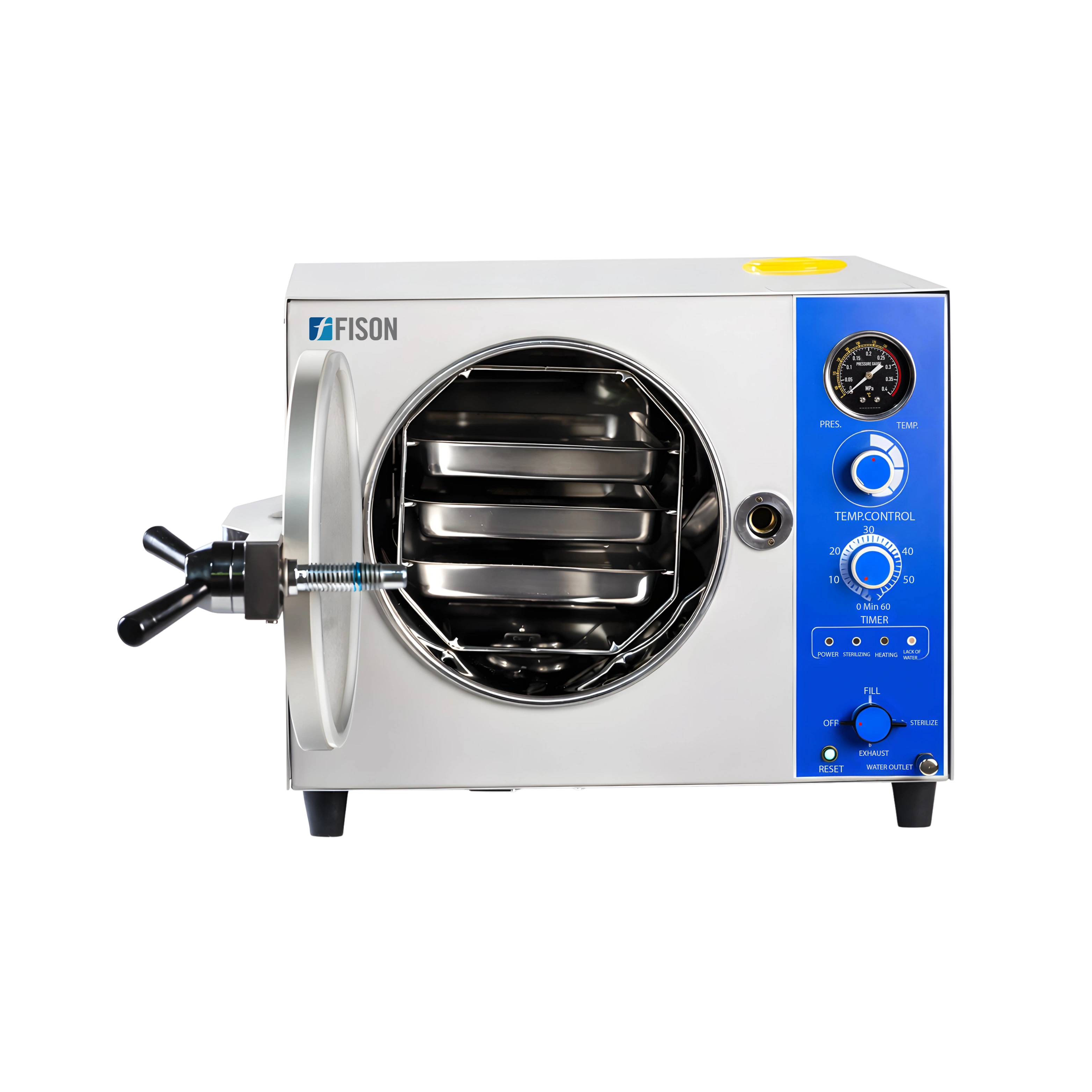
Laboratories, hospitals, research centres and advanced facilities working with limited bench or counter space often assume that a compact instrument means compromising on sterilization performance. A Fison Benchtop Autoclave is built to prove otherwise, delivering a complete steam sterilization cycle from a footprint that fits directly into existing workspace. This article walks through how a benchtop autoclave works, five advantages its compact design brings, and what to check before choosing one.
Why Footprint Matters as Much as Sterilization Performance
Sterilization equipment is often evaluated purely on chamber volume and cycle capability, with available floor or counter space treated as an afterthought. In settings where bench space is already committed to instruments, samples and other equipment, that ordering deserves to be reversed: footprint becomes a filtering criterion just as important as sterilization performance itself.
A Benchtop Sterilizer earns its place in these settings precisely because it does not force a choice between the two, and a benchtop steam sterilizer specified with actual bench dimensions in hand tends to hold up better long term than one chosen on chamber volume alone. Matching cycle capability to a compact footprint, rather than treating them as a tradeoff, is what separates a well-specified Benchtop Autoclave from one that simply happens to be small.
Benchtop Autoclave Principle: How a Compact Chamber Delivers a Full Sterilization Cycle
A Benchtop Steam Sterilizer follows the same core physics as any steam autoclave, holding saturated steam at controlled pressure and temperature for a fixed exposure period, but does so within a chamber sized for single-bench installation rather than a dedicated equipment room.
Basket Loading
Steam Buildup
Sterilization Dwell
Cool-Down & Unload
Because the chamber holds a fraction of the water and mass found in a floor-standing unit, a benchtop steam sterilizer reaches operating pressure and completes its hold phase in less time than a large-batch machine running an equivalent cycle. This same compact-chamber approach is what lets a Benchtop Autoclave sterilizer turn instruments around between appointments or short lab intervals rather than waiting for a scheduled bulk run. A facility that tracks how quickly its Benchtop Autoclave turns over instruments between sessions can spot capacity issues before they cause delays.
Where the Benchtop Autoclave Sits Within Fison's Laboratory Autoclave Range
A Benchtop Autoclave belongs to a broader laboratory autoclave category that also includes vertical and horizontal chamber formats, all built around the same steam sterilization principle but suited to different batch sizes, footprints and installation types. Within this category, teams typically compare chamber volume, cycle programming, water handling and how easily a unit fits an existing bench layout.
The complete laboratory autoclave range lays out these formats side by side, and for facilities weighing sterilization equipment against other laboratory instrument categories, the Fison home page catalogues the wider range available. Positioning a Benchtop Autoclave correctly within this category up front avoids re-evaluating the choice again a few months after installation.
Five Advantages That Come From a Benchtop Autoclave's Small Footprint
A Benchtop Autoclave allows direct placement on existing bench or counter space, avoiding the need for a dedicated equipment room or reinforced floor mounting that a larger chamber format often requires.
Faster cold-start and cycle times, since a smaller chamber and lower water volume heat to operating pressure more quickly than a larger, higher-mass chamber running the same cycle type.
Lower water and energy draw per cycle, a direct result of the smaller chamber volume a benchtop laboratory autoclave needs to bring to sterilizing conditions each run.
Simpler installation against an ordinary power and water connection, without the dedicated utility runs a plumbed-in, floor-standing chamber typically needs.
A Benchtop Autoclave also offers the flexibility to add a second unit as demand grows, letting a facility scale sterilization capacity in smaller increments rather than committing to one large floor-standing chamber upfront.
Where Space Efficiency Pays Off Across Different Settings
Each Benchtop Autoclave application shares the same compact steam cycle, adapted to a different pace of daily work across these settings. A Benchtop Autoclave placed close to where the work happens keeps turnaround short across each of these settings.
Laboratories running frequent small-batch sterilization of glassware, media and instruments benefit from a Benchtop Autoclave that sits within reach of the bench where the work happens, rather than requiring a walk to a shared central unit.
Hospital departments outside the main sterile processing area, such as satellite treatment rooms, use a compact chamber to handle small instrument sets locally instead of routing them through a central department.
Research centres running several parallel small studies find that a benchtop sterilizer positioned near each work area avoids scheduling conflicts that a single shared large-capacity unit would create.
Advanced analytical labs handling sensitive, low-volume sample preparation rely on a nearby benchtop unit to keep sterilization turnaround aligned with tight testing schedules.
This spread of Benchtop Autoclave application areas is part of why the compact format remains a practical fit well beyond any single type of facility.

Selection Mistakes to Watch For When Choosing a Benchtop Autoclave
A handful of recurring missteps show up during evaluation, and most only become clear once a Benchtop Autoclave is already installed:
- Overlooking electrical circuit capacity. Adding a Benchtop Autoclave to a bench already running other equipment on the same circuit can trip a breaker during the heating phase of a cycle if capacity isn't checked beforehand.
- Ignoring bench or counter load rating. A chamber filled with water for a full cycle adds real weight, and a bench not rated for sustained equipment load can sag or shift over time.
- Treating a small footprint as zero clearance. A compact design still needs side and rear clearance to release heat during a cycle without warming nearby equipment or work surfaces.
- Assuming all benchtop models share the same footprint-to-capacity ratio. Two units with a similar counter footprint can hold noticeably different chamber volumes, so footprint alone is not an accurate stand-in for usable capacity.
- Adding a second unit without reassessing shared utilities. Scaling up by placing a second unit nearby can strain a water supply or drain line originally sized for a single Benchtop Autoclave sterilizer.
Choose the Benchtop Autoclave That Fits Your Bench
Chamber volume, cycle speed and installation needs vary across benchtop laboratory autoclave models, and matching a bench top steam sterilizer to actual daily instrument volume and available bench space matters more than choosing the largest chamber on offer. Reviewing the full laboratory autoclave lineup alongside these figures helps confirm that a compact chamber still covers actual daily throughput before committing to one. Confirming these figures for a specific Benchtop Autoclave before purchase avoids surprises once it is already installed.
Explore Benchtop Autoclave Options