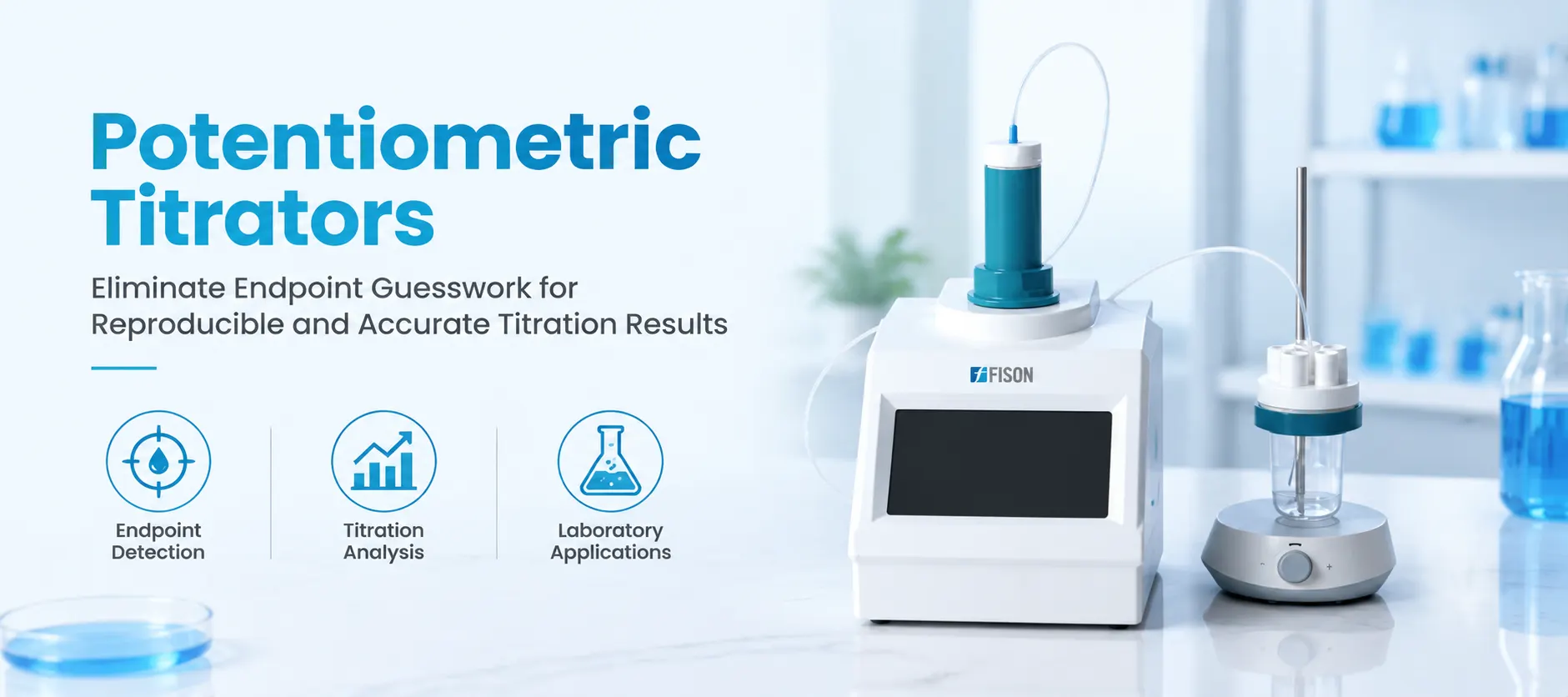
Laboratories, hospitals, research centres and advanced facilities running acid-base, redox and precipitation titrations rely on an Fison Automatic Potentiometric Titrator to detect the exact endpoint electronically rather than by watching a color change. This article looks at how these instruments work, where they fit into a wider titration setup, and what to check before choosing one.
Why Visual Endpoint Detection Falls Short in Precise Titration Work
Manual titration relies on a color-change indicator to signal when a reaction reaches its endpoint, which depends entirely on the operator judging exactly when that color shift happens. Colored, turbid or dark samples make that judgment even harder, since the indicator's color change can be difficult to see against the sample's own color.
A Potentiometric Titrator removes that subjectivity by tracking the electrical potential of the sample directly through an electrode, marking the endpoint at the point where potential changes most sharply rather than relying on a visible color cue. This shift from a visual to an electronic endpoint is what makes potentiometric titration analysis repeatable across operators and sample types. That shift also lines up with the practical potentiometric titration definition most laboratories use: an endpoint identified from measured potential rather than a color change.
How an Automatic Potentiometric Titrator Works: From Electrode Signal to Endpoint
The potentiometric titration definition centres on measuring the electrical potential between a sensing electrode and a reference electrode as titrant is added to a sample in small, controlled increments. A precision burette delivers the titrant while the electrode continuously reports the changing potential back to the instrument's software.
Sample Preparation
Titrant Delivery
Potential Monitoring
Endpoint Detection
As the reaction nears completion, the potential reading shifts sharply, and the software identifies this inflection point as the endpoint, calculating the result from the titrant volume delivered up to that exact point rather than an operator's visual estimate.
Potentiometric Autotitrators and Manual Setups: Matching Method to Workload
A manual titration setup, built around a hand-operated burette and a separate potentiometer titrator readout, still works for labs running only a handful of titrations a day, where an operator can watch the potential reading and dispense titrant by hand near the expected endpoint.
A potentiometric autotitrator instead automates titrant delivery, potential monitoring and endpoint calculation in one sequence, which matters once titration volume grows large enough that manual dispensing becomes the bottleneck. Facilities weighing manual against automated formats can compare titrant delivery precision and electrode options on the Potentiometric Titrator category page before settling on a configuration. Labs replacing an ageing potentiometer titrator setup with an automated model typically start that comparison from the same category listing.
Where the Automatic Potentiometric Titrator Fits in the Wider Titration Equipment Category
An Automatic Potentiometric titrator belongs to a broader titration equipment category that also includes Karl Fischer titrators and photometric titration systems used across laboratories and industrial testing facilities. Within this category, teams typically compare electrode compatibility, titrant delivery resolution, sample throughput and how easily a unit handles different titration methods within one instrument. That comparison is exactly what a lab weighing potentiometric titration equipment upgrades needs to work through before committing to one platform.
Reviewing the full Potentiometric Titration instrument range is a practical starting point for lining up these factors before narrowing a shortlist.
For facilities exploring titration and analytical equipment beyond potentiometric methods alone, the Fison home page lists the wider catalogue of laboratory and hospital equipment the brand carries.

Potentiometric Titration Analysis Across Laboratory and Industrial Testing
Each Potentiometric Titration application shares the same electrode-and-endpoint-detection method, adapted to different sample matrices and industries. Pharmaceutical laboratories run automatic potentiometric titration to confirm acid-base and redox assay results on raw materials and finished products, where an electronic endpoint removes the ambiguity a colored sample can introduce. Food and beverage testing applies the same Potentiometric Titration equipment to measure acidity in products where color and turbidity would make a visual indicator hard to read.
Water testing labs use a Potentiometric Titration device to measure chloride content and hardness in samples ranging from drinking water to industrial process water, while petrochemical laboratories rely on the same electrode-based method to determine acid number and base number in oils and fuels. Environmental testing programs apply potentiometric titration analysis to track specific ion concentrations across sampling sites over time. Together, these examples round out the range of potentiometric titration application areas a single instrument design can cover.
Selection Mistakes to Watch For When Choosing a Potentiometric Titration Device
A handful of recurring missteps show up during evaluation of Automatic Potentiometric Titration setups, and most only become clear once the instrument is already in routine use:
- Mismatching electrode type to analyte. A general-purpose electrode may not respond well to all the ions or compounds a lab needs to titrate, leading to a poorly defined endpoint.
- Overlooking titrant delivery resolution. A burette with coarse dispensing steps near the endpoint can overshoot the true inflection point, skewing the calculated result.
- Ignoring stirring consistency. Uneven mixing during titrant addition can produce a noisy potential signal that makes the endpoint harder to identify cleanly.
- Skipping regular electrode maintenance. A drifting or fouled electrode slowly loses sensitivity, and the change can go unnoticed until results start looking inconsistent.
- Choosing a fixed endpoint algorithm for a variable sample set. Some samples need an inflection-point algorithm rather than a preset endpoint value, and a rigid setup can misjudge the result on unfamiliar sample types.
Single-Parameter and Multi-Parameter Titrators: A Quick Comparison
Some titrators are built around one titration method, while others handle several methods and electrode types within a single instrument. The table below outlines where each approach tends to fit.
| Aspect | Single-Parameter Titrator | Multi-Parameter Titrator |
|---|---|---|
| Method flexibility | One titration method at a time | Multiple methods on one instrument |
| Electrode changeover | Simple, fixed setup | Requires switching electrodes between methods |
| Typical setting | Focused, repetitive testing | Labs running varied titration work |
| Software complexity | Lower, single method programmed | Higher, multiple methods stored |
Ready to Compare Automatic Potentiometric Titrator Options?
Electrode compatibility, titrant delivery precision and method flexibility differ meaningfully between models, and reviewing a potentiometric titration instrument lineup together helps match an instrument to actual titration needs rather than a rough estimate.
View Titrator Options