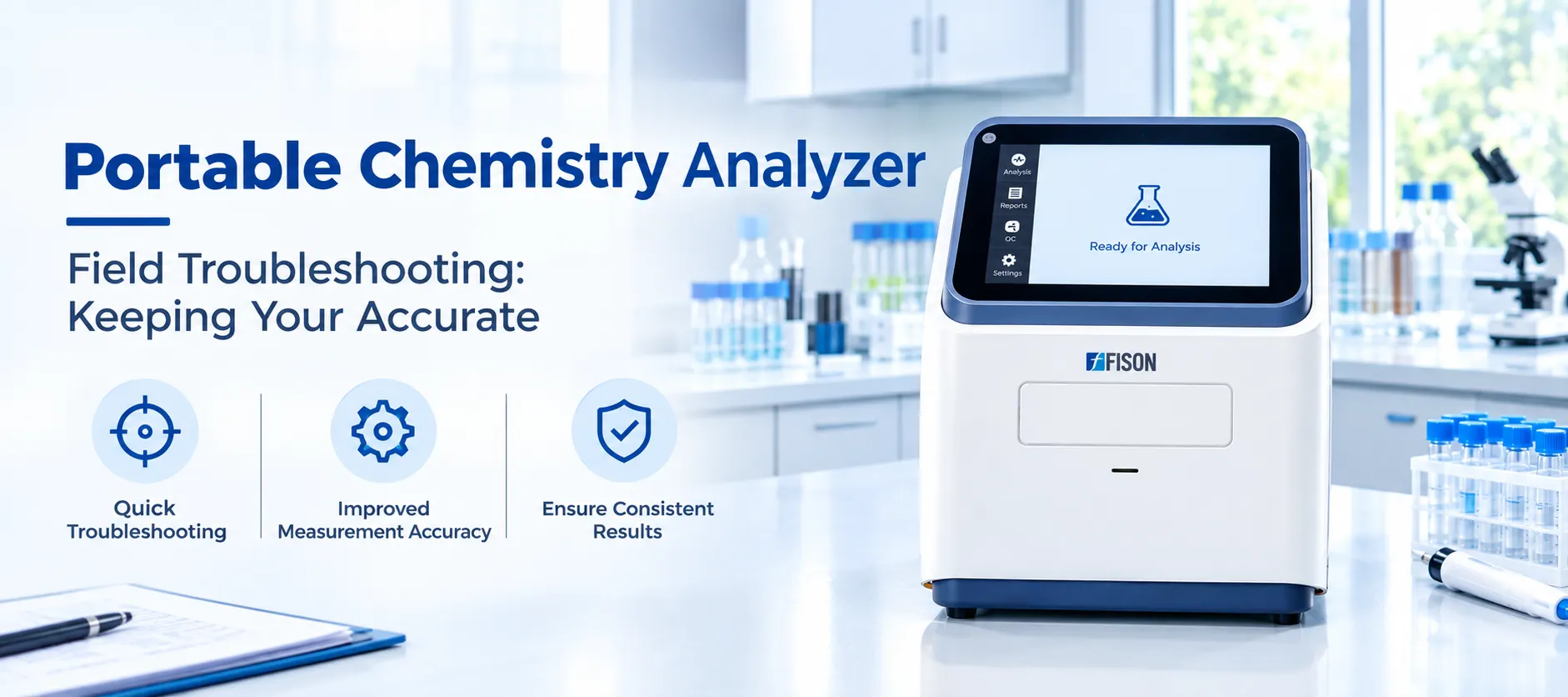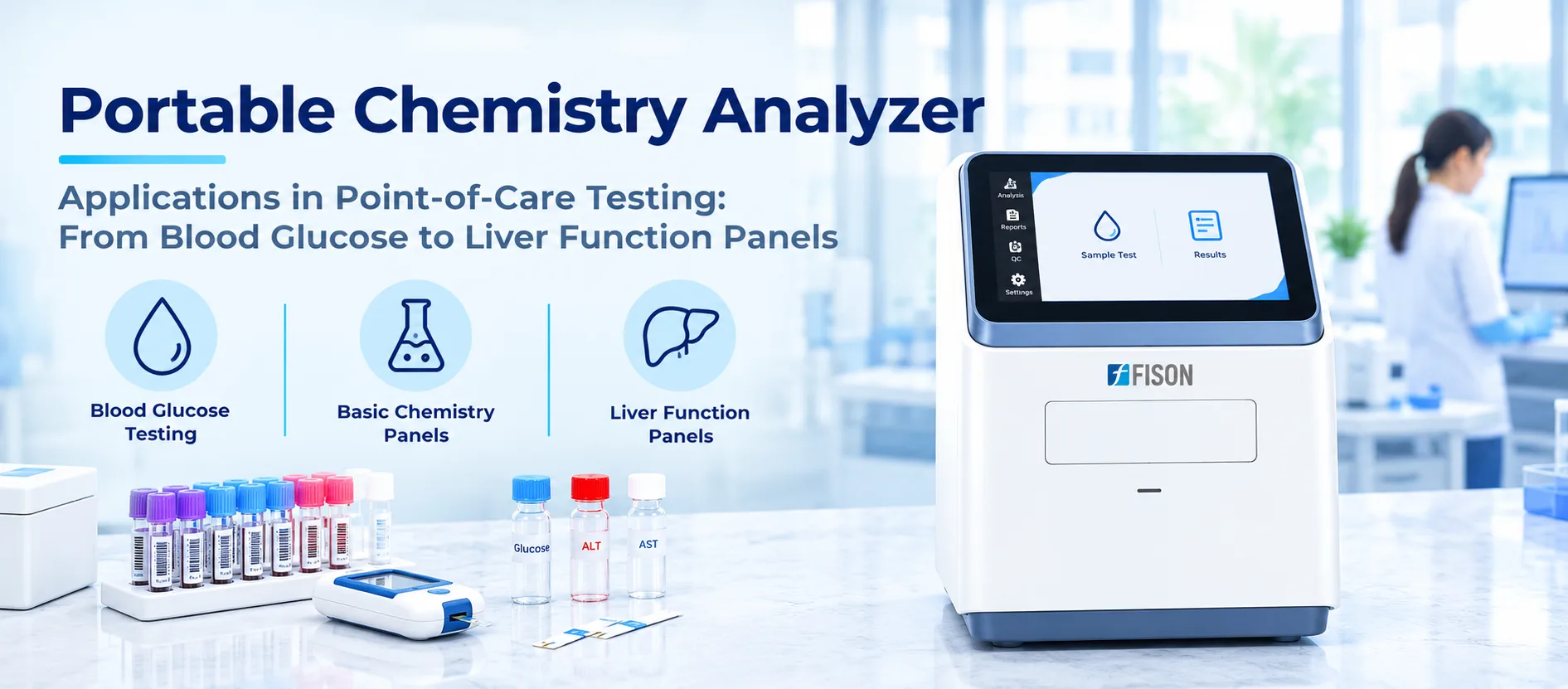
Chemistry testing used to mean sending samples to a central laboratory and waiting for a batch to run. A Fison Portable Chemistry Analyzer brings the measurement to the point of care. This guide explains how the instrument works, where it suits clinical and field work, how it differs from benchtop systems, and what to check before choosing one.
How Chemistry Testing Reached the Point of Care
A Benchtop Chemistry Analyzer sits in a central laboratory. Samples travel to it, wait in a queue, and are often prepared before loading, so the result reaches the clinician well after the sample was taken.
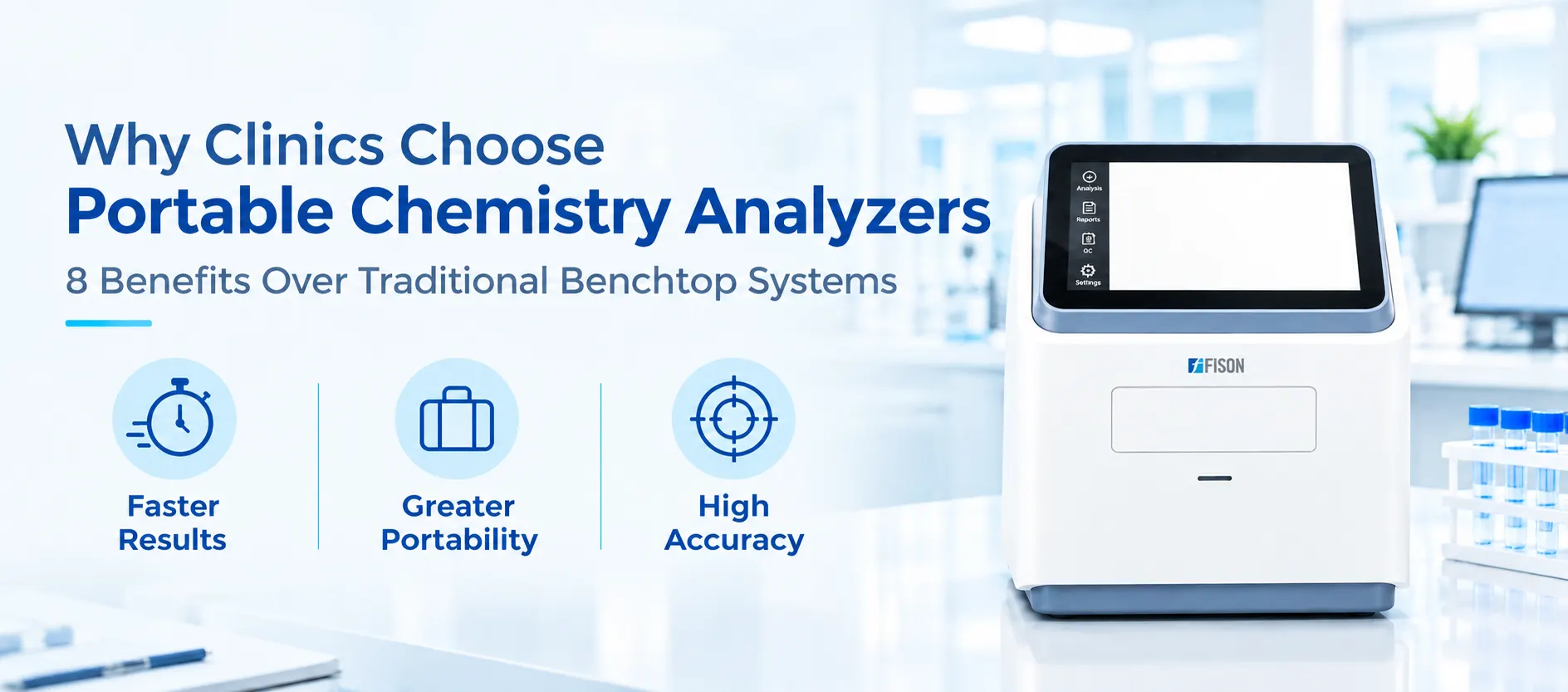
A Portable Chemistry Analyzer changes that sequence. It is a compact, fully automated instrument that tests a small sample at the bedside, in a clinic room, or in a mobile unit. Often described as a Portable Biochemistry Analyzer, it lets hospital teams, clinics, and research centres act on chemistry results while the patient or study participant is still present.
Inside the Reagent Disc Workflow
The Portable Chemistry Analyzer instrument is built around a reagent disc. The disc carries the reagents needed for a panel of tests, so the operator does not measure or mix anything by hand. Fison's design uses reagent disc technology for multi-parameter analysis.
Load the Sample
A small sample is placed on the reagent disc with no external preparation.
Automated Reaction
The disc is inserted and the analyzer runs the test steps on its own, so operator handling stays short.
Result Reporting
In most designs the reaction in each chamber is read by light absorbance, and values for the whole panel appear together.
Eight Practical Gains for Clinical Workflows
Compared with a floor-standing laboratory analyzer, a Portable Blood Chemistry Analyzer shifts the daily workflow in eight ways.
Results in Minutes
Testing at the point of care removes the transport and queue time that come before a benchtop run.
Low Sample Volume
A small sample is enough, which helps when sampling is limited.
No External Preparation
The sample goes directly onto the disc, without separate preparation steps.
Multi-Parameter Panels
One disc supports several parameters in a single run.
Automated Operation
The analyzer carries out the test sequence itself, which limits manual steps.
Compact Footprint
A compact body fits a clinic bench, a trolley, or a mobile unit.
Use Beyond the Laboratory
The same instrument works in clinical and field environments.
Simple Operation
A user-friendly design shortens training for staff who do not work in a laboratory.
Practical Use Cases Across Care Settings
Wherever a chemistry result changes the next step of care, testing close to the patient saves time.
Emergency Care
Rapid chemistry values support early decisions when time matters.
Mobile Diagnostics
Mobile healthcare units can test on site instead of returning samples to a laboratory.
Clinics and Hospital Wards
Point-of-care testing keeps results close to the consultation or the bedside.
Research and Advanced Labs
Research centres can run a small Portable Chemistry Analyzer laboratory at a field site or pilot study.
Benchtop systems still handle large sample volumes and broad test menus, so many facilities run both. The Fison Portable Chemistry Analyzer covers the point-of-care side, and laboratories planning a wider setup can look through the range of chemistry analyzers.
How Portable and Benchtop Systems Differ
| Factor | Benchtop System | Portable Analyzer |
|---|---|---|
| Place of testing | Central laboratory | Bedside, clinic, or mobile unit |
| Time to result | Includes transport and queueing | Minutes at the point of care |
| Sample preparation | Often needed before loading | No external preparation |
| Sample volume | Depends on the system | Low volume |
| Operation | Trained laboratory staff | Automated and simple |
| Throughput | Large batches | Single samples or small runs |
| Test menu | Broad | Panels set by the reagent disc |
Common Selection Mistakes to Avoid
Choosing on Parameter Count Alone
A long menu means little if your routine tests are missing from it. List the parameters you run most and check them against the available discs.
Overlooking Sample Type and Volume
Confirm which sample types the analyzer accepts and how much is needed, particularly for paediatric or limited-volume sampling.
Ignoring the Operating Environment
Mobile units and field sites bring limits on space, power, and temperature. Check that the complete Portable Chemistry Analyzer system suits those conditions.
Neglecting Data and Training
Look at how results are displayed, stored, and exported, and how quickly new operators can learn the workflow on a Portable Chemistry Analyzer machine.
Understanding the Chemistry Analyzer Category
Portable instruments belong to the wider chemistry analyzer family, which covers benchtop, floor-standing, and compact systems that measure the chemical content of blood and other samples. A Chemistry Analyzer Machine in this family can be a compact point-of-care unit or a large laboratory system.
Laboratories evaluating options here usually weigh sample volume, test menu, throughput, operating environment, and data output. To see how these differ across instruments, explore the full chemistry analyzer category. More laboratory equipment is listed on the Fison home page.
Explore the Portable Chemistry Analyzer
See the instrument's features and testing capabilities on the product page.
Explore Portable Chemistry Analyzer