Laboratories, hospitals, research centres and advanced facilities running daily moisture testing often overlook the one component that determines both accuracy and instrument lifespan: the heating element. A Fison Halogen Moisture Analyzer depends on that lamp staying clean and undamaged, and this article covers the maintenance habits that keep it working the way it should for years of routine use.
Why Heating Element Care Determines Long-Term Accuracy
A Halogen Moisture Meter reports a moisture percentage with the same confidence whether the underlying lamp is in excellent condition or gradually degrading, since the display rarely warns of a slow decline in heating performance. Spattered sample residue on the reflector housing, a slightly discoloured bulb or a door seal that no longer closes fully can each change how evenly heat reaches the sample pan.
Facilities running Halogen Moisture Testing across multiple sample types typically find that a short daily cleaning habit, not a more powerful lamp, is what actually keeps drying curves consistent from one batch to the next. Some regions spell the instrument a halogen moisture analyser, but the underlying maintenance habits are identical regardless of which spelling appears on the datasheet.
How a Halogen Moisture Analyzer Determines Moisture Content
The Halogen Moisture Analyzer working principle relies on loss-on-drying: a sample is weighed, then rapidly and evenly heated from above while an integrated precision balance tracks the falling mass in real time. The stages below outline how a typical reading moves from a raw sample to a finished moisture percentage.
Sample Loading & Taring
Halogen Lamp Heating
Continuous Weighing
Moisture % Calculation
Once the drying curve flattens against a preset endpoint criterion, the balance stops recording and the final moisture percentage is calculated automatically from the difference between starting and dried mass. A digital halogen moisture analyzer displays this curve on screen as the test runs, which makes it easier to spot an unusually slow or uneven drying pattern before it affects the result.
A Digital Halogen Moisture Analyzer also makes this kind of drift easier to catch early, since the on-screen curve reveals a developing problem long before the final percentage looks obviously wrong.
Where the Halogen Moisture Analyzer Sits Within Fison's Moisture Analyzer Range
A halogen analyzer belongs to a broader moisture analyzer category that also includes infrared and microwave drying instruments, each suited to a different sample type and drying speed. Within this category, facilities typically compare heating uniformity, sample pan capacity and drying-curve display options before settling on which halogen analyser matches their daily workload. A halogen analyser purchased for one department often ends up shared across several teams, which makes a consistent cleaning routine even more important than it would be for a single-user instrument. Reviewing the full moisture analyzer range alongside a facility's typical sample types is a practical way to confirm a good fit before committing to routine use. Understanding the Halogen Moisture Analyzer working principle well enough to recognise a slow drift is usually more useful than chasing a marginally faster lamp.
The Fison home page catalogues the wider set of laboratory and hospital equipment this moisture analyzer range belongs to, alongside particle sizing and sterilization equipment built around the same accuracy expectations.

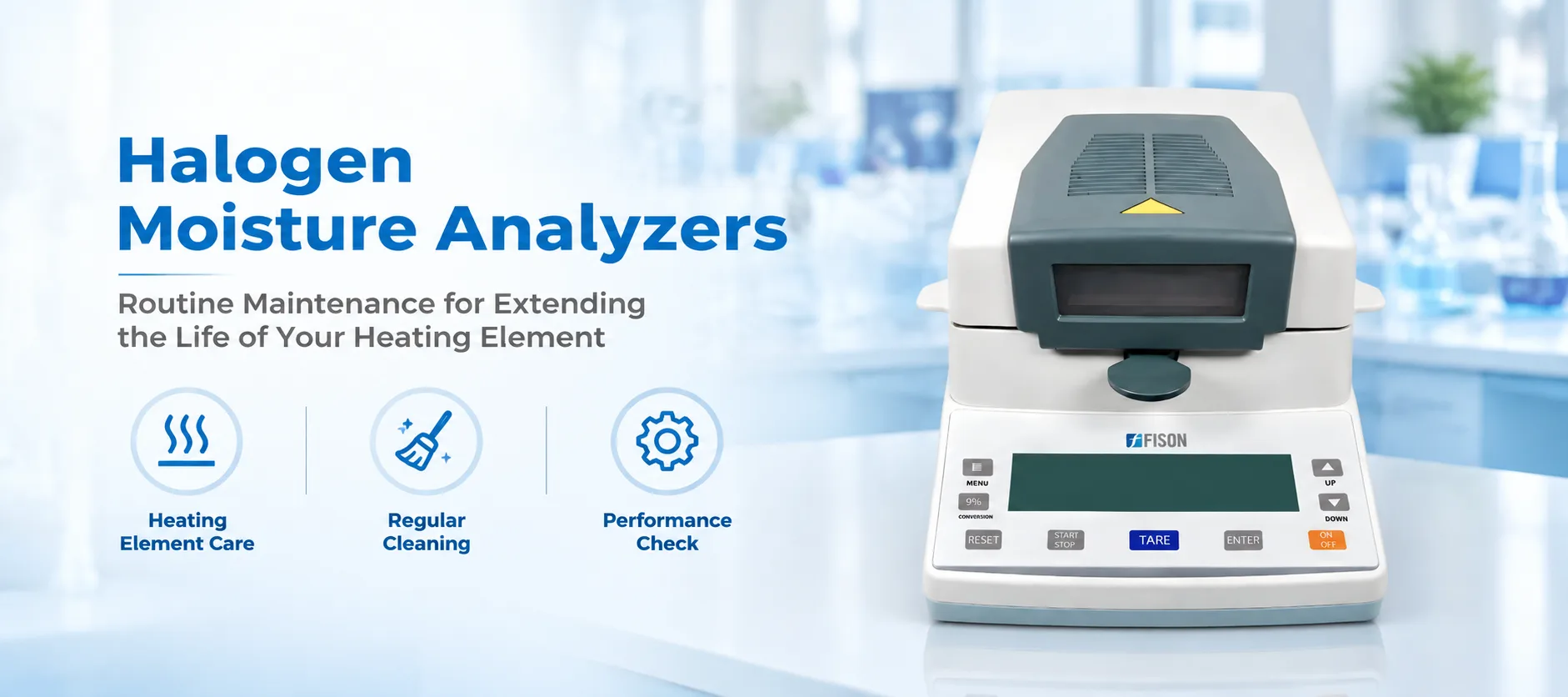
Maintenance Checklist: Protecting the Halogen Heating Element
Whether the instrument on the bench is labelled a halogen analyzer, a halogen moisture balance or a halogen moisture analyzer, the same heating element care applies regardless of the exact name on the datasheet.
Clean the reflector housing and lamp cover after each test involving liquids or pastes, since dried spatter reduces heat transfer and can create localised hot spots.
Avoid touching the halogen bulb directly with bare fingers during any service check, since skin oil left on the glass can cause uneven heating and shorten bulb life.
Allow the chamber to cool with the lid open before closing it after a hot test, since sealing in trapped heat repeatedly can stress the lamp and housing over time.
Check the door seal and ventilation slots for residue buildup, since restricted airflow changes how heat and moisture vapour move through the chamber during a run.
Schedule a Halogen Moisture Analyzer calibration check against certified reference weights on a fixed interval rather than only after a reading looks questionable.
Where Laboratories, Hospitals, Research Centres and Advanced Labs Use a Halogen Moisture Analyzer
Halogen moisture testing shows up wherever a facility needs a fast, repeatable moisture reading before a material moves to the next process step. Reviewing the full moisture analyzer category alongside a facility's sample volume is a practical way to confirm which pan size and heating profile actually apply.
Laboratories running food and feed testing rely on a halogen moisture balance to confirm grain, powder or feed samples meet a target moisture range.
Hospitals and pharmaceutical quality labs check tablet or powder moisture content, where excess residual moisture can affect shelf stability. A halogen moisture meter used for daily quality checks depends on the same reflector and calibration habits as a higher-throughput instrument running continuous batches.
Research centres studying material properties use repeat moisture readings across a project timeline, which makes consistent heating behaviour especially important to maintain.
Advanced labs handling plastics, textiles and chemical powders rely on an even halogen moisture reading to catch batch variation before it reaches production.
This spread of Halogen Moisture Analyzer application areas reflects how differently laboratories, hospitals, research centres and advanced labs depend on the same underlying heating and weighing process. Each new Halogen Moisture Analyzer application tends to follow the same underlying heating and weighing principle, adapted to a different sample type rather than a different piece of equipment.
Selection Mistakes to Watch For When Choosing or Maintaining a Halogen Moisture Analyzer
A handful of recurring missteps show up around both selection and upkeep, and most only become clear once a result looks inconsistent with a known sample:
- Spreading the sample too thick on the pan. A dense layer traps moisture at the centre and can crust over at the surface, sealing in moisture and skewing the reading low.
- Skipping reflector cleaning between spatter-prone samples. Residue left on the housing gradually changes heating uniformity in ways that are easy to miss day to day.
- Using the wrong pan liner for liquid or paste samples. A plain pan without a glass fibre filter can allow spattering directly onto the lamp during rapid heating.
- Assuming factory calibration lasts indefinitely. Balance drift can occur gradually with normal use, which is why a fixed recalibration schedule matters more than a one-time setup check.
- Running volatile or flammable samples at an excessive temperature setting. Matching the heating profile to the sample type protects both the result and the operator.
- Skipping a Halogen moisture analyzer calibration check after a suspicious reading. A small, uncorrected drift at this stage is one of the more common ways a minor issue turns into a harder-to-diagnose problem later.
Explore Fison's Halogen Moisture Analyzer
Heating element condition, reflector cleanliness and calibration discipline all affect how much a halogen moisture analyzer's readings hold up over time, and matching a maintenance routine to actual daily use matters more than following a generic calendar. Documenting each check alongside instrument logs makes drift easier to catch the next time a result looks unexpected, whichever spelling of halogen moisture analyser appears on the instrument's own labelling.
Explore Halogen Moisture Analyzer Options