Immunoassays detect specific proteins, hormones, and drugs in patient samples. This explains how a Fison Fluorescence Immunoassay Analyzer reads those tests, where it is used in clinical labs and beyond, and what to check before choosing one.
What an Immunoassay Measures
An Immunoassay uses antibodies to recognize one specific target in a sample, such as a protein or a hormone. Because antibodies bind so selectively, an Immunoassay can pick out a single biomolecule from a complex sample like serum or whole blood. Clinical labs rely on this to detect and quantify markers linked to heart, thyroid, and other conditions.
A Fluorescence Immunoassay Analyzer turns that binding into a measured result. The target is tagged with a fluorescent label on a test card, and the fluorescence immunoassay analyzer reads how strongly the label glows. That reading becomes a numeric value, so each Fluorescence Immunoassay Test gives a measured result instead of a visual judgment of a colored line.
How Fluorescence Turns Binding into a Result
The Fluorescence Immunoassay Analyzer principle relies on light at two different wavelengths. The analyzer shines ultraviolet light onto the test card, and the fluorescent label absorbs it and emits light at a longer red wavelength. A detector measures that emitted light.
Excitation
An ultraviolet light source excites the fluorescent label bound to the target on the card.
Detection
The detector reads emitted light at a separate, longer wavelength, which keeps the signal apart from the excitation light.
Card-based tests like these are often described as Dry Fluorescence Immunoassay Testing, because the reagents sit on the card rather than in liquid form. A Dry Fluorescence Immunoassay Analyzer reads each card within seconds, and multiple items can be tested on one card.
What a Fluorescent Immunoassay System Brings to the Lab
These features explain why clinical labs choose a Fluorescent Immunoassay System over reading test cards by eye.
Seconds per Reading
Detection takes only seconds per test, and throughput reaches hundreds of tests per hour.
Multiple Items per Card
A single card can carry multiple test items, so several results come from one card.
Random Sample Insertion
Random sample insertion lets staff load samples in any order for instant testing.
Several Sample Types
The Fluorescence Immunoassay Analyzer accepts serum, plasma, whole blood, and urine.
Consistent Readings
Low variation between repeat tests and a strong linear correlation support consistent results.
Automatic Calibration
Automatic calibration keeps the Fluorescence Immunoassay Analyzer ready with minimal staff input.
Built-In Printer
A thermal printer produces a report as soon as each reading finishes.
LIS and HIS Link
Serial, USB, and Ethernet ports connect to code scanners and LIS or HIS systems.
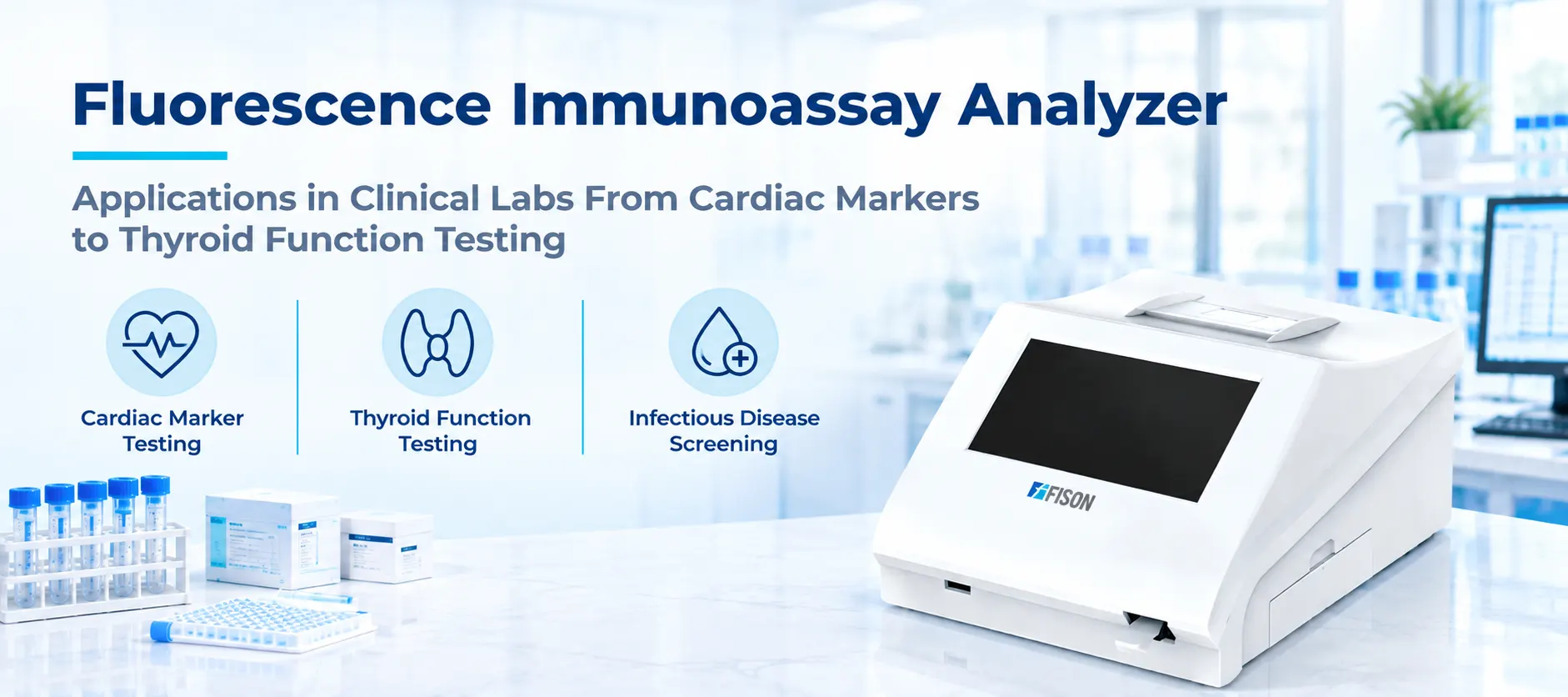
From Cardiac Markers to Thyroid Function and Beyond
Fluorescence Immunoassay Analyzer uses span healthcare, pharmaceutical, biotechnology, and environmental monitoring work, wherever proteins, hormones, or drugs need to be measured.
Cardiac Marker Testing
Cardiac markers are proteins in blood. Hospitals and healthcare labs use a Fluorescence Immunoassay Analyzer to measure these proteins in serum, plasma, or whole blood.
Thyroid Function Testing
Thyroid function testing measures hormones in blood. Hospitals and clinical labs can run these hormone tests on a Fluorescence Immunoassay Analyzer when the matching test card is available.
Pharmaceutical and Biotechnology Work
Pharmaceutical and biotechnology labs use immunoassays to detect and quantify proteins, hormones, and drugs in their samples.
Environmental Monitoring
Environmental monitoring teams apply immunoassay testing to detect specific biomolecules in their samples.
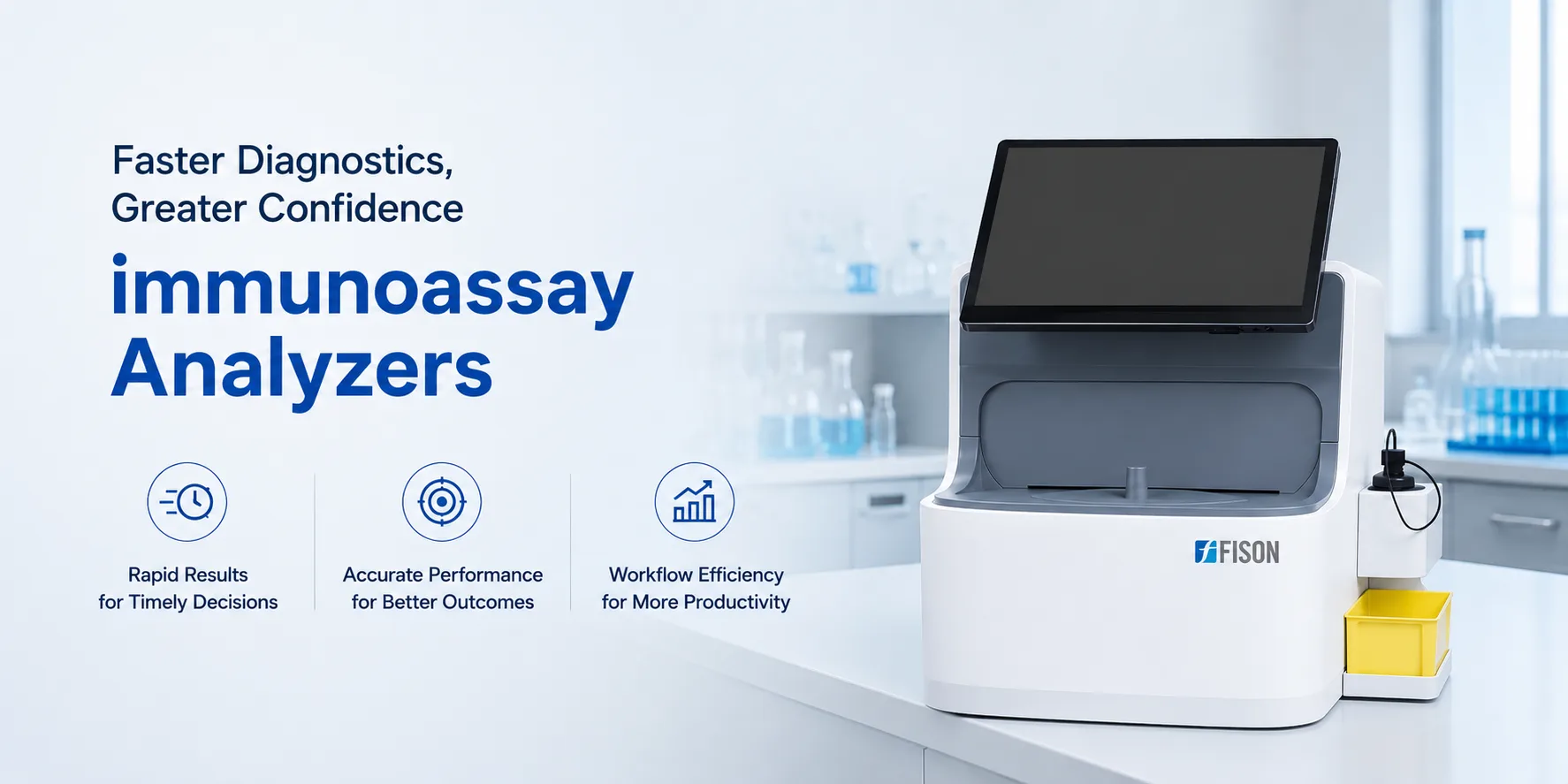
Immunoassay Analyzer uses depend on the test cards available for each instrument, so confirm the markers your healthcare lab needs before choosing. The range of Immunoassay Analyzers shows how fluorescence and chemiluminescent designs compare.
Visual Card Reading and Fluorescence Detection Compared
| Factor | Reading a Card by Eye | Fluorescence Immunoassay Analyzer |
|---|---|---|
| Reading method | Visual check of a line | Optical excitation and detection |
| Result type | Present or absent | Measured value |
| Multiple items | Read one by one | Several items on one card |
| Operator effect | Depends on judgment | Instrument reading |
| Records | Handwritten | Printed and sent to LIS or HIS |
Common Selection Mistakes to Avoid
Not Checking the Test Menu
An analyzer is only as useful as the test cards it reads. Confirm that the cardiac, thyroid, or other markers you need are available before choosing a Fluorescence Immunoassay Analyzer.
Ignoring Sample Types
Check that the analyzer accepts the sample types your lab collects, whether serum, plasma, whole blood, or urine.
Overlooking Channel Count
A single detection channel reads one card at a time. Match channel count and tests per hour to your peak workload.
Forgetting Connectivity
Ports, code scanner support, and LIS or HIS links decide how results reach patient records. Confirm compatibility early.
Exploring the Immunoassay Analyzer Category
The Immunoassay Analyzer category includes Fluorescence Immunoassay Analyzers and Chemiluminescent Immunoassay Analyzers. Labs comparing an automatic Fuorescence Immunoassay Analyzer with other options usually weigh detection method, test menu, sample types, tests per hour, calibration, and connectivity.
Whether you run cardiac marker tests or thyroid function panels, you can review the full Immunoassay Analyzer lineup to compare models, or browse other laboratory instruments on the Fison home page.
Review Fluorescence Immunoassay Testing in Detail
Compare sample types, test speed, and connectivity options.
Explore Fluorescence Immunoassay Analyzers