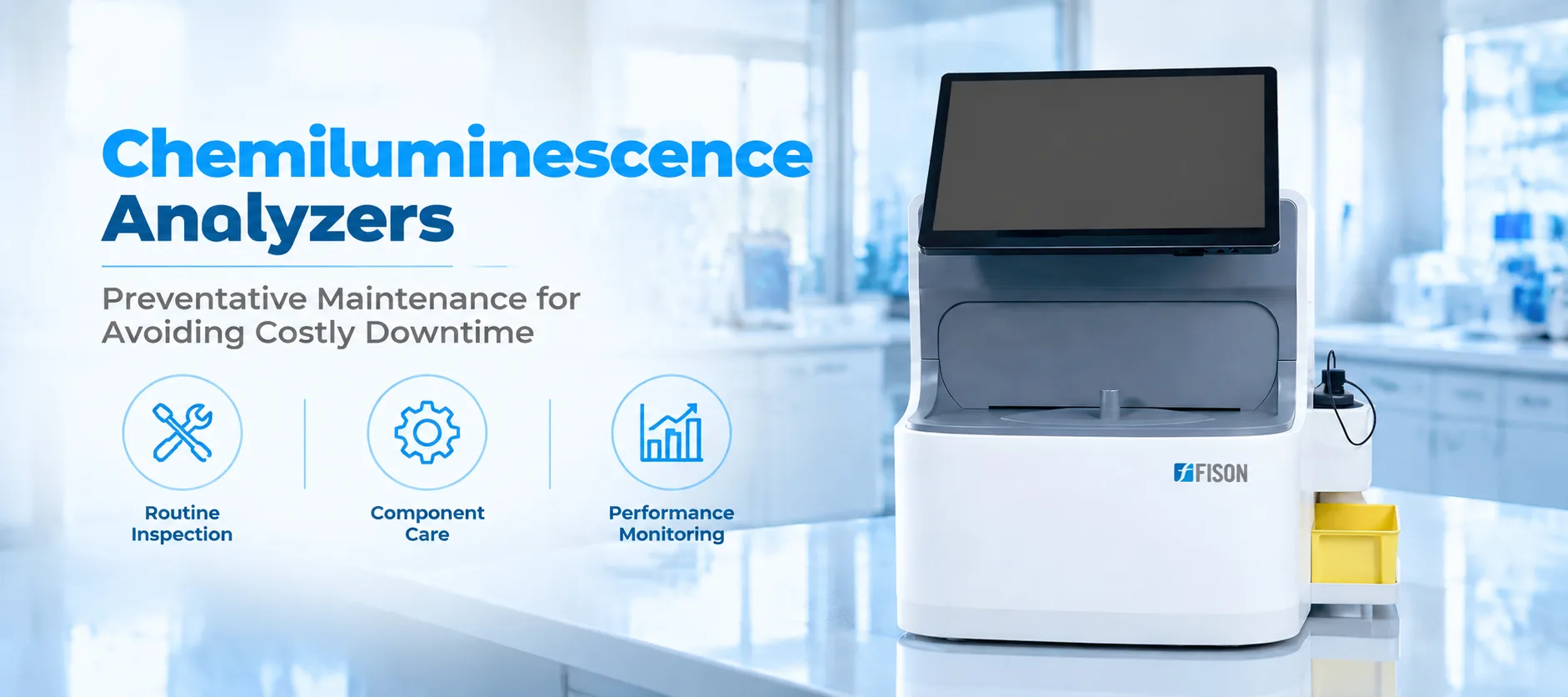
Laboratories, hospitals, research centres and advanced facilities running daily diagnostic panels depend on results that arrive on schedule, and an unplanned service interruption disrupts far more than a single test run. A Fison Chemiluminescent Immunoassay Analyzer holds up well over years of continuous use when a handful of preventative habits are followed consistently, and this article covers what actually protects uptime.
Why Preventative Care Reduces Unplanned Downtime
A Chemiluminescence Immunoassay System can run hundreds of samples without an obvious warning sign while a wash probe gradually mists or a magnetic separation step slowly loses efficiency in the background. By the time a result looks visibly wrong, the underlying issue has often been building for weeks.
Facilities running high sample volumes typically find that a short, scheduled maintenance routine, not a faster instrument, is what actually keeps a Chemiluminescent Immunoassay Analyzer running between planned service visits rather than failing mid-batch.
A chemiluminescence immunoassay test result only holds up if the detector and wash path that produced it are in good working order, which is why preventative maintenance sits upstream of each reported value. Running a chemiluminescence immunoassay test on a poorly maintained instrument can look normal for weeks before a control value finally drifts outside its expected range.
How a Chemiluminescent Immunoassay Analyzer Generates a Result
The Chemiluminescence Immunoassay Analyzer principle relies on a labelled antibody that emits light once a trigger reagent is added, with the amount of light captured by a sensitive detector directly related to how much of the target analyte is present in the sample. The stages below outline how a typical run moves from a loaded sample to a reported concentration.
Sample & Reagent Loading
Immune Complex & Magnetic Separation
Trigger Reagent & Light Emission
Signal Detection & Result Calculation
Once the detector records the emitted light in relative light units, onboard software compares that signal against a stored calibration curve to calculate a final concentration. A fully automated chemiluminescence immunoassay analyzer handles washing, reagent dispensing and detection in sequence without manual intervention between samples, which is part of why detector and wash-path cleanliness matter so much to consistent results.
Grasping the Chemiluminescent Immunoassay Analyzer working principle in enough depth to recognise early drift is more valuable day to day than memorising a full service manual. The Chemiluminescent Immunoassay Analyzer working principle depends on consistent light detection, which is exactly why optical path cleanliness sits at the top of any maintenance checklist.
The Chemiluminescent Immunoassay Analyzer principle behind light-based detection makes it especially sensitive to any change in the optical path or reagent chemistry. A technician who understands the Chemiluminescent Immunoassay Analyzer principle can often diagnose a drifting result faster than one who only follows a fixed troubleshooting script.
Where the Chemiluminescent Immunoassay Analyzer Sits Within Fison's Immunoassay Analyzer Range
A Chemiluminescence Machine belongs to a broader immunoassay analyzer category that also includes enzyme-linked and fluorescence-based detection systems, each suited to a different sensitivity requirement and assay menu. A chemiluminescence immunoassay system and a simpler chemiluminescence machine used for a narrower panel both depend on the same detector and wash-path cleanliness to stay accurate over time. Within this category, facilities typically compare detection sensitivity, sample throughput and assay menu breadth before settling on which chemiluminescence immunoassay machine matches their daily test volume. Reviewing the full immunoassay analyzer range alongside a facility's typical test mix is a practical way to confirm a good fit before committing to routine use. Choosing a fully automated chemiluminescence immunoassay analyzer for a high-volume laboratory only pays off if the maintenance routine keeps pace with the sample throughput it was selected for.
The Fison home page catalogues the wider set of laboratory and hospital equipment this immunoassay analyzer range belongs to, alongside moisture analysis and particle sizing equipment built around the same accuracy expectations.

Preventative Maintenance Checklist: Protecting Detection Accuracy
Inspect the optical detector housing and light path for dust or residue, since even a small amount of contamination can dampen a genuine signal and flatten a result curve.
Check wash probes and fluid lines for partial blockages, since incomplete washing leaves residual reagent behind and can carry signal from one sample into the next.
Examine the magnetic separation module for wear, since a weakened magnet can let unbound material escape a wash step and quietly distort results.
Store trigger reagents according to the temperature and light-exposure conditions most chemiluminescence immunoassay analyzer manufacturers specify, since premature reagent degradation shows up as a slow signal drift rather than an obvious failure.
Run a calibration verification on a fixed schedule rather than only after a control value looks questionable, so drift is caught before it reaches patient or sample results.
Understanding the chemiluminescence immunoassay analyzer principle well enough to recognise early drift is often more useful than following a checklist item by item, though most chemiluminescence immunoassay analyzer manufacturers document the same core checks in their service literature.
Where Laboratories, Hospitals, Research Centres and Advanced Labs Use a Chemiluminescent Immunoassay Analyzer
Chemiluminescence immunoassay analyzer uses span hormone panels, tumour marker testing, infectious disease serology and cardiac marker screening, each drawing on the same underlying light-based detection method. Reviewing the full immunoassay analyzer category alongside a facility's typical panel mix is a practical way to confirm which throughput and assay menu actually apply.
Laboratories running high-volume hormone and thyroid panels rely on consistent detector sensitivity to keep low-concentration results accurate.
Hospitals screening for cardiac markers depend on fast, repeatable turnaround where a delayed or drifting result can affect a time-sensitive decision.
Research centres studying biomarker trends use repeat measurements across long timelines, which makes consistent calibration especially important to maintain.
Advanced labs running infectious disease serology rely on stable detection thresholds to separate a genuine positive from background signal.
This spread of Chemiluminescent Immunoassay Analyzer application areas reflects how differently laboratories, hospitals, research centres and advanced labs depend on the same underlying detection process. Each new Chemiluminescent Immunoassay Analyzer application tends to follow the same underlying light-based detection method, adapted to a different biomarker rather than a different piece of equipment.
Chemiluminescence immunoassay analyzer uses keep expanding as new biomarker panels are validated, which is part of why a flexible assay menu matters alongside raw throughput. Chemiluminescent Immunoassay Analyzer uses across a facility are worth documenting on a routine basis, since that record also helps confirm the assay menu still matches what a laboratory actually runs day to day. Reviewing Chemiluminescent Immunoassay Analyzer uses at planned intervals also makes it easier to spot when a department's testing pattern has outgrown its original assay menu.
Selection Mistakes to Watch For When Choosing or Maintaining a Chemiluminescent Immunoassay Analyzer
A handful of recurring missteps show up around both selection and upkeep, and most only become clear once a chemiluminescent immunoassay analyzer's result pattern looks inconsistent with a known sample:
- Choosing an assay menu that does not match daily test volume. A chemiluminescence immunoassay machine sized for a small panel struggles once test variety grows beyond what it was configured for.
- Skipping wash-path inspection between high-volume runs. Residual reagent left in the fluid path gradually changes background signal in ways that are easy to miss day to day.
- Ignoring trigger reagent storage conditions. Light or temperature exposure outside the recommended range can degrade reagent performance before its labelled expiry.
- Assuming factory calibration lasts indefinitely. Detector drift can occur gradually with normal use, which is why a fixed recalibration schedule matters more than a one-time setup check.
- Overlooking magnetic separation maintenance. A worn separation module is one of the more common ways a subtle accuracy problem develops without an obvious alarm.
Explore Fison's Chemiluminescent Immunoassay Analyzer
Optical detector cleanliness, wash-path condition and calibration discipline all affect how much a chemiluminescent immunoassay analyzer's uptime can be protected between scheduled service visits, and matching a maintenance routine to actual daily test volume matters more than following a generic calendar. Documenting each check alongside Chemiluminescent Immunoassay Analyzer logs makes drift easier to catch before it turns into unplanned downtime.
Explore Chemiluminescent Immunoassay Analyzer Options