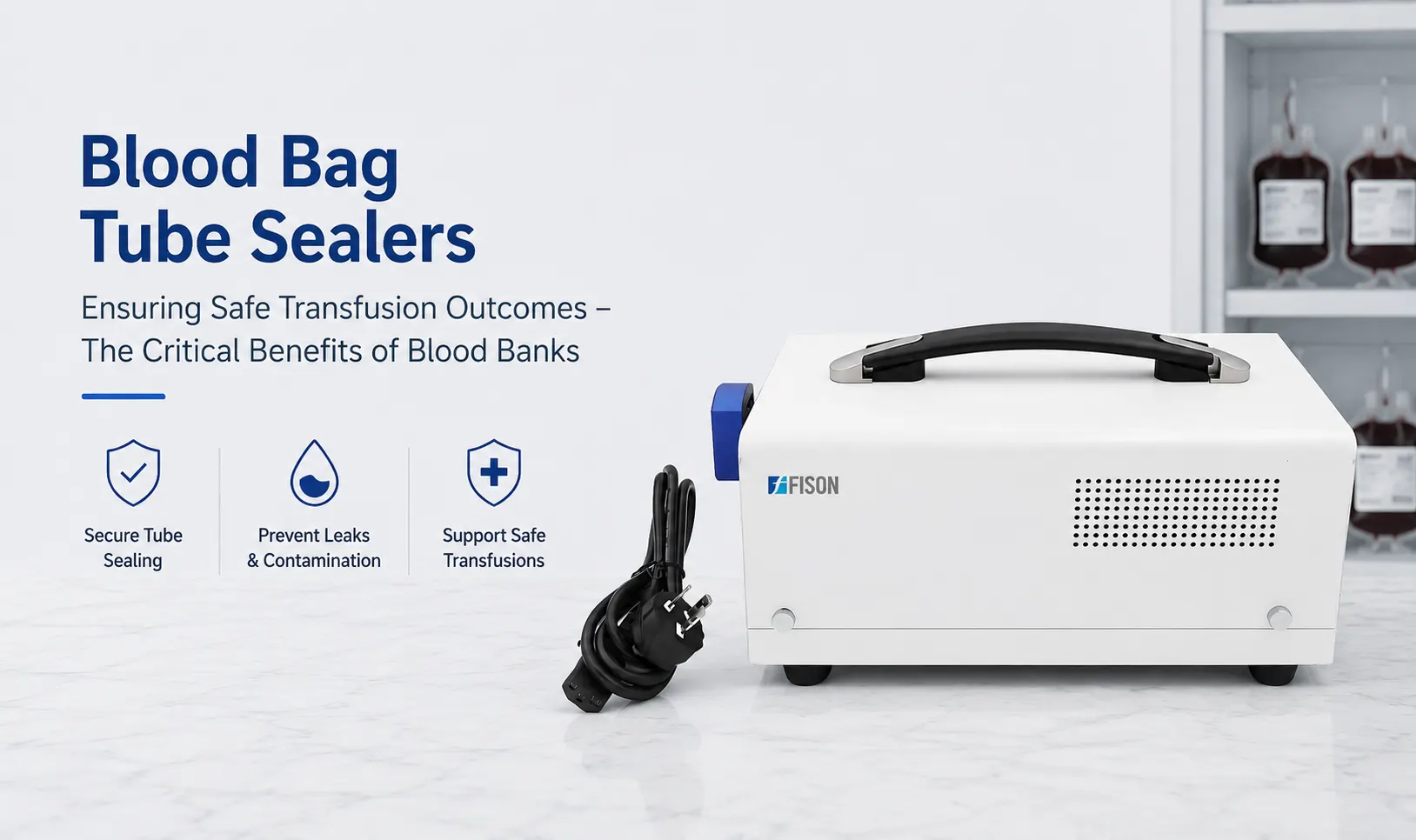
Laboratories, hospitals, research centres and advanced facilities preparing donated blood for storage or transfusion rely on a Fison Blood Bag Tube Sealer to close each tube segment securely without opening the collection bag to outside air. This article looks at how these instruments keep the system closed, where they fit within wider blood bank equipment, and what to check before choosing one.
Why an Open Tube Segment Puts Transfusion Safety at Risk
A collected blood bag stays connected to its donor line through a length of tubing that must eventually be divided into short segments, one for the bag itself and several pilot segments kept aside for typing and cross-matching. Cutting that tubing without first closing it off exposes the blood inside to open air, introducing a contamination risk at exactly the stage where the sample needs to remain as clean as it was at collection.
A heat or radio-frequency seal placed just ahead of each cut closes the tubing before it is separated, so the segment that results stays closed on both ends. This single step is what keeps a blood bag sealer relevant across donor collection, apheresis processing and pilot tube preparation alike, since each of those workflows depends on tubing that can be divided without breaking the closed system.
How a Blood Bag Tube Sealer Works: From Tube Placement to a Finished Seal
Most units position the tubing between two jaws that apply heat, or a radio-frequency field, across a short length of the tube wall until the plastic fuses into a solid, closed band. A Blood Bag Tube Sealer machine holds this pressure and energy for a set duration, long enough for the fused band to cool and set before the jaws release the tubing.
Tube Positioning
Heat or RF Sealing
Seal Formation & Cooling
Cut & Separate
Once the fused band sets, the tubing can be cut through the middle of that band, leaving a closed end on each of the two resulting pieces. That outcome is what separates a proper blood sealer from a plain mechanical clamp, which closes a segment only until it is disturbed rather than fusing it into one continuous, closed wall.
Portable and Fixed Blood Bag Tube Sealer Formats: Matching Method to Setting
A fixed, benchtop Blood Bag Sealer suits a central blood bank laboratory where tubing arrives already collected and sealing happens at one workstation alongside component separation and labeling. A portable Blood Bag Tube Sealer instead runs on a rechargeable battery, which matters for mobile donation drives and camp collections where mains power is not always close at hand.
Facilities running both settings often keep one fixed Blood Bank Tube Sealer at the main site and a Blood Bag Tube Sealer portable enough for outreach, comparing seal cycle time, tube diameter range and battery runtime across the full Blood Bag Tube Sealer range before settling on a pairing. A facility replacing an existing Blood Bag Tube Sealer Terumo unit typically starts from the same comparison, since tube material compatibility and seal width matter more than the brand already in use.
Where the Blood Bag Tube Sealer Fits in the Wider Blood Bank Equipment Category
A Blood Bag Tube Sealer belongs to a broader blood bank equipment category that also includes plasma extractors, blood mixers and weighing scales used across collection, component separation and storage stages. Within this category, teams typically compare sealing method, tube diameter compatibility, seal cycle time and whether a fixed unit or a portable Blood Bag Tube Sealer matches how the facility collects and processes blood, a comparison that often starts by benchmarking against a Blood Bag Tube Sealer Terumo unit already on site.
Reviewing the full Blood Bag Tube Sealer category page is a practical starting point for lining up these factors before narrowing a shortlist. For facilities exploring blood bank and laboratory equipment beyond tube sealing alone, the Fison home page lists the wider catalogue the brand carries.

Blood Bag Tube Sealer Uses Across Blood Banks and Research Facilities
Each Blood Bag Tube Sealer application shares the same closed-seal method, adapted to a different stage of the blood banking workflow. Blood Bag Tube Sealer uses extend beyond routine donor collection into several stages of blood bank work. Donor collection sites seal the main bag line right after draw, closing off pilot segments that are later cut apart and sent for typing and infectious-disease screening without disturbing the primary bag. Apheresis units apply the same method to seal individual component lines once plasma, platelets or red cells have been separated into their own bags.
Research centres and advanced labs use a blood bank tube sealer to prepare archived tubing segments for later cross-matching, and hospital blood banks rely on the same closed-seal approach when dividing a single donation into multiple patient-ready units. Across each of these settings, the seal itself is what keeps the sample chain closed from collection through to the point the blood reaches a patient, rounding out the range of Blood Bag Tube Sealer application areas a single instrument design can cover.
Selection Mistakes to Watch For When Choosing a Blood Bag Tube Sealer
A handful of recurring missteps show up during evaluation of a Blood Bag Tube Sealer machine, and most only become clear once the unit is already in routine use:
- Overlooking tube diameter range. A unit sized for one tubing gauge may not seal a wider or narrower line cleanly, leaving a weak spot near the fused band.
- Ignoring seal cycle time. A slow seal cycle can bottleneck a busy collection session where several bags need dividing in quick succession.
- Skipping battery runtime checks on portable units. A Blood Bag Tube Sealer portable enough for outreach can still leave a team without a working seal partway through a donation drive if its runtime falls short.
- Assuming all tube materials seal alike. Different plastic tubing formulations fuse at different temperatures, and a fixed setting tuned for one material may under-seal another.
- Placing the cutting point too close to the seal. A cut made too near the fused band can weaken it, undoing the closed seal the unit just formed.
Ready to Explore Blood Bag Tube Sealer Options?
Tube diameter range, seal cycle time and portability differ meaningfully between models, and reviewing a blood sealer lineup together helps match a unit to actual collection and processing needs rather than a rough estimate.
Explore Sealer Options