Introduction
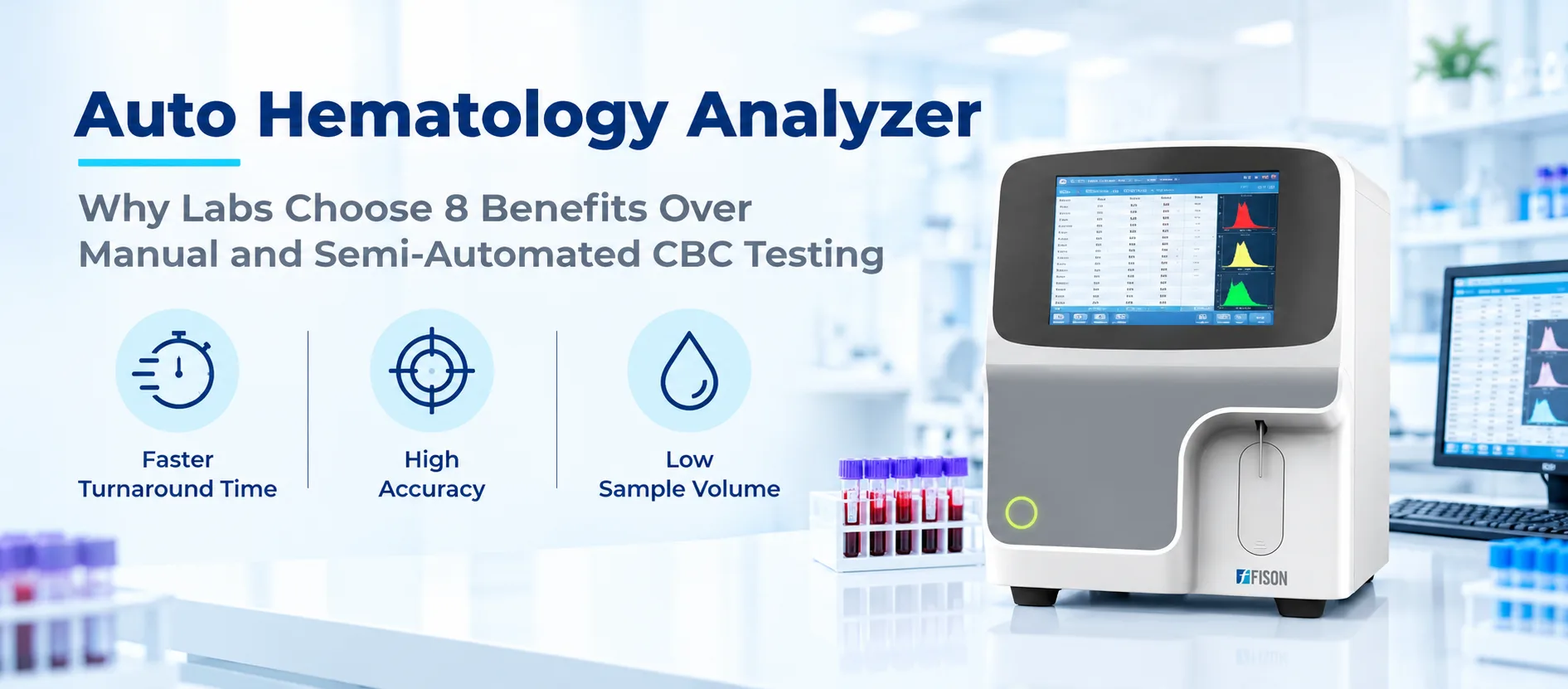
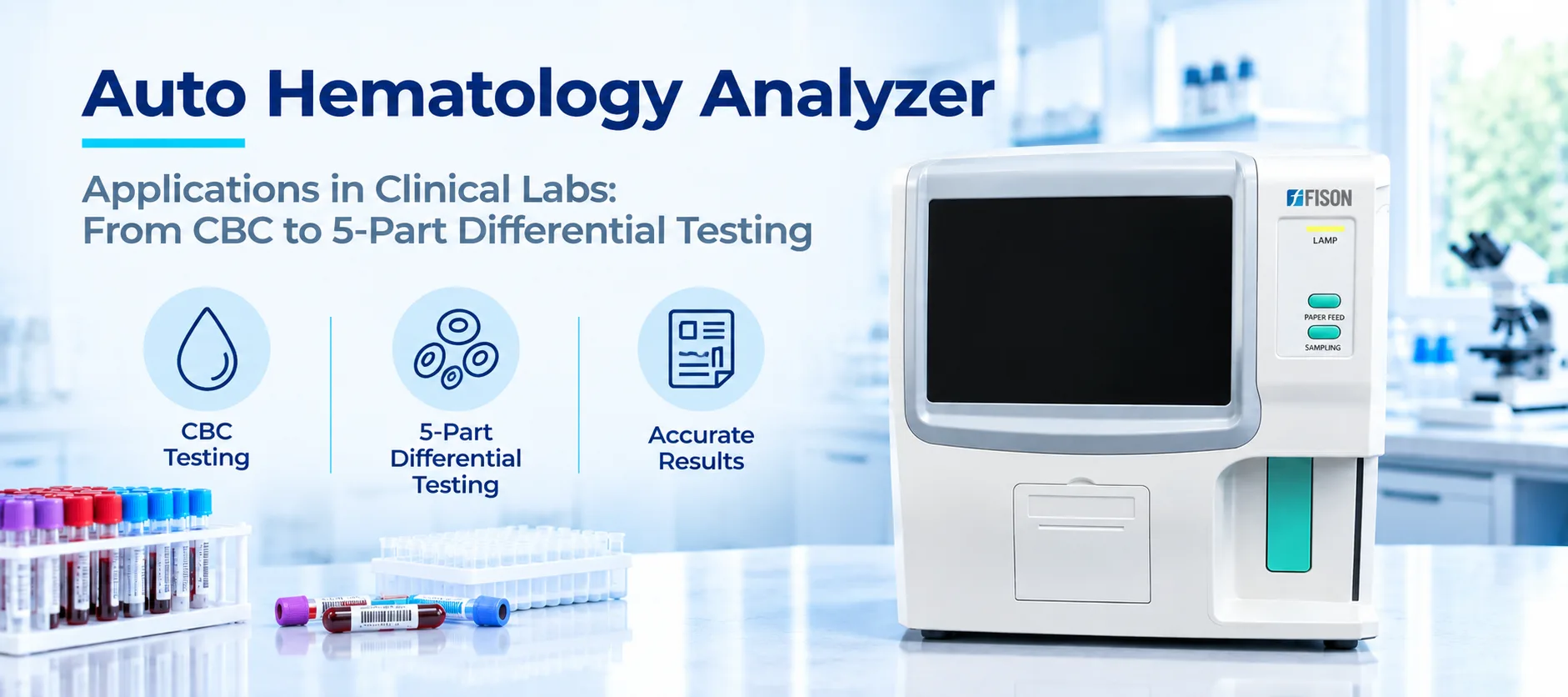
A practical look at how an Fison Auto Hematology Analyzer supports blood cell counting in hospital, research and advanced laboratories, from routine CBC testing to five-part differential counts.
Where Blood Cell Analysis Fits in Clinical Practice
A complete blood count (CBC) is often the first test a clinician requests when a patient's general condition needs review. An auto hematology analyzer processes a small blood sample and reports red blood cell (RBC), white blood cell (WBC) and platelet (PLT) parameters, so the clinical laboratory can return CBC testing results without manual chamber counts.
The practical hematology analyzer uses in a diagnostic laboratory include:
- Anemia screening through the RBC count and hemoglobin review
- Infection and inflammation assessment through the WBC count and differential count
- Platelet count monitoring before medical procedures
- Blood cell counting during long treatment courses, such as chemotherapy
- Research studies that need repeatable blood cell counting across large sample panels
Because an automatic hematology analyzer performs the counting itself, laboratory staff can spend more time reviewing flagged results. An auto hematology analyzer machine also keeps CBC testing consistent between operators, which matters in hospital laboratories and research centres alike. Each of these hematology analyzer uses depends on accurate blood cell counting.
How Cells Are Counted and Sized
The Hematology analyzer principle behind the basic count is electrical impedance, also called electrical resistance. Cells travel in a conductive diluent through a small aperture, and each cell briefly disturbs the current. The number of pulses gives the cell count, while pulse height reflects cell volume. The Fison auto hematology analyzer listing names this same principle for counting WBC, RBC and PLT. This auto hematology analyzer principle suits routine CBC testing well.
That size information produces the histograms used in auto hematology testing and blood cell counting, and the Fison auto hematology analyzer listing notes three histograms for cell size distribution. Knowing the auto hematology analyzer principle helps laboratory staff interpret flags, since many of them trace back to abnormal size distributions. A fully auto hematology analyzer runs its counting cycle through an automatic operating system, as the Fison auto hematology analyzer listing shows.
1. Sample preparation
The blood sample is run in whole blood or prediluted mode and mixed with diluent.
2. Aperture detection
Cells pass through the aperture and generate pulses that are counted and sized.
3. Histogram output
Pulse data from the automatic hematology analyzer becomes counts, indices and size distribution curves.
Illustrative diagram placeholder: basic counting sequence in an auto hematology analyzer machine.

Three-Part and Five-Part Reporting Compared
Both formats begin with the same CBC. The difference lies in how far the white cell population is separated in the differential count. A three-part report groups white cells into lymphocytes, mid-sized cells and granulocytes. A five-part report names neutrophils, lymphocytes, monocytes, eosinophils and basophils individually, which usually calls for optical detection in addition to impedance. An auto hematology analyzer built on impedance alone reports the first format.
The Fison auto hematology analyzer listing describes impedance counting with three histograms, so five-part reporting is presented here only as a general point of comparison for laboratories reviewing their differential count needs in an automated hematology analyzer machine.
| Aspect | Three-part differential | Five-part differential |
|---|---|---|
| White cell groups | Three size-based groups | Five named cell types |
| Detection method | Impedance with size histograms | Impedance combined with light scatter or fluorescence |
| Typical setting | Routine CBC testing benches using an auto hematology analyzer | Hospital and referral laboratories with complex case mix |
| Abnormal cell alerts | Size-distribution flags | Population-based flags on scattergrams |
| Reagent handling | Fewer reagents to store and manage | Additional lytic and staining reagents |
Illustrative placeholder: a scattergram in which five white cell populations form separate clusters, the visual basis of five-part differential counts from an auto hematology analyzer.
Matching Instruments to Laboratory Settings
No single configuration suits all laboratories. A Fully automated Hematology Analyzer performs counting automatically, but the workload it carries differs between sites, so the auto hematology analyzer should match the laboratory it serves.
Hospital laboratories
Steady sample flow from wards and outpatient departments favors a higher-throughput automated hematology analyzer machine with clear flagging.
Research centres
Limited sample material makes low sample volume and a prediluted mode useful, and the Fison auto hematology analyzer listing includes whole blood and prediluted sampling modes.
Advanced laboratories
Detailed differential count data and histogram review from an automatic hematology analyzer support complex hematology cases.
A fully auto hematology analyzer with a three-part output can serve a busy screening bench, while specialist work may need a five-part system.
Workflow Details That Shape Daily Use
Specifications only tell part of the story. Once an automatic hematology analyzer is installed, these points shape how well it fits the routine:
- Sample volume: whole blood and prediluted modes on an auto hematology analyzer machine use different sample amounts, which matters for small collections.
- Throughput: the Fison auto hematology analyzer listing describes 60 samples per hour, which suits a routine CBC testing bench.
- Operating interface: the Fison auto hematology analyzer listing mentions a 10.4-inch color touch LCD screen for intuitive operation.
- Quality control: regular control runs on a fully automated Hematology Analyzer confirm that blood cell counting stays within expected limits.
Selection Mistakes Worth Avoiding
Laboratories comparing an auto hematology analyzer often overlook the same few points:
- Choosing an auto hematology analyzer on samples per hour alone, without checking how many results need review.
- Selecting five-part capability in an automated hematology analyzer machine when routine CBC testing is the main workload, or the reverse when case complexity is rising.
- Overlooking minimum sample volume for small or fragile patients.
- Ignoring reagent storage and waste handling.
- Leaving staff training on the hematology analyzer principle and maintenance planning until after installation.
Terms such as auto haematology analyzer, auto hematology and auto hematology analyzer machine describe the same instrument class, so compare each model on equal terms. Reviewing the listings across the auto hematology analyzer range before shortlisting makes differences in sampling modes, counting principle and throughput easier to see.
Exploring the Wider Hematology Range
Auto hematology analyzers sit within the larger family of hematology analyzer instruments used in diagnostic and research laboratories. When laboratories compare options in this family, they usually weigh throughput, sample volume, sampling modes, display and operation, and reagent requirements. Common hematology analyzer uses across this family cover CBC testing, differential counts and research counting, and a fully automated Hematology Analyzer suits laboratories that want less manual handling.
The full set of models can be viewed through the complete category listing. Fison is a UK-based manufacturer, and its wider catalogue of laboratory instruments can be browsed from the Fison home page.
Summing Up
Auto hematology testing runs from the first CBC testing request to a full five-part differential count, the value of an auto hematology analyzer depends on matching a fully auto hematology analyzer to the work a laboratory performs. Clear knowledge of the auto hematology analyzer principle, honest estimates of sample load and attention to daily workflow details lead to a better long-term fit than any single specification.