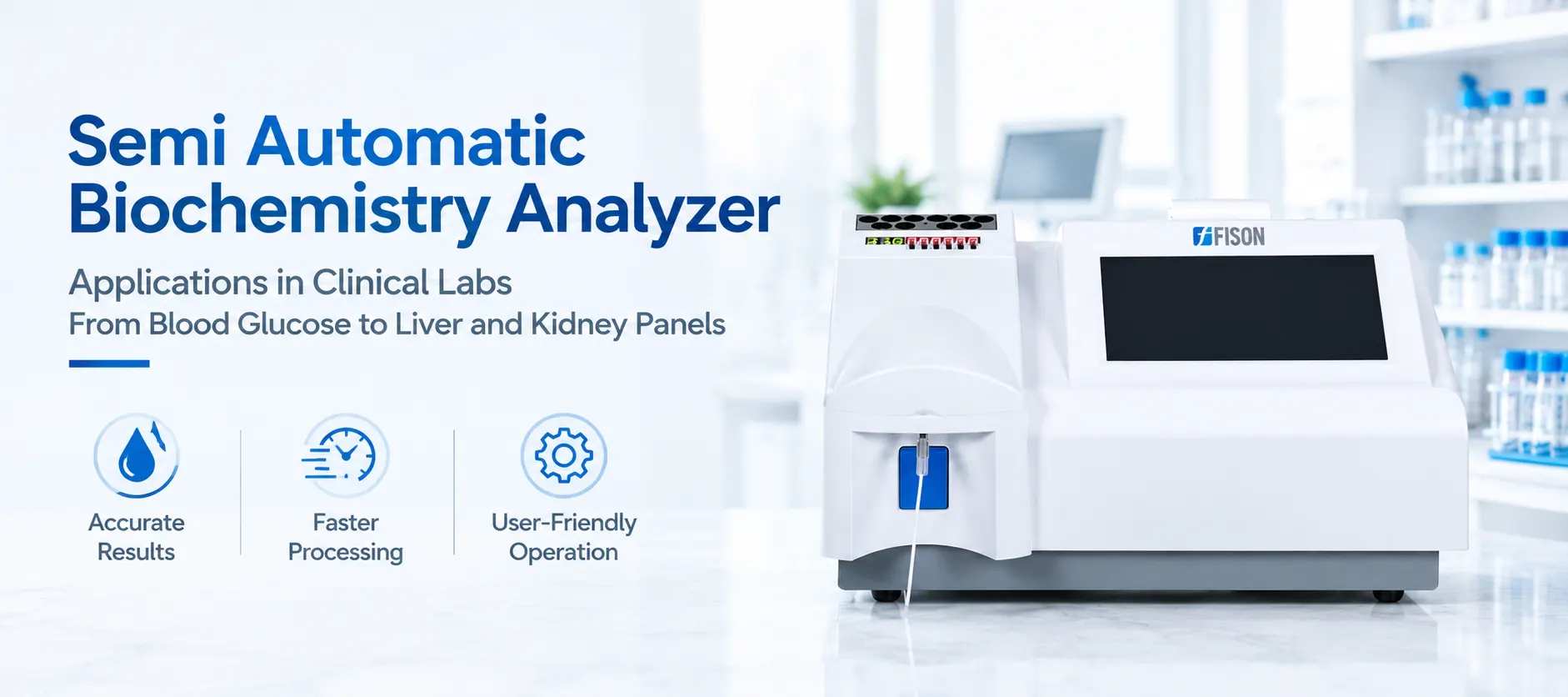
Biochemistry tests measure glucose, enzymes, proteins, and other substances in patient samples. This explains how a Fison Semi-Automatic Biochemistry Analyzer works, which clinical panels it supports, and what to check before choosing one.
What Clinical Biochemistry Testing Involves
Many clinical biochemistry tests rely on a color reaction. A reagent reacts with the substance being measured, and the strength of the resulting color shows how much of that substance is present. Measuring that color accurately is the job of a photometer.
A Semi-Automatic Biochemistry Analyzer handles the measurement and calculation, while the operator prepares the sample and reagent. Once the mixture is drawn into the flow cell, the Semi-Automatic Biochemistry Analyzer reads the reaction, calculates the result, and prints a report. That balance of manual preparation and automated reading makes it a practical Semi Automatic Biochemistry Machine for clinical labs running a broad test menu.
How Photometry Turns Color into Results
The Semi Automatic Biochemistry Analyzer working principle is photometric. A halogen lamp sends light through the sample in a titanium flow cell, and filters select the wavelength that matches each test. The detector measures how much light the sample absorbs, and the analyzer converts that absorbance into a concentration.
Wavelength Filters
Seven filters span the ultraviolet and visible range, and each wavelength has its own signal processing circuit to improve measurement precision.
Back Spectrophotometry
Back spectrophotometry measures light absorption accurately even for turbid or scattered samples, with no moving parts during measurement.
Different tests need different reading methods. The Semi-Automatic Biochemistry Analyzer offers kinetic, end point, two-point, and multi-point modes, so enzyme tests that track a changing reaction and end point tests that read a finished color can run on the same instrument.
What the Analyzer Brings to the Clinical Lab
These features explain why clinical labs choose a Semi Auto Biochemistry Analyzer for routine panels.
Seven Wavelength Filters
Filters across the ultraviolet and visible range cover a wide test menu.
Titanium Flow Cell
A titanium flow cell resists chemical corrosion and needs only a small sample volume.
Peltier Temperature Control
Peltier elements hold the flow cell at a steady temperature for consistent readings.
Several Test Modes
Kinetic, end point, two-point, and multi-point modes suit different reaction types.
Low Precision Error
Fine absorbance resolution and low drift support repeatable results.
Touch Screen Operation
A touch screen makes test selection and setup quick for staff.
Stored Programs and Data
The Semi-Automatic Biochemistry Analyzer stores patient data and test programs for repeat use.
Built-In Printer
A thermal printer produces a report as soon as each test finishes.
From Blood Glucose to Liver and Kidney Panels
Semi Automatic Biochemistry Analyzer uses span routine clinical panels in hospitals, medical laboratories, and research institutions, covering enzyme activity, glucose levels, and protein concentrations.
Blood Glucose
Glucose is one of the routine tests run on a Semi-Automatic Biochemistry Analyzer in hospitals and medical laboratories.
Liver Function Panel
Liver function tests include ALT, AST, ALP, total bilirubin, total protein, and albumin, all read on the same analyzer.
Kidney Function Panel
Renal function tests such as BUN, creatinine, and uric acid help medical laboratories assess kidney function.
Lipid and Cardiac Tests
Lipid tests such as triglycerides, HDL-C, and LDL-C sit alongside cardiac tests such as CK, CK-MB, and LDH, and immune proteins such as IgA, IgG, and IgM.
Catalogs often shorten the name to a Semi Auto Analyser, a Semi Auto Analyser Machine, or a Semi Auto Analyser Biochemistry unit. Whatever the label, the core Semi Auto Analyser function is the same: reading a color reaction and turning it into a result. A typical Semi Auto Analyser use covers glucose, liver, kidney, lipid, and cardiac tests. The range of biochemistry analyzers shows how these features come together.
Semi-Automatic and Fully Automatic Analyzers Compared
| Factor | Semi-Automatic Biochemistry Analyzer | Fully Automatic Chemistry Analyzer |
|---|---|---|
| Sample and reagent mixing | Prepared by the operator | Handled by the instrument |
| Sample loading | One sample at a time into the flow cell | Batches loaded on a tray |
| Operator involvement | Higher | Lower |
| Typical fit | Smaller daily workloads and flexible test menus | High daily sample volumes |
Common Selection Mistakes to Avoid
Not Matching Filters to Tests
Each test reads at a set wavelength. Confirm the analyzer's filters cover the wavelengths your reagents need.
Overlooking Temperature Control
Kinetic enzyme tests depend on a steady temperature. Check that the Semi-Automatic Biochemistry Analyzer controls flow cell temperature.
Mismatching Workload
Operators prepare each sample by hand. For very high daily volumes, compare against a fully automatic chemistry analyzer.
Ignoring Data Output
Results leave through USB and serial ports. Confirm how reports will reach your lab records.
Exploring the Biochemistry Analyzer Category
Biochemistry Analyzers sit alongside other clinical analyzers such as automatic chemistry analyzers, electrolyte analyzers, and blood gas analyzers. Clinical labs and research institutions comparing a Semi Automatic Chemistry analyzer with other options usually weigh wavelength range, flow cell design, temperature control, test modes, data storage, and printing.
Whether you run glucose checks or full liver and kidney panels, you can review the full biochemistry analyzer lineup to compare options, or browse other laboratory instruments on the Fison home page.
Review Semi-Automatic Biochemistry Testing in Detail
Compare wavelength filters, test modes, and data options.
Explore Semi-Automatic Biochemistry Analyzers