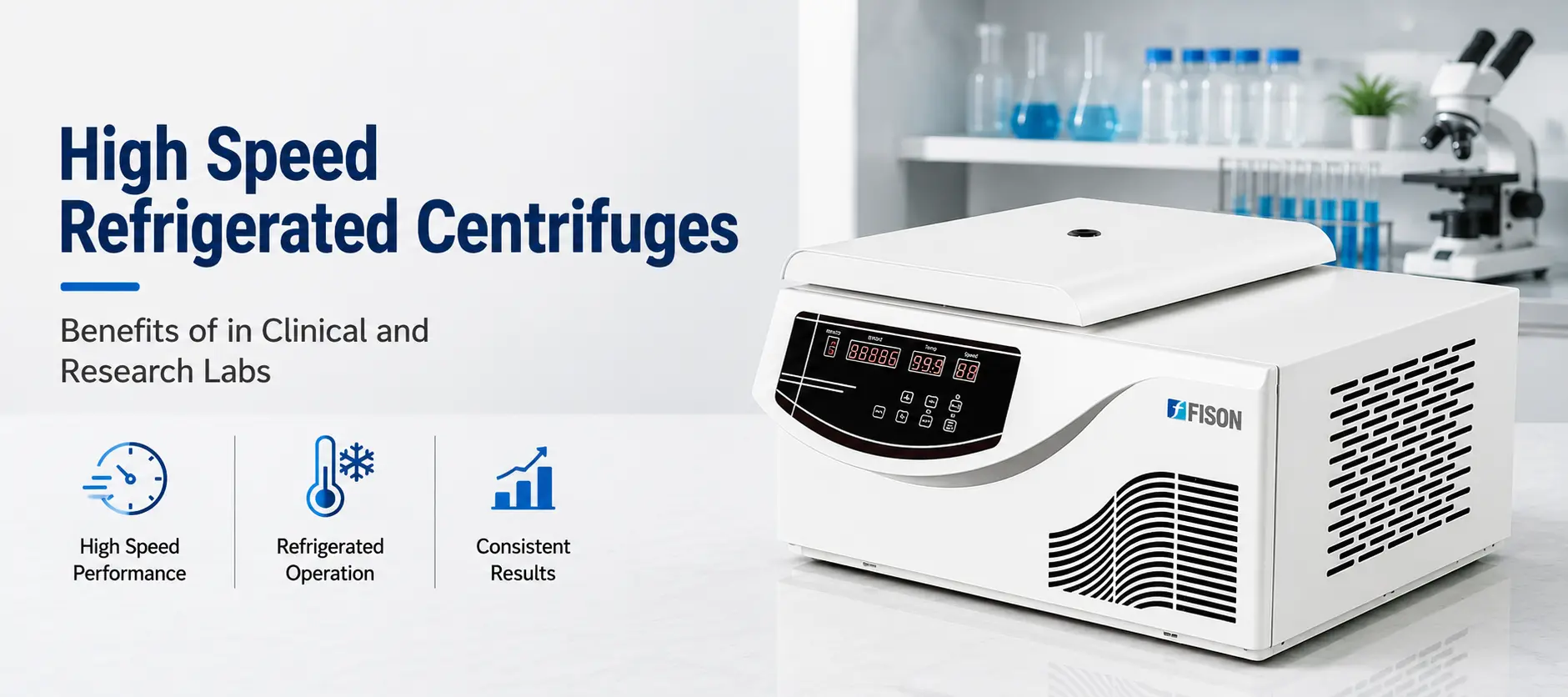
Hospitals, laboratories, research centres and advanced facilities that work with blood components, nucleic acids or heat-sensitive proteins need a way to spin samples fast without letting friction warm them past a safe point, and that balance is exactly what a Fison High Speed Refrigerated centrifuge is built to hold. This article looks at how these units work, where they fit into a wider centrifugation setup, and what to check before choosing one.
Why Sample Integrity Depends on Speed and Temperature Together
Spinning a sample at a high speed generates real friction inside the rotor chamber, and that heat can be enough to degrade enzymes, break down platelets or alter a nucleic acid sample before it ever reaches the next step of a workflow. A plain high speed centrifuge without cooling can separate a sample just as quickly, but it offers no way to keep the chamber at a set temperature while that separation happens.
A high speed cooling centrifuge solves this by pairing a compressor-based cooling system with the rotor chamber, holding a set temperature throughout the run rather than letting it climb as speed increases. That combination matters most for temperature-sensitive work, where a few degrees of drift during a long spin can be the difference between a usable sample and one that has to be discarded.
How a High Speed Refrigerated Centrifuge Works: Principle and Cooling Design
At its core, a High Speed Refrigerated Centrifuge spins a rotor loaded with sample tubes fast enough that centrifugal force separates components by density, while a refrigeration unit removes the heat that spinning generates. The relationship between rotational speed and the force actually applied to a sample is not one-to-one: a high speed centrifuge rpm reading only tells part of the story, since the same rpm value produces a different relative centrifugal force depending on rotor radius.
Load Rotor
Set Speed & Temperature
Cooled Spin Cycle
Separated Sample
Understanding centrifuge machine speed settings alongside rotor size, rather than looking at rpm alone, is what lets a lab reproduce a published separation protocol accurately on a different instrument.
Micro and Full-Size Refrigerated Centrifuges: Matching Rotor Capacity to Sample Volume
A refrigerated micro centrifuge is built around small-volume tubes, typically well under two millilitres, and suits work like nucleic acid preparation or small-scale enzyme assays where sample volume is limited from the start. A micro High Speed Refrigerated Centrifuge can often reach very high relative centrifugal force values precisely because its rotor radius and tube size are small.
A full-size refrigerated centrifuge, by contrast, accepts larger tube or bottle rotors and suits blood component separation or bulk sample processing where volume matters more than reaching the highest possible force. Facilities deciding between these formats can compare rotor options, capacity and cooling range on the High Speed Refrigerated Centrifuge category page before settling on a configuration.
Where the High Speed Refrigerated Centrifuge Fits in the Wider Centrifugation Equipment Category
A High Speed Refrigerated Centrifuge sits within a broader group of centrifugation equipment that also includes non-refrigerated benchtop centrifuges, microcentrifuges and larger floor-standing units. Within this group, facilities typically compare maximum rotational speed and relative centrifugal force, rotor types such as fixed-angle versus swinging bucket, temperature range and stability, noise and vibration at full speed, and the containment features available for samples that need extra handling care.
Reviewing the full High Speed Refrigerated Centrifuge range is a practical starting point for lining up these factors before narrowing a shortlist.
For facilities exploring centrifugation equipment beyond this single category, the Fison home page lists the wider catalogue of laboratory and hospital equipment the brand carries.
High Speed Refrigerated Centrifuge Laboratory Uses Across Hospitals and Research Centres
A High Speed Refrigerated Centrifuge laboratory setup tends to support more workflows than any single department might expect once the equipment is shared across teams.
Hospital laboratories use these units for blood component separation, isolating plasma and platelets for transfusion or diagnostic testing where sample temperature affects how usable the result is. Research laboratories rely on the same equipment for nucleic acid extraction, protein pelleting and subcellular fractionation, all of which depend on tight temperature control during a spin. Advanced labs running many samples a day often pair the centrifuge with plate rotors so a full batch of well plates can be processed in a single cooled run instead of several smaller ones.
Selection Mistakes to Watch For When Choosing a High Speed Refrigerated Centrifuge Machine
A handful of recurring missteps show up during evaluation, and most only become clear once the unit is already in routine use:
- Comparing rpm without checking relative centrifugal force. Two centrifuges with the same rpm rating can apply very different forces to a sample if their rotor radii differ, so rpm alone is not a fair comparison point.
- Overlooking rotor capacity for actual sample counts. A high speed centrifuge machine sized for occasional small batches can become a bottleneck once daily sample volume grows.
- Ignoring noise and vibration at full speed. A unit installed in a shared lab space can disrupt nearby work if vibration and noise were not checked during a full-speed run.
- Underestimating cooling recovery time. Some units take longer to return to a set temperature between back-to-back runs, which matters in labs processing samples continuously through a shift.
- Skipping containment needs for the sample type. A High Speed Refrigerated Centrifuge machine handling samples that could aerosolize needs sealed rotors or buckets, and this requirement is easy to overlook during an initial evaluation.
High Speed and General-Purpose Centrifuges: A Quick Comparison
Some labs still rely on a general-purpose benchtop centrifuge without refrigeration for routine, non-temperature-sensitive spins. The table below outlines where each approach tends to fit.
| Aspect | General-Purpose Centrifuge | High Speed Refrigerated Centrifuge |
|---|---|---|
| Maximum relative centrifugal force | Lower, suited to routine spins | Higher, suited to high-force protocols |
| Temperature control | Not typically available | Held at a set point through the run |
| Sample types supported | Non-temperature-sensitive samples | Blood components, proteins, nucleic acids |
| Typical setting | General lab spins and quick preps | Clinical labs and temperature-sensitive research work |
Ready to Compare High Speed Refrigerated Centrifuge Options?
Rotor capacity, maximum force and cooling range differ meaningfully between models, and reviewing them together helps match a unit to actual sample workflow rather than a rough estimate.
View High Speed Refrigerated Centrifuge Options