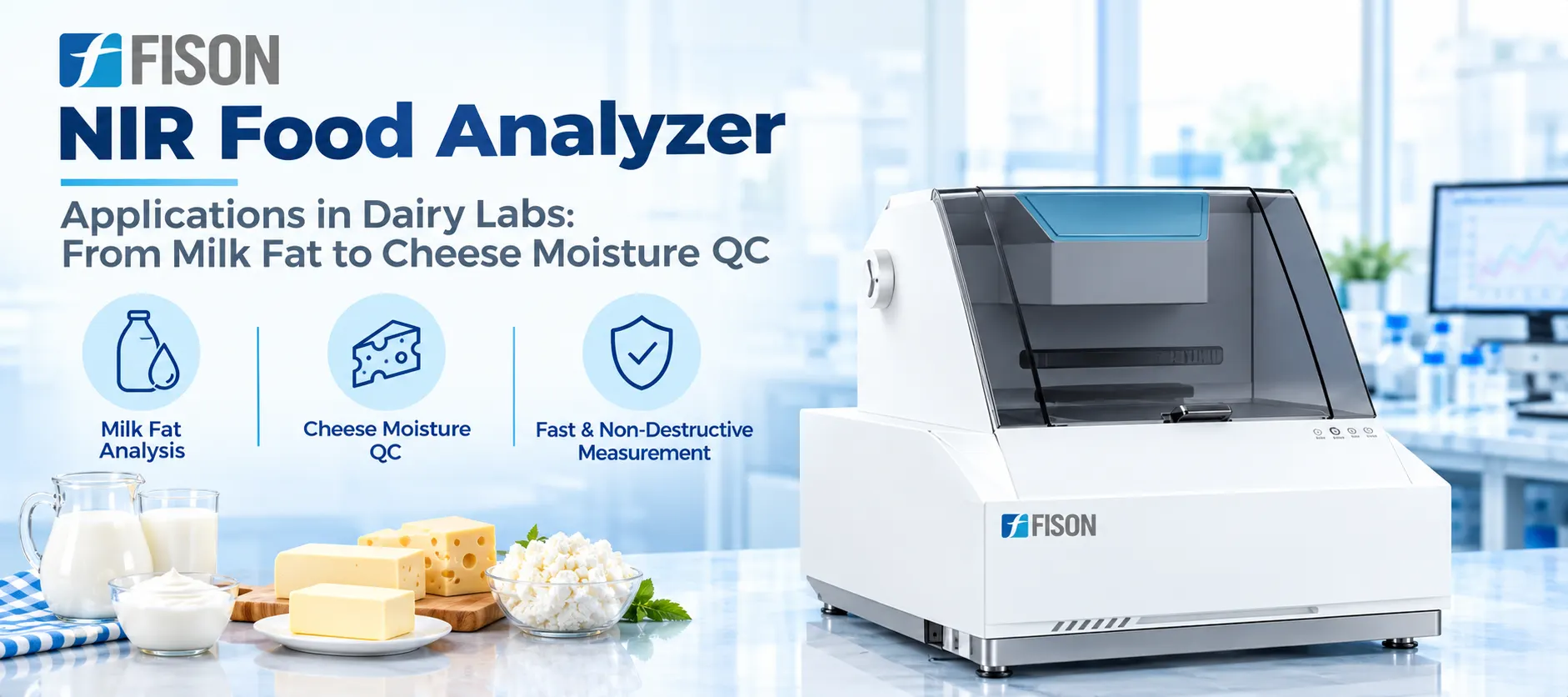
Introduction
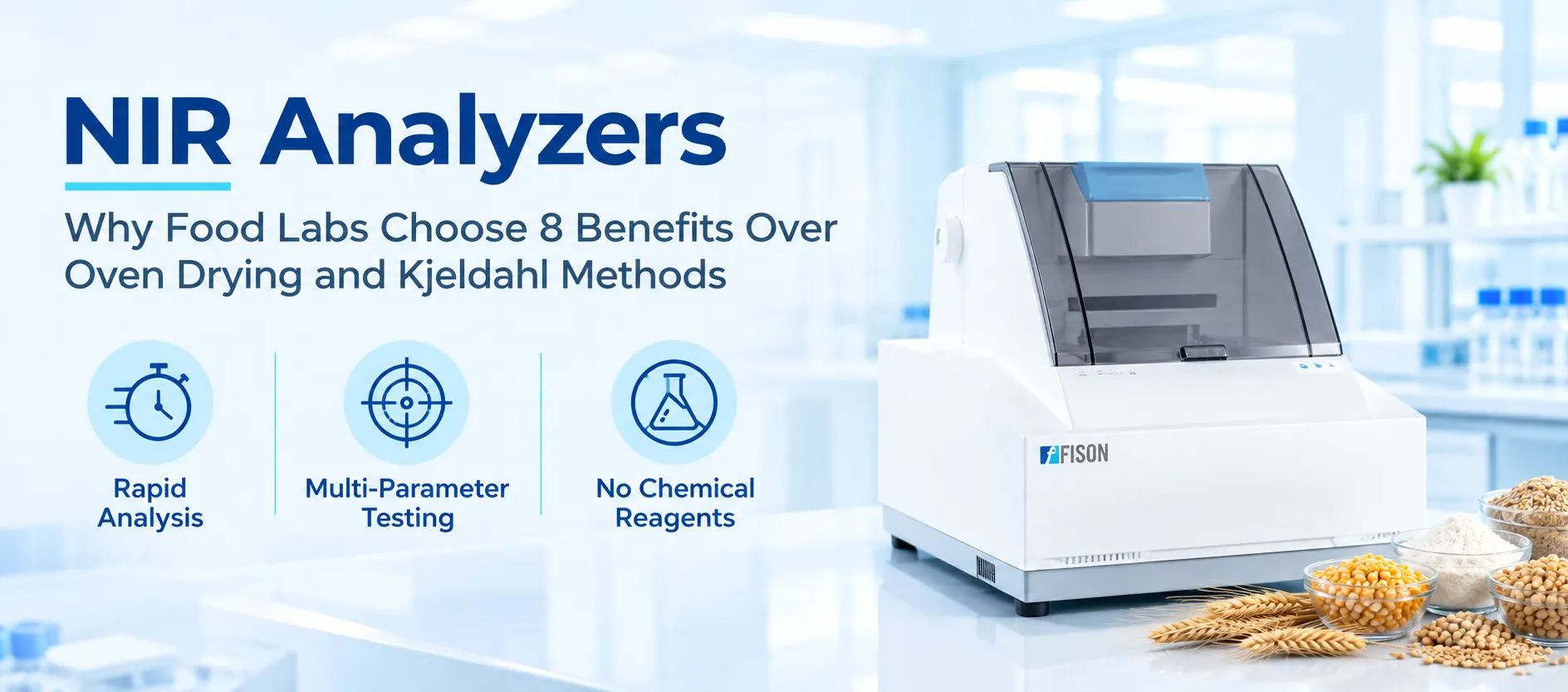
Milk fat, protein and cheese moisture shift daily in a dairy process. This article explains how a Fison NIR-IR-Food Analyzer works, where dairy laboratories, hospital laboratories and research centres apply a near infrared analyzer, and which choices most often lead to poor results.
Why Dairy Labs Turn to Near-Infrared Testing
Milk fat, protein and moisture in cheese all shift with the season, the herd and the process line, and a dairy lab cannot wait hours for a wet-chemistry result on each batch. Composition drifts from one day to the next, so testing needs to keep pace with production rather than trail behind it.
A NIR-IR-Food Analyzer answers that need by reading a sample's near-infrared spectrum and converting it into moisture, fat and protein values within seconds. Laboratories, hospital laboratories, research centres and advanced labs use this NIR Analyzer speed to release batches, adjust standardisation and catch drift before it reaches a finished product. A near infrared analyzer of this kind fits routine work in any laboratory that tests dairy samples daily.
NIR Analyzer Working Principle
A near infrared analyzer, and specifically the NIR-IR-Food Analyzer discussed in this article, works by diffuse reflectance. Light from a source, typically a tungsten halogen lamp, strikes the sample surface, and the light that scatters back is captured by a detector across a range of wavelengths. Different chemical bonds, such as those in water, fat and protein, absorb light at characteristic points in the near-infrared range.
Software compares the resulting spectrum against calibration models built from reference samples, and reports the result as a percentage for each component. Because the measurement reads the sample as it is, this type of NIR Analyzer needs little preparation and returns a result without solvents or reagents, which suits dairy laboratories running many samples across a shift. An set up this way also suits hospital laboratories testing nutrition samples.
Inside the NIR-IR-Food Analyzer Product
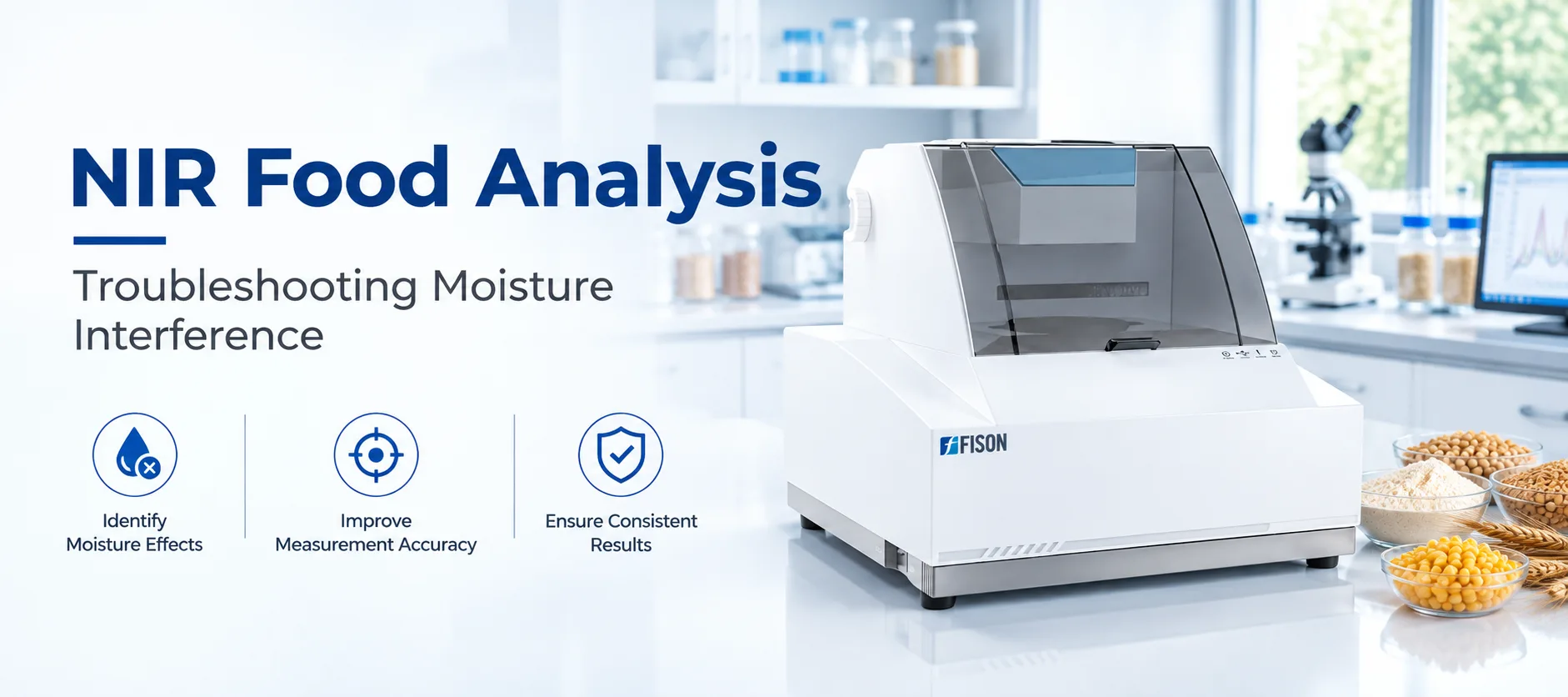
The NIR-IR-Food Analyzer product from Fison is a nir - food analyzer product built around diffuse reflectance measurement. The same NIR-IR-Food Analyzer is also referenced as a nir- food analyzer machine and a nir - food analyzer dgital unit in some distributor listings, and each name points to the same near infrared analyzer. Whether a laboratory calls it a nir- food analyzer machine or a nir - food analyzer dgital unit, the underlying nir - food analyzer product stays the same. Distributor listings citing this model describe a 1000 to 1800 nm spectral range, a sample volume of 50 to 150 ml across three cup types, and an analysis time of around 6 to 10 seconds per sample, figures typical of a nir - food analyzer product in this class.
The same listings note a tungsten halogen light source rated beyond 5000 hours, a cooled InGaAs detector, a USB interface, an ambient operating range of 5 to 35°C, and 198 to 242 V power at 50 Hz, details that separate one nir- food analyzer machine from another. As these figures come from a distributor page rather than Fison's own specification table for the NIR-IR-Food Analyzer, a laboratory should confirm exact figures directly with Fison before ordering this nir - food analyzer dgital unit.
From Milk Fat to Cheese Moisture: Dairy Applications
Dairy composition testing spans the whole process, from raw intake to finished product, and a nir food analyzer for food quality testing fits at several of these points, wherever a laboratory needs an NIR analyzer reading quickly. A laboratory looking for a nir food analyzer for food quality testing can review the Fison food analyzer range against the dairy parameters it needs to cover.
Raw Milk Fat and Protein
Fat and protein readings from a nir food testing analyzer for quality control support payment testing and standardisation on incoming milk before processing.
Cheese Moisture QC
Moisture content in cheese affects texture and yield, so a nir food analyzer for food quality testing checks it at several points during ripening.
Yoghurt and Cream Composition
Fat content in cream and yoghurt is tracked with an NIR analyzer to keep recipes consistent between batches.
Milk Powder Testing
A nir food testing analyzer for quality control checks moisture and protein in milk powder after drying, to confirm the product meets its label claim.
Animal Feed and Grain
The same near infrared analyzer principle applies to protein and moisture testing in feed and grain samples on a nir analyzer.
Pharmaceutical and Research Use
Research centres and hospital laboratories apply near infrared analyzer methods to composition checks beyond food, including pharmaceutical raw materials and nutrition testing.
Building Calibration Models That Hold Up
An NIR analyzer is only as accurate as its calibration model. A model built from milk is not automatically valid for cheese on the same NIR-IR-Food Analyzer, since the two matrices scatter light differently, so each product category needs its own set of reference samples measured by a primary method.
Recalibration matters on any near infrared analyzer when a formulation, a milk source or a processing step changes, because a model trained on one set of conditions can drift when the underlying material shifts. A dairy lab that reviews its calibration set periodically keeps its NIR-IR-Food Analyzer, used as a nir food testing analyzer for quality control, aligned with what it actually measures.
NIR Compared with Reference Wet-Chemistry Methods
Near infrared results from an NIR-IR-Food Analyzer are usually checked against a slower reference method during calibration, and the two approaches serve different stages of a testing programme.
| Aspect | NIR-IR-Food Analyzer | Wet-chemistry reference method |
|---|---|---|
| Result time | Seconds per sample | Minutes to hours, depending on the method |
| Sample handling | Minimal preparation, no reagents | Extraction, digestion or titration steps |
| Role in the lab | Routine screening and batch release | Calibration and periodic verification |
Common Selection Mistakes
Choosing among nir - food analyzer machine and NIR-IR-Food Analyzer options is often decided on wavelength range alone. These patterns cause the most rework once an analyzer is in daily use.
- Skipping matrix-specific calibration on the NIR-IR-Food Analyzer. A calibration built for one product does not transfer cleanly to another without its own reference set.
- Overlooking sample presentation on a nir- food analyzer machine. Cup type, fill level and sample temperature can all shift a reading if they are not kept consistent.
- Ignoring service and support for updates. Calibration models need periodic review, so ongoing support matters as much as the initial purchase.
- Comparing wavelength range on a nir - food analyzer product without context. A wider range helps only if the calibration models actually use it for the components being measured.
- Underestimating training needs for staff running a NIR-IR-Food Analyzer. Staff need to understand what a spectrum represents to judge whether a result looks reasonable.
Exploring the Wider Food Analyzer Category
The NIR-IR-Food Analyzer sits within Fison's broader food analyzer category, which covers a near infrared analyzer and other instruments for moisture, fat, protein and nutrient testing across food and dairy products. Laboratories evaluating this category typically compare spectral range, sample throughput, calibration support and the range of food matrices each instrument covers.
The full range of NIR-IR-Food Analyzer and near infrared analyzer models within this category is available on the Fison food analyzer category page, and the wider laboratory equipment portfolio can be reached through the Fison home page.