What a Vertical Autoclave Actually Does
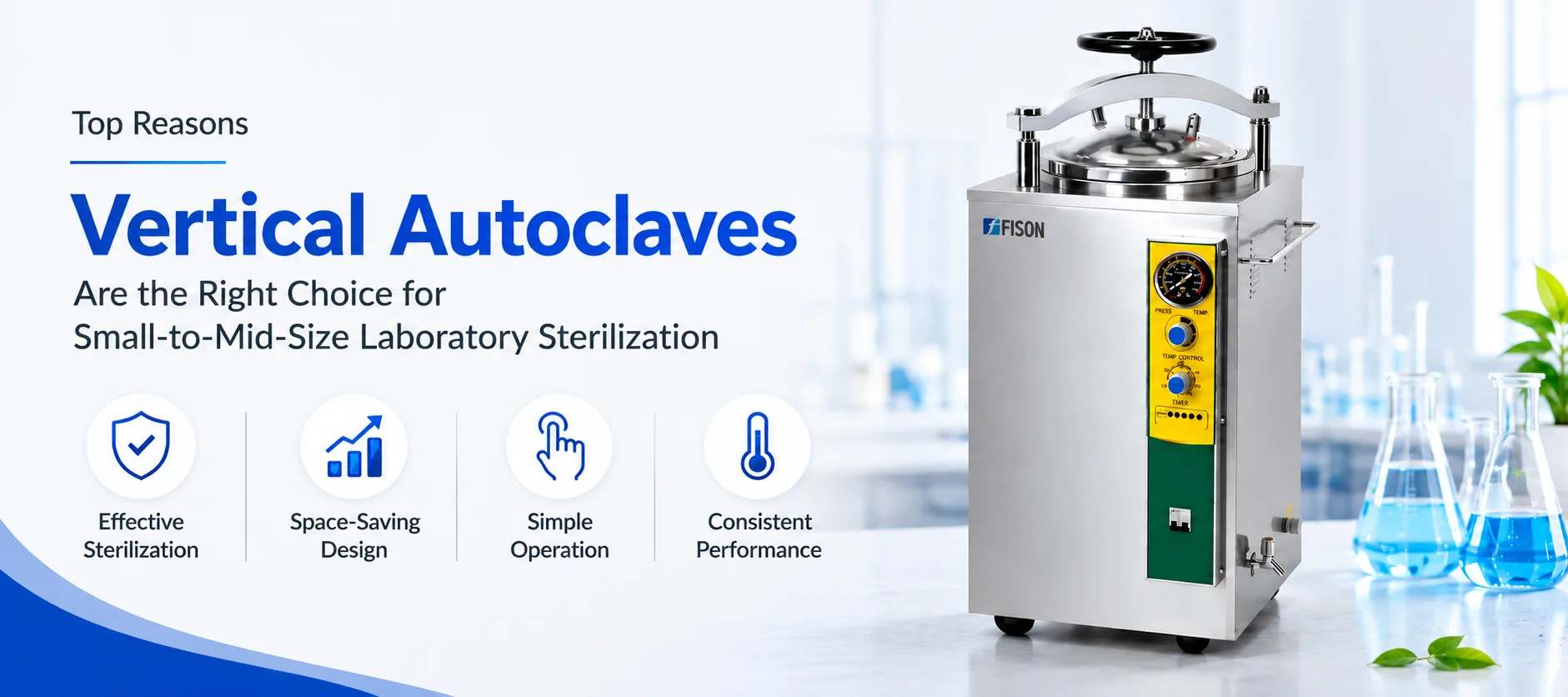
A Fison Vertical Autoclave uses pressurized steam to bring glassware, media, instruments, and waste up to a temperature and hold time that inactivates microorganisms. The chamber sits upright rather than on its side, which lets a facility with a limited footprint place the unit against a wall or in a corner without giving up floor space that a horizontal chamber would otherwise need.
Because the chamber loads from the top, staff lower baskets straight down instead of sliding trays in and out horizontally. For labs handling glassware, pipette tips, or wrapped instrument sets, this loading style reduces the chance of items shifting mid-cycle and simplifies stacking multiple baskets in a single run.
Top-loading steam chamber diagram placeholder
How Pressure and Cycle Timing Work Together
Steam sterilization depends on three variables moving in tandem: chamber pressure, temperature, and exposure time. Raising the Vertical Autoclave pressure lets steam reach a higher temperature within the sealed chamber, and it is this combination of heat and moisture, not pressure alone, that denatures proteins in microbial cells.
Pressure Build-Up
Sealed chamber raises internal pressure ahead of the hold phase.
Temperature Hold
Chamber sustains a set temperature for the sterilization phase.
Exhaust & Drying
Controlled release brings the chamber back to atmospheric pressure.
Cycle programs typically differ for liquids, wrapped goods, and waste, since each load type releases steam and cools at a different rate. A program built for glass media bottles that is applied to a dense waste bag can leave the load under-processed, which is why cycle selection matters as much as the pressure setting itself.
Where Vertical Sterilizers Fit in Daily Lab Work
An automatic Vertical Autoclave is common in settings that need repeatable sterilization without dedicating a technician to monitor each cycle manually. Programmable cycles, automatic water fill, and door interlocks reduce the number of manual steps between loading and unloading.
Hospital Central Supply
Reprocessing of instrument trays and linen packs between procedures, where a compact footprint matters in a shared utility room.
Research Centre Media Prep
Sterilizing culture media, buffers, and glassware ahead of daily bench work in microbiology and cell culture areas.
Advanced Labs & QC Areas
Decontaminating waste and instruments as part of a routine that sits alongside other bench-scale equipment.
General Laboratory Use
Routine sterilization of pipette tips, containers, and small instrument sets between test batches.
Sizing a Chamber to Actual Workload
The capacity of a Vertical Autoclave is usually the first spec a lab checks, and it is easy to size a chamber around occasional peak loads rather than the volume that passes through on a typical day. An autoclave vertical 100 litres chamber, for example, suits a lab running several baskets of glassware or media bottles a day, while a smaller chamber may sit underused in that same setting or force more cycles to clear the same workload.
Vertical Autoclave capacity is also shaped by how the load is packed. Tall narrow bottles stack differently than flat instrument trays, so two labs quoting the same litre figure can end up loading a noticeably different number of items per run. Walking through a typical day's load list before comparing chamber sizes avoids resizing the purchase later.
Selection Mistakes Worth Avoiding
A few recurring missteps show up when labs move from evaluating Vertical Autoclave options to placing an order:
- Sizing on floor space alone — a compact footprint is a genuine advantage, but chamber volume and daily throughput still need to line up with actual load frequency.
- Overlooking utility requirements — water supply, drainage, and electrical load for an automatic cycle are easy to underestimate until installation day.
- Ignoring cycle variety — a lab that runs both liquids and wrapped goods needs distinct programs, not a single generic cycle stretched across all load types.
- Skipping door and interlock checks — safety interlocks and door seal design affect daily handling more than most spec sheets suggest.
- Treating pressure rating as the only differentiator — Vertical Autoclave pressure ratings matter, but recovery time between cycles often has a larger effect on daily throughput.
Vertical Sterilizers Within the Wider Autoclave Category
Vertical sterilizer autoclave units sit within a broader category of steam sterilization equipment that also includes horizontal and tabletop formats, each suited to a different combination of floor space, batch size, and load type. When evaluating options within this category, labs typically compare chamber orientation, usable capacity, control interface, and how each format handles mixed loads of liquids, wrapped goods, and waste. The full range of sterilization equipment on offer can be reviewed on the Autoclave and sterilization equipment category page, alongside broader instrumentation listed on the Fison home page.
Vertical Format Versus Other Autoclave Layouts
| Factor | Vertical Format | Horizontal Format |
|---|---|---|
| Floor footprint | Smaller footprint, upright chamber | Larger footprint, side-loading chamber |
| Typical setting | Small-to-mid-size labs, hospital utility rooms | Central sterile services, high-volume facilities |
| Loading style | Top-loading baskets | Front or side-loading trays and carts |
| Batch size | Moderate, several baskets per cycle | Larger, cart-based batch loads |
Neither layout replaces the other outright; the choice comes down to available floor space, daily batch volume, and how loads are packed. A lab replacing an aging horizontal unit with a vertical model, for instance, often gains usable bench space without giving up cycle programming options, provided the new chamber's capacity is checked against actual daily throughput. Cycle logs, common with an automatic Vertical Autoclave machine, are also worth reviewing during that comparison since they show real recovery time between runs rather than a published average, and browsing specification sheets on the sterilization equipment listing beforehand makes that side-by-side comparison easier.
Maintenance Habits That Extend Chamber Life
Door gaskets, water reservoirs, and drain lines are the parts that wear fastest on any steam sterilizer, vertical or otherwise. Wiping down the gasket after each cycle and flushing the reservoir on a set schedule prevents mineral build-up that otherwise slows heat-up time and shortens gasket life. Logging cycle counts alongside routine checks also makes it easier to catch a slow pressure ramp before it turns into a failed run and a delayed batch.