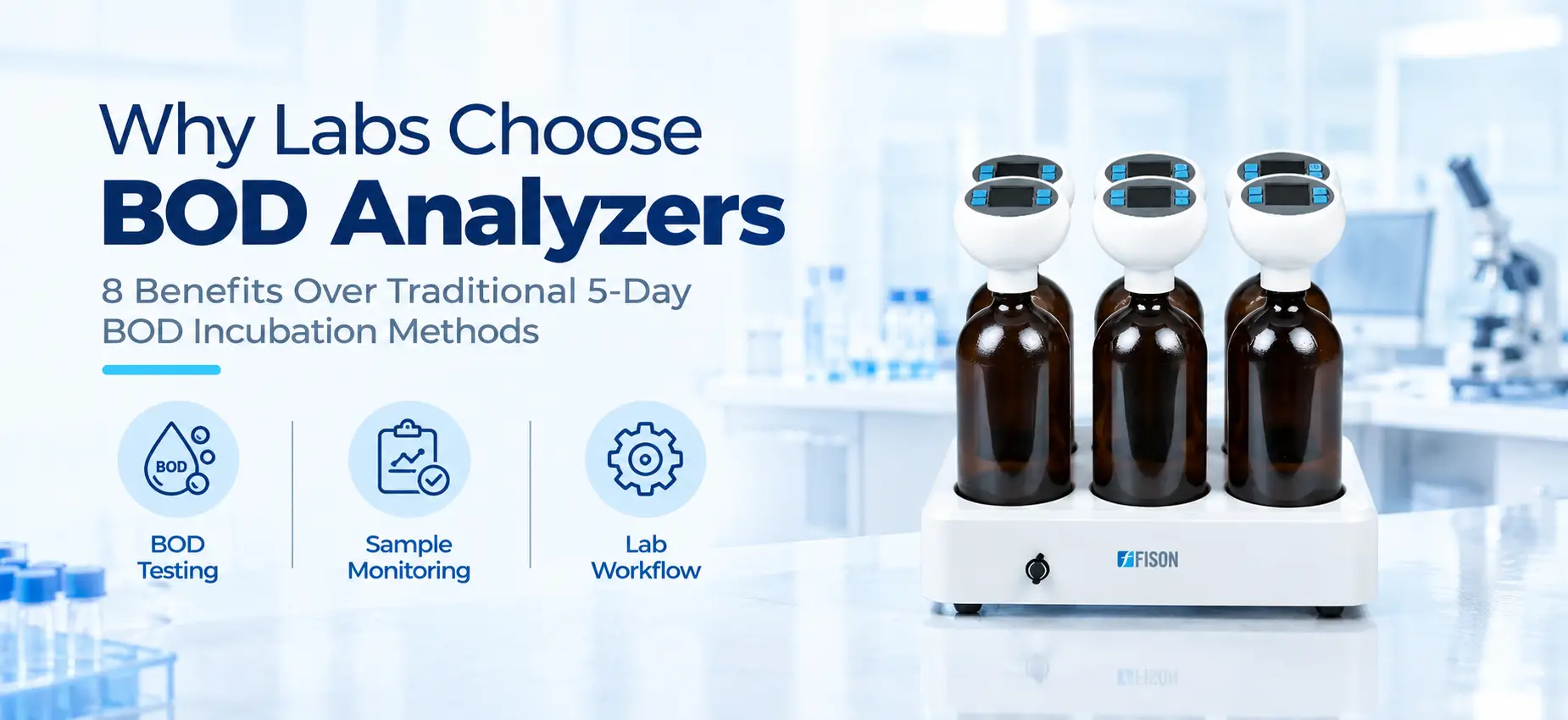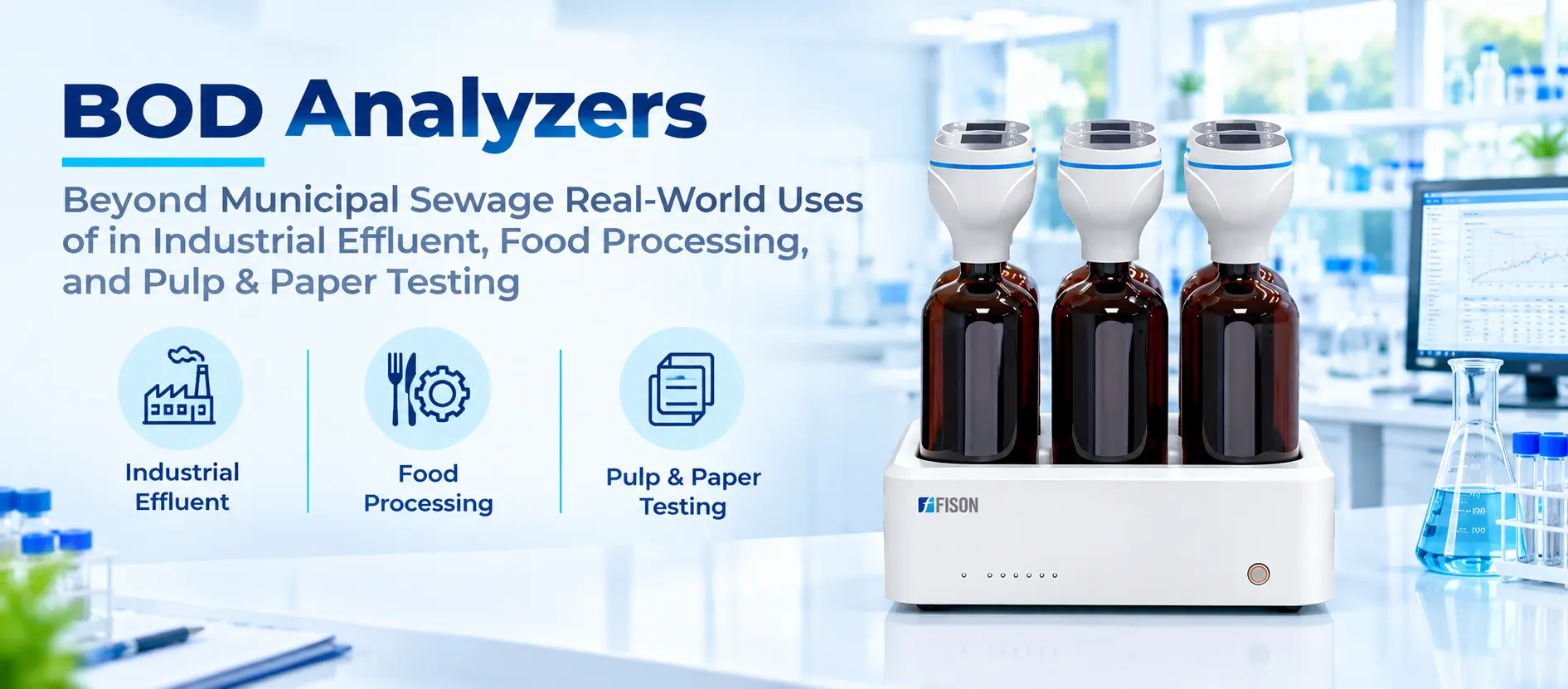
Biochemical oxygen demand shows how much organic matter in water can be broken down by microbes. This explains how a Fison BOD Analyzer works, where it is used beyond municipal sewage, and what to check before choosing one.
What Biochemical Oxygen Demand Measures
When organic matter enters water, microbes consume dissolved oxygen as they break it down. Biochemical oxygen demand (BOD) expresses how much oxygen that process uses, so a high value signals a heavy organic load. BOD Analysis is a core water quality test at wastewater treatment plants, effluent treatment plants, and environmental monitoring labs.
A BOD Analyzer carries out this measurement automatically. Rather than measuring dissolved oxygen by hand at the start and end of a test, the BOD Analyzer tracks oxygen use throughout incubation and displays the BOD concentration directly. That makes BOD monitoring practical for labs handling samples from many different sources, not only municipal sewage.
How Pressure Difference Reveals Oxygen Demand
The BOD Analyzer working principle uses a mercury-free pressure difference method. Each sample sits in a sealed bottle with air above the liquid. As microbes consume oxygen, the carbon dioxide they release is captured inside the bottle, so the gas pressure in the space above the sample falls. A pressure sensor in the cap records that drop, and the BOD Analyzer converts it into a BOD value in milligrams per liter.
Pressure Sensing
The sensor follows the pressure change throughout incubation, so the BOD Analyzer shows real-time readings instead of a single result at the end of the test.
Magnetic Stirring
In a BOD Analyzer, program-controlled magnetic stirring keeps each sample evenly mixed for uniform sample distribution throughout the test.
Incubation runs at a controlled temperature, and test length can be set anywhere from one day up to thirty days. This flexibility lets one automated BOD Analyzer handle the familiar five-day BOD analysis method as well as shorter or longer studies.
What Automation Brings to BOD Testing
Compared with manual dissolved oxygen readings or a basic BOD test kit, a BOD automated Analyzer changes daily lab work in these ways.
Six Independent Channels
Each BOD Analyzer channel runs its own test, so different samples can start and finish separately.
Wide Direct Range
Direct measurement across a wide concentration range lets high-strength samples be read straight from the analyzer.
Mercury-Free Method
The pressure difference method works without mercury, keeping the lab free of that hazard.
Real-Time Display
A high-definition LCD screen on the BOD Analyzer shows progress during incubation, not only at the end.
Flexible Test Length
Tests can run from one day up to thirty days to suit routine checks or longer studies.
Long-Term Storage
Depending on the model, a BOD Analyzer stores years of test data or a set of records per test cap.
USB Data Transfer
A BOD Analyzer base with multiple USB ports moves results to a computer without retyping.
Long Battery Life
A battery life measured in years supports long incubations without frequent changes.
BOD Analyzer Machine Uses Beyond Municipal Sewage
BOD Analyzer machine uses reach well past municipal sewage. Any site that sends organic wastewater to an effluent treatment plant (ETP) relies on BOD monitoring to see how heavy that load is.
Industrial Effluent
Effluent treatment plant samples from industrial sites are tested with a BOD Analyzer to measure their organic load.
Food Processing Wastewater
Food processing plants send organic-rich wastewater to their effluent treatment plant, where BOD analysis shows how much organic matter remains.
Pulp and Paper Effluent
Pulp and paper mills treat process water containing organic material, and BOD monitoring of effluent samples shows how treatment is performing.
Environmental and Research Labs
Environmental monitoring agencies and research institutions use a BOD Analyzer to assess water quality in field and study samples.
Wastewater treatment plants remain the most familiar setting, yet the same BOD Analyzer serves industrial effluent, environmental monitoring, and research work. The range of BOD analyzers shows how channel count, data storage, and other features differ between models.
Manual BOD Testing and Automated Analysis Compared
| Factor | Manual Dissolved Oxygen Method | Automated BOD Analyzer |
|---|---|---|
| How BOD is found | Oxygen measured at start and end | Pressure change tracked throughout |
| Readings during test | None until the end | Real-time display |
| Sample dilution | Several dilutions often needed | Wide direct reading range |
| Mixing | Manual | Program-controlled magnetic stirring |
| Result recording | Handwritten | Stored and transferred via USB |
Common Selection Mistakes to Avoid
Underestimating Channel Needs
Six independent channels suit many labs, but sites testing several effluent streams at once should match channel count to their sample load.
Overlooking Incubation Temperature
BOD results depend on a steady incubation temperature. Plan how the BOD Analyzer bottles will be held at the controlled temperature throughout the test.
Ignoring Sample Strength
High-strength industrial effluent can exceed narrow ranges. A wide direct reading range lets these samples be measured directly.
Assuming All Models Store Data Alike
One BOD Analyzer may store years of data on the instrument, while another keeps a set of records in each test cap. Match storage to your reporting needs.
Exploring the BOD Analyzer Category
BOD analyzers belong to a wider group of water testing instruments that also includes TOC analyzers and turbidity meters. Labs comparing BOD options usually weigh measuring principle, number of channels, direct reading range, incubation time settings, data storage, and connectivity.
Whether you test municipal sewage, industrial effluent, or research samples, you can review the full BOD Analyzer lineup to compare models, or browse other laboratory instruments on the Fison home page.
Review Automated BOD Testing in Detail
Compare channels, test length, and data storage across BOD analyzers.
Explore BOD Analyzers