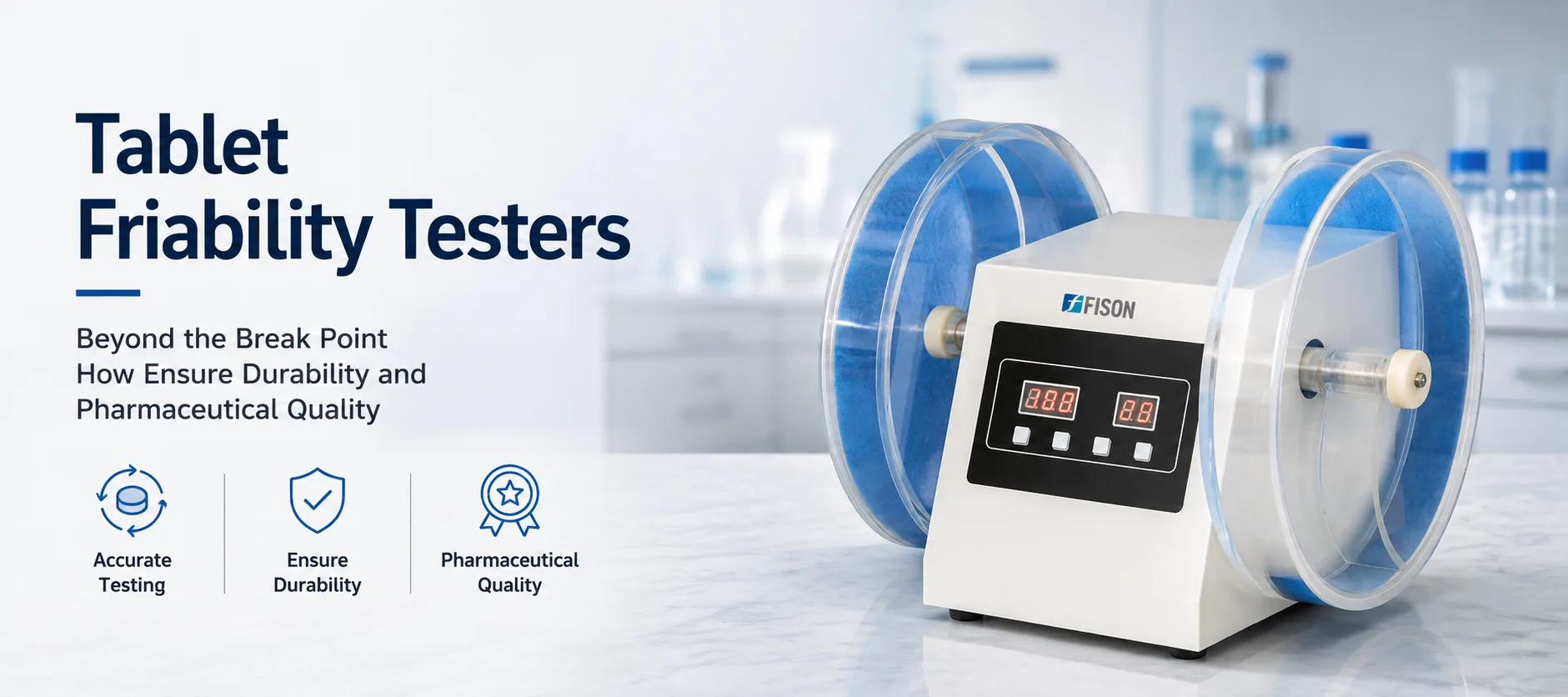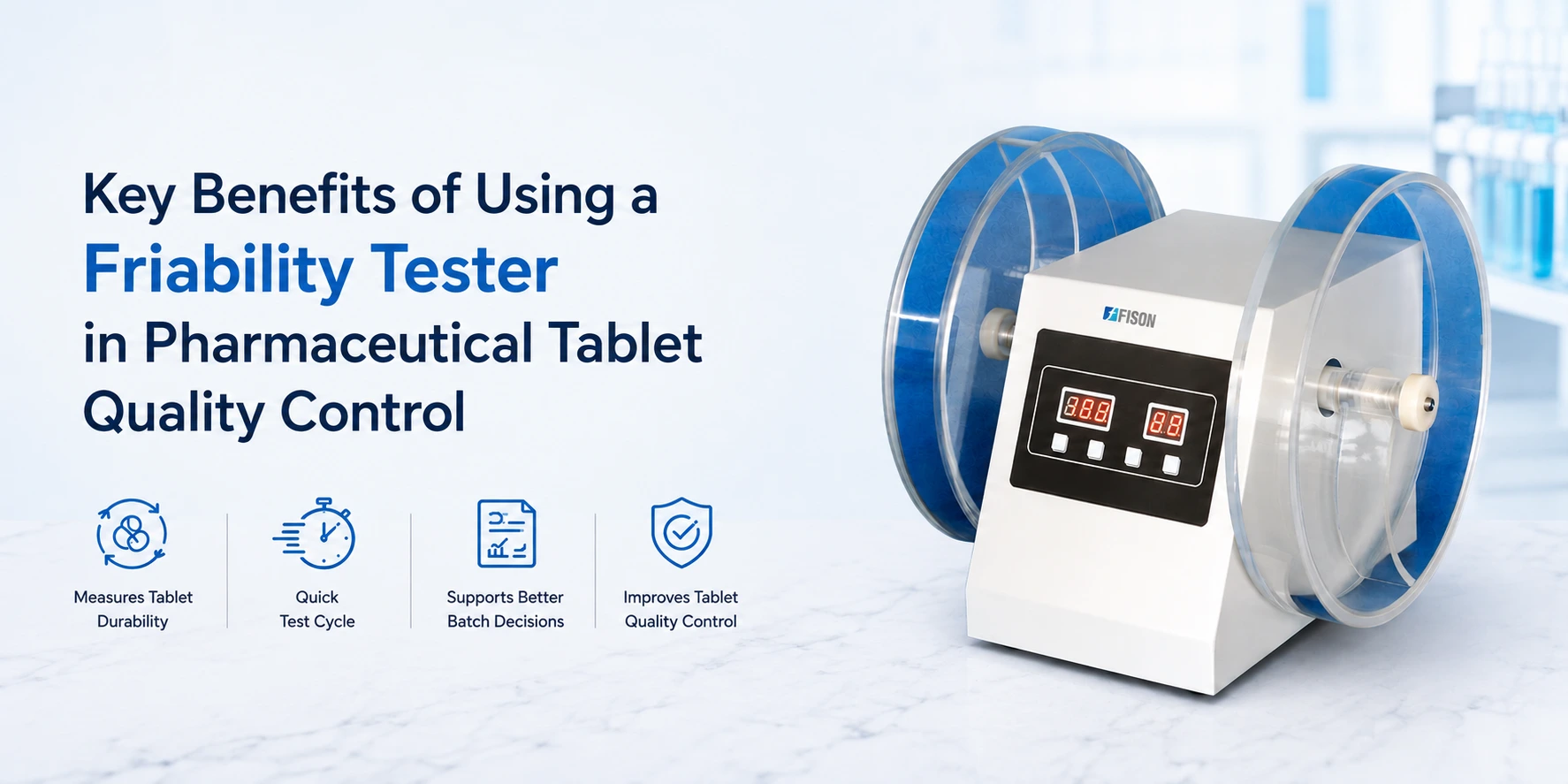
A professional look at how a Fison Friability Tester measures tablet durability through controlled tumbling, the benefits this test brings to tablet quality work, and the factors that matter for laboratories, hospitals, research centres, and advanced labs.
How a Friability Test Apparatus Works
A Tablet Friability Tester places a weighed sample of dedusted tablets inside a rotating drum fitted with an internal baffle. As the drum turns, tablets repeatedly lift and drop, subjecting them to the kind of abrasion and light impact they would experience during handling, packaging, and transport.
After a set number of rotations, the tablets are removed, dedusted again, and reweighed. The friability test equation compares starting and final weight, expressing the difference as a percentage weight loss. A lower percentage points to a more durable tablet, while a higher figure signals a formulation or compression issue that may show up later as chipping, capping, or excess dust during real-world handling.
Weight loss after controlled tumbling is converted into a friability percentage.
Where This Equipment Fits in Tablet Testing
A Friability Test apparatus belongs to a wider category of pharmaceutical tablet testing equipment that also includes hardness testers, disintegration testers, and dissolution testers, each examining a different physical property relevant to how a tablet performs. Facilities comparing options in this category typically weigh drum capacity, rotation speed accuracy, ease of cleaning between batches, and whether a unit supports single or dual-drum testing.
Fison lists its full range of tablet testing instruments on its Tablet Friability Tester category page, where individual models can be reviewed side by side. Readers exploring the wider catalog beyond this category can also start from the Fison home page for an overview of the other laboratory equipment lines the company carries.
Key Benefits for Tablet Quality Control
Teams comparing drum capacity and rotation control on the Tablet Friability Tester product listing will find these benefits apply across most models used in daily quality control work.
Predicts Real-World Handling Durability
A Friability Test uses controlled tumbling to approximate what tablets experience during packaging lines, transport, and dispensing, giving an early signal of how well a batch will hold up before it reaches a pharmacy shelf.
Fast and Straightforward to Run
A typical Friability Test apparatus completes a run in a matter of minutes, making it practical to check multiple batches or formulation variants within a single working session.
Supports Formulation Comparison
During development, running the same Friability test device across different binder or compression settings helps a formulation team see which combination produces the most durable tablet before scaling up production.
Gives an Objective, Quantifiable Result
Because the Friability Test equation is based on a simple before-and-after weight comparison, results are easy to record, compare across batches, and track over time without relying on subjective visual judgment alone.
Non-Destructive to the Wider Batch
Only a small sample is drawn for Friability apparatus testing, leaving the remainder of the production batch untouched and available for other quality checks or release.
Helps Catch Issues Early in Production
A Friability Tester flags tablets prone to chipping or capping before they move further down the line, giving a production team an earlier opportunity to adjust settings than waiting for complaints after packaging.