Introduction
A practical look at how a Fison TOC Analyzer supports water quality work in electronics, power generation and environmental testing, with the TOC analyzer working principle, laboratory workflow and selection points explained.
Why Organic Carbon Deserves Attention
Water can look clear and still carry dissolved organic matter. Rather than testing each compound separately, laboratories use total organic carbon as a bulk indicator, and TOC Analyzers report it as a single value. This makes TOC measurement a practical first check in water analysis, with clear trends and easy comparison between samples.
A total organic carbon analyzer is sometimes called a TOC meter, but a TOC Analyzer instrument does more than display a number: it prepares the sample, converts organic carbon into a measurable gas and calculates the result. Fison describes its TOC analyzers as tools for measuring total organic carbon levels in water for both offline and online monitoring, so the same TOC analysis suits laboratory benches and process lines.
From Sample to Signal: How Measurement Works
The TOC Analyzer working principle follows three stages. First, organic carbon is oxidized to carbon dioxide. Second, a detector measures the carbon dioxide released. Third, the instrument converts that signal into a concentration, usually in mg/L. Understanding the TOC Analyzer working principle helps a laboratory judge how a TOC Analyzer will behave with its own samples.
Because the result depends on sample preparation, careful TOC analysis relies on clean vials, blank readings and consistent handling as much as on the detector. Good TOC measurement starts before the sample reaches the TOC Analyzer equipment.
1. Oxidation
Organic carbon in the sample is converted to carbon dioxide.
2. Detection
A detector measures the carbon dioxide released from the sample.
3. Calculation
The signal is converted into a carbon concentration for the sample.
Illustrative diagram placeholder: the TOC Analyzer working principle in three stages.
Three Settings Where Results Drive Decisions
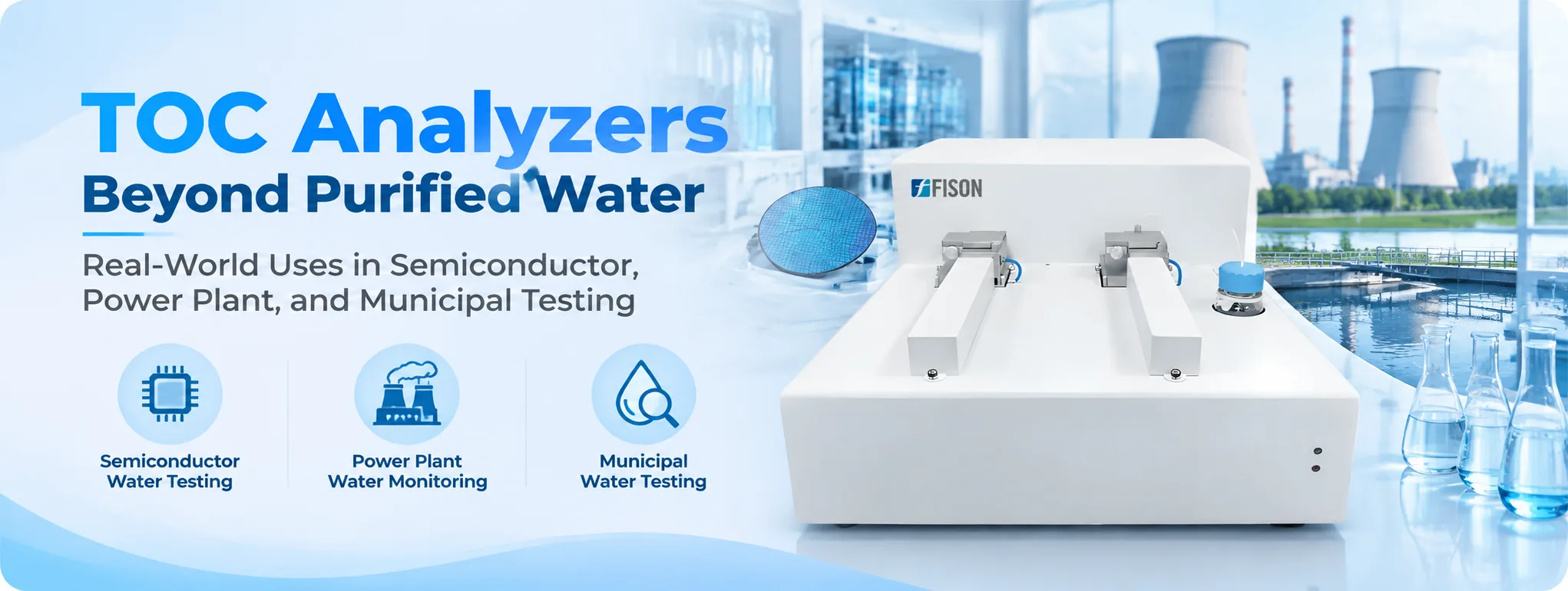
The main TOC Analyzer uses appear wherever water quality has to be watched. The Fison page names pharmaceuticals, electronics, food and environmental testing. Power generation is included here as a general point, since water monitoring matters in that setting too.
Semiconductor and electronics
Electronics is one of the industries listed for TOC analysis, where water purity is watched closely.
Power plants
Water quality monitoring is a routine task in power generation, and a TOC Analyzer gives a quick view of organic carbon in that water.
Environmental and municipal water
Environmental testing and water quality monitoring use a total organic carbon analyzer to follow organic load in water samples.
Since pharmaceutical and food testing appear on the same list of TOC Analyzer uses, one TOC Analyzer instrument can serve several types of laboratory.

Bringing the Measurement into the Laboratory
In a busy TOC Analyzer laboratory, workflow matters as much as measuring range. Sample bottles, vial cleanliness and blank readings all affect low-level results, and where a TOC Analyzer autosampler is fitted, sequential loading reduces manual handling and keeps run conditions consistent across a batch of samples.
The Fison listing describes offline and online types and mentions solid or suspension liquid samples, with measuring ranges from 0.001 mg/L up to 10,000 mg/L across the models shown. An offline TOC Analyzer suits sample-by-sample work, while an online TOC Analyzer follows a water stream continuously.
| Aspect | Offline format | Online format |
|---|---|---|
| Sampling | Grab samples carried to the laboratory | Continuous flow taken from a process line |
| Typical role | Batch checks, investigation and method work | Round-the-clock monitoring of a water stream |
| Data pattern | One result per prepared sample | A running trend that shows drift early |
| Question answered | What is in this sample? | Is the water changing right now? |
A portable TOC Analyzer is another format worth asking about when checks are needed away from the bench, and a compact TOC meter style unit may also be considered.
Selection Mistakes Worth Avoiding
Laboratories reviewing TOC Analyzer equipment often meet the same few problems:
- Choosing a measuring range that does not cover both the cleanest and the most contaminated samples in TOC analysis
- Overlooking sample type, since some models list solid or suspension liquid samples
- Assuming an online TOC Analyzer can replace laboratory checks, or the reverse
- Ignoring blank control, consumables and maintenance planning for the TOC Analyzer laboratory workflow
- Leaving sample throughput and TOC Analyzer autosampler needs until after installation
- Forgetting to ask whether a portable TOC Analyzer is needed alongside bench instruments
Comparing models on range, sample type and format is easier when the full range of TOC analyzers is viewed together, and a clear picture of expected TOC Analyzer uses keeps the shortlist short.
Exploring the Wider Water Analysis Family
TOC analyzers belong to the broader group of laboratory and analytical equipment used for water analysis. Laboratories comparing options in this group usually weigh measuring range, sample compatibility, online or offline format and the manual preparation each model needs. A total organic carbon analyzer is one instrument in that group.
All models can be viewed on the TOC analyzers category page. Fison Instruments is a UK-based manufacturer of a wide range of laboratory equipment, and the wider catalogue is available from the Fison home page.
Summing Up
From electronics rinse water to environmental samples, TOC measurement turns organic carbon into a number that supports decisions. Clear knowledge of the TOC Analyzer working principle, realistic expectations of TOC Analyzer uses and attention to laboratory workflow lead to a better fit than any single specification.