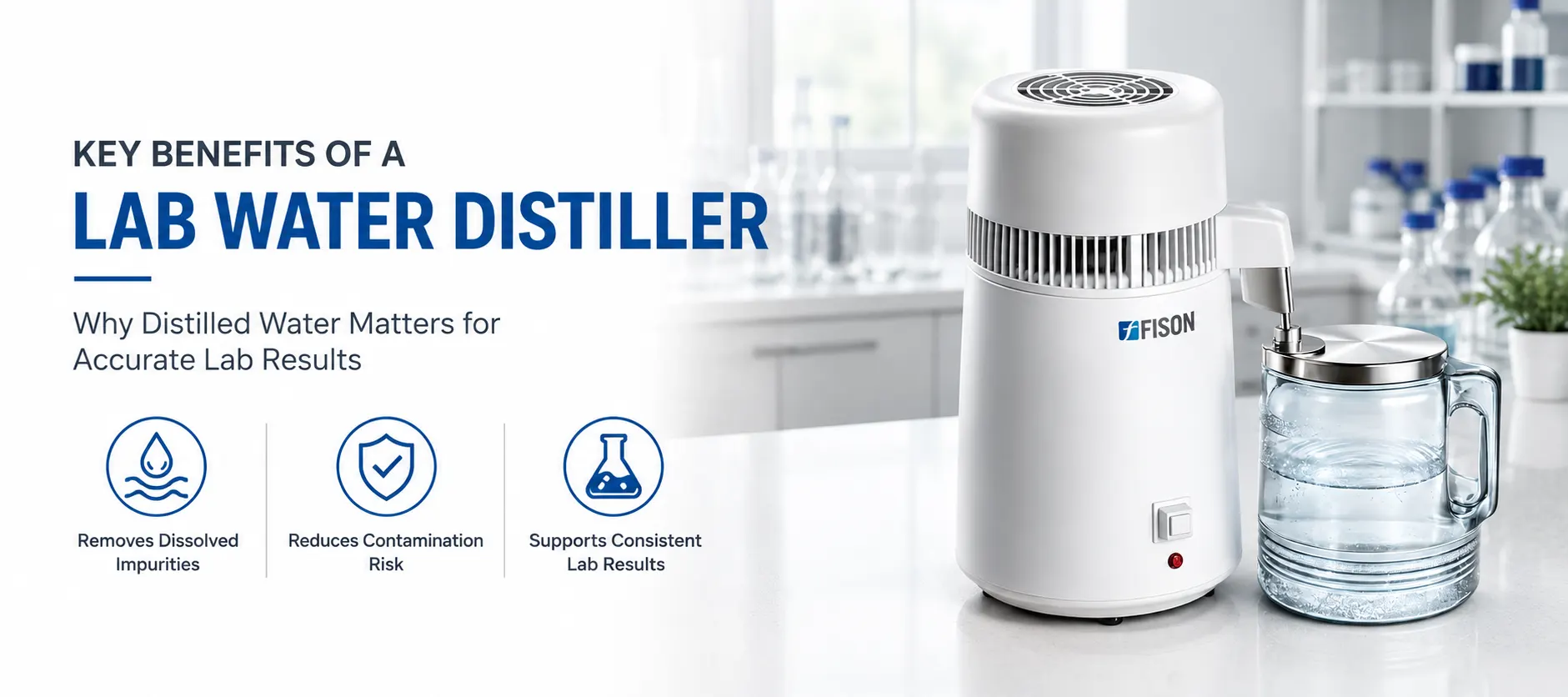
What a Water Distillation Unit Does for Laboratory Water Purity
Laboratories, hospital pathology sections and research centres each depend on a steady feed of purified water for reagent preparation, glassware rinsing and instrument calibration. A Fison Water Distillation Unit addresses this need by turning ordinary feed water into vapor and then condensing that vapor back into liquid form, leaving behind dissolved minerals, organic residue and most microbial matter in the process. Where filtered or tap water carries variable mineral content from one supply source to another, this thermal separation approach gives a lab a controlled and repeatable degree of purity that plain filtration struggles to match on its own.
Water distillation equipment today spans a wide size range, from compact benchtop units suited to teaching or quality-control benches to higher-output water distillation systems installed in hospital sterile processing areas and advanced research facilities that run continuous testing schedules.
How a Water Distillation Machine Works
Most water distillation devices follow the same working principle even when their build details differ. Feed water enters a heating chamber, sometimes called the distillation kettle, where an element brings it to a rolling boil. The resulting steam rises through a vapor path and passes into a condenser, typically a coiled or finned tube cooled by circulating water or air. As the vapor loses heat inside the condenser, it turns back into liquid and drips into a collection vessel that is sealed against outside air and dust.
Because minerals, salts and most organic contaminants do not travel with steam, they stay behind in the heating chamber as scale, which needs periodic descaling depending on how hard the source water is. Some water distillation equipment adds a pre-filter stage ahead of the boiler to reduce sediment, or a post-collection carbon or UV stage to address trace gases and airborne contamination picked up after condensation.
Why Distilled Water Matters for Accurate Lab Results
Consistent baselines across repeat titrations, pH readings and conductivity checks, since mineral variation from tap water is removed before testing begins.
Reduced scale buildup inside glassware, autoclaves and rinsing lines, which in turn lowers the chance of residue interfering with sensitive readings.
Fewer background ions during reagent mixing, which matters directly for spectrophotometry, chromatography and other trace-level chemistry work.
Longer service life for pumps, heating elements and tubing across the lab, since a water distillation machine removes most of the material that causes internal scaling over time.
Where Water Distillation Devices Are Put to Work
Microbiology & Culture Prep
Culture media, buffers and rinse water for plating work all call for water free of mineral or microbial interference, which is exactly what a water distillation system is built to supply.
Hospital Sterile Processing
Autoclave feed lines and instrument rinsing stages in hospital settings often draw from a dedicated Water Distillation Unit for laboratory and clinical areas alike, keeping mineral scale away from sterilizers.
Research & Analytical Chemistry
Reagent and buffer prep in research centres benefits from a distiller machine that produces water with a stable, repeatable mineral profile from batch to batch.
Common Mistakes When Choosing a Water Distillation Machine
- Picking a unit by output capacity alone, without checking how that pace lines up with actual daily water demand on the bench.
- Overlooking the boiling chamber material — glass, stainless or another option changes cleaning routines and how the unit handles hard feed water over time.
- Skipping a check on local feed water hardness, which directly affects how often the water distillation kettle will need descaling.
- Ignoring cooling water or airflow requirements for the condenser stage, which can throttle actual output well below the rated figure.
- Assuming one water distillation device fits each and any department, when a hospital sterile-processing area and a small teaching lab often call for very different footprints and duty cycles.
Looking through the options listed on the Water Distillation Unit page before deciding helps line up capacity, material and maintenance needs against how the equipment will actually be used day to day.
Where a Water Distillation Unit Sits Within Lab Water Purification Equipment
A Water Distillation Unit belongs to a broader group of water purification equipment that also includes reverse-osmosis systems, deionizers and combination purification setups. People comparing options inside this wider category typically weigh output rate, energy draw per litre produced, footprint on the bench or floor, feed water material (glass versus stainless or polypropylene), and how much routine descaling or filter change-out the equipment will call for once installed. The full set of distillation options can be browsed on Fison's Water Distillation Unit category page, alongside the wider lab equipment listing on the Fison home page, where related purification and lab support equipment is grouped together.
Glass, Metal and Home-Scale Options Compared
Water Distillation Unit, Glass Build
A Water Distillation Unit glass build is generally chosen where trace-metal-free output matters, such as analytical chemistry benches preparing reagent water for titration and calibration work, since glass does not leach metal ions into the collected water the way some metal chambers can over long use.
Home-Scale vs Laboratory-Scale Units
A Water Distillation Unit for home use is usually sized for a household's drinking-water needs and simple upkeep, while laboratory-grade water distillation equipment is built around higher, steadier daily output and closer control over the resulting distilled Water Distillation Unit's purity for testing purposes.