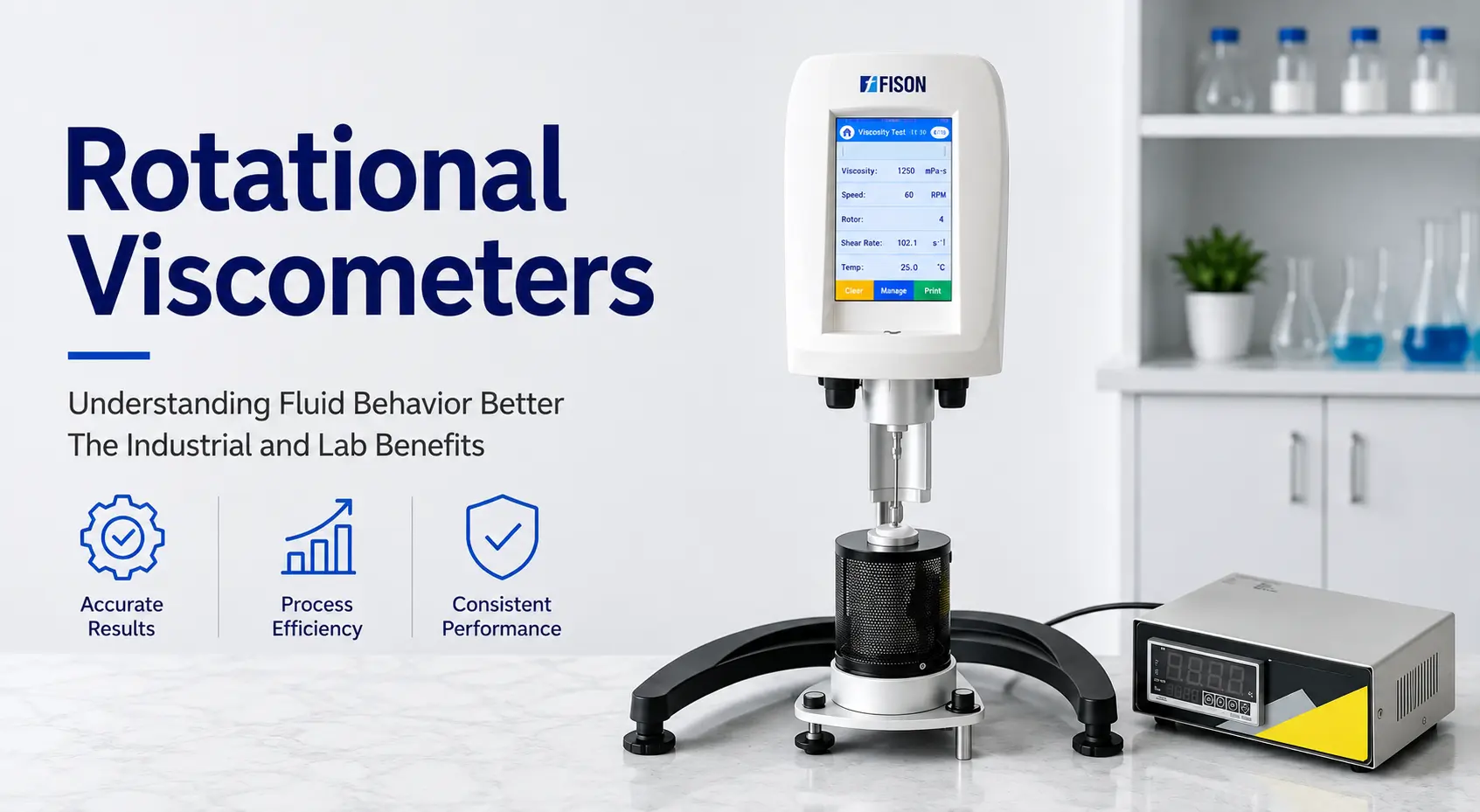
Laboratories, hospitals, research centres and advanced facilities that work with paints, adhesives, food products or biological fluids all need a consistent way to describe how thick or thin a sample behaves under motion, and that reading usually comes from a Fison Rotational Viscometer. This article looks at how these instruments work, where they sit within a wider testing setup, and what to check before choosing one.
Why Viscosity Measurement Needs More Than a Simple Flow Check
Watching how quickly a fluid pours from a cup gives a rough impression of thickness, but it says nothing about how that fluid behaves under different amounts of stress. Many everyday products - paints, creams, sauces, adhesives - thin out or thicken depending on how hard they are stirred, and a single pour-time reading cannot capture that shift.
A dedicated viscosity meter addresses this by applying a controlled, repeatable motion to the sample and measuring the resistance it produces, rather than relying on gravity alone. Viscosity testing equipment built around this principle gives a number that can be compared batch to batch, lab to lab, which matters once a formulation needs to stay within a defined range over time.
How a Rotational Viscometer Works: Principle Behind Spindle-Based Readings
A Rotational Viscometer lowers a spindle into the sample and rotates it at a set speed, then measures the torque needed to keep that speed against the resistance the fluid offers. Because a thicker fluid resists rotation more, the torque reading converts directly into a viscosity value once the spindle geometry and speed are factored in. This design is often described as a rotating spindle viscometer, since the spindle itself is what drives the measurement.
Spindle Selection
Sample Immersion
Rotation & Torque
Viscosity Readout
Spindle size and rotation speed both change the shear rate applied to the sample, which is why matching spindle geometry to the expected viscosity range matters more than defaulting to whichever spindle happens to be on hand.
Rotational Viscometers and Other Viscometer Types: Matching Equipment to Fluid Behavior
A capillary viscometer times how long a fixed volume of fluid takes to pass through a narrow tube, which works well for thin, consistent liquids but says little about a fluid that changes behavior under stress. A falling-ball viscometer times a ball dropping through the sample, a method that suits clear, low-viscosity fluids but struggles with opaque or thick samples.
A Rotational Viscometer covers a wider range of fluid types, including pastes, gels and shear-sensitive suspensions, because the spindle speed can be adjusted to see how a sample responds across a range of shear rates rather than a single pass. Facilities deciding between these formats can compare spindle options, speed ranges and sample volume requirements on the Rotational Viscometer category page before settling on an instrument.
Where the Rotational Viscometer Fits in the Wider Viscosity Testing Equipment Category
A Rotational Viscometer belongs to a broader group of viscosity testing equipment that also includes capillary viscometers, falling-ball viscometers and cone-plate rheometers. Within this group, labs typically compare spindle and speed range, sample volume and temperature control, the shear rate range a unit can reach, and how easily the equipment integrates with existing quality workflows.
Reviewing the full Rotational Viscometer range is a practical starting point for lining up these factors before narrowing a shortlist.
For facilities exploring viscosity testing equipment beyond this single category, the Fison home page lists the wider catalogue of laboratory and hospital equipment the brand carries.
Practical Uses Across Laboratories, Hospitals and Research Centres
A Rotational Viscometer test shows up across more settings than formulation work alone, once a facility looks beyond its most obvious use case.
In quality laboratories, the instrument confirms that paints, coatings, adhesives and food products stay within an expected viscosity range from batch to batch. Hospital and clinical settings occasionally rely on similar readings when characterizing biological fluids or topical formulations where consistency affects how a product performs. Research centres use a laboratory viscometer during formulation development to see how ingredient changes shift a mixture's flow behavior, while advanced labs running frequent testing often pair the instrument with temperature-controlled sample cells so results stay comparable across a full working day.
Selection Mistakes to Watch For When Choosing Rotational Viscometer Equipment
A handful of recurring missteps show up during evaluation, and most only surface once the instrument is already in routine use:
- Choosing a single spindle for all sample types. A spindle sized for a thin liquid will not read a thick paste accurately, and Rotational Viscometer equipment often ships with a set for this reason.
- Overlooking shear rate relevance. A fluid that thins or thickens under stress needs readings at more than one speed to describe its behavior properly.
- Ignoring temperature control. Viscosity changes with temperature, and a sample tested at slightly different temperatures from one day to the next can produce numbers that are difficult to compare.
- Underestimating sample volume needs. Some spindle and cup combinations need more sample than a lab expects, which matters when working with limited or costly material.
- Skipping a calibration routine. A rotational viscosity meter left unchecked for long stretches can drift, and catching that drift early avoids questioning results after the fact.
Automatic and Manual Rotational Viscometers: A Quick Comparison
Some labs still run readings on a manually operated viscometer rather than a unit with automatic spindle detection and programmable test sequences. The table below outlines where each approach tends to fit.
| Aspect | Manual Operation | Automatic Rotational Viscometer |
|---|---|---|
| Hands-on time per test | Higher, with manual speed and spindle changes | Lower, sequences run with less input |
| Reading repeatability | Varies with operator technique | Stays consistent test to test |
| Multi-speed testing | Time-consuming to switch manually | Runs programmed speed steps automatically |
| Typical setting | Occasional, low-volume research checks | Routine quality and formulation testing |
Ready to Compare Rotational Viscometer Options?
Spindle range, speed options and sample volume differ meaningfully between models, and reviewing them together helps match an instrument to actual testing needs rather than a rough estimate.
View Rotational Viscometer Options