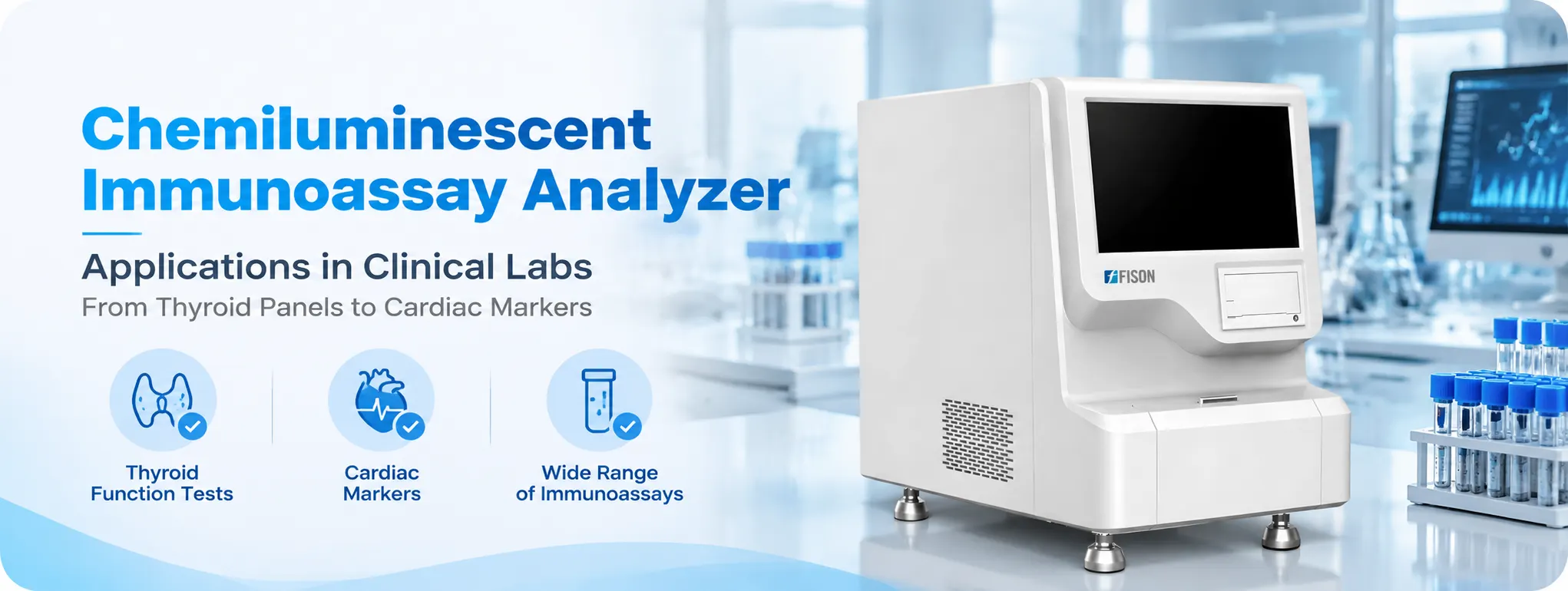
Manual immunoassay testing leaves room for operator-driven variation in timing and handling. This article covers seven benefits automation brings to a Fisom Chemiluminescent Immunoassay Analyzer, how the underlying working principle delivers them, and where precision still depends on the operator.
Why Automation Changed What a Chemiluminescence Immunoassay Machine Can Do
A manual immunoassay workflow asks a technician to pipette, incubate, wash and read each plate by hand, and each of those steps is a place where timing drifts and results vary between operators. A fully automated chemiluminescence immunoassay analyzer removes that dependence on manual timing by running the same sequence the same way for each sample, from reaction cup to detector.
A Chemiluminescent Immunoassay Analyzer brings this automation to hospital laboratories, research centres and advanced labs that need to run thyroid, cardiac and tumour panels on a Chemiluminescence Immunoassay System without a technician standing over each step. Some labs still refer to this kind of instrument informally as a chemiluminescence machine, though Chemiluminescence Immunoassay System and Chemiluminescent Immunoassay Analyzer are the more precise terms used when comparing models. The seven benefits below cover what that automation and the underlying Chemiluminescence Immunoassay Analyzer principle actually deliver in daily use.
Seven Benefits Laboratories Report in Daily Use
Consistent Reaction Timing
A chemiluminescence immunoassay system controls incubation and wash timing precisely, so the chemiluminescence immunoassay analyzer principle applies the same way to each sample in a run.
Reduced Hands-On Time
Loading reaction cups and reagents is largely where operator involvement ends on this chemiluminescence immunoassay machine, since the instrument carries each sample through binding, separation and detection unattended.
Higher Sensitivity at Low Concentrations
Magnetic particle binding and a chemiluminescent substrate reaction give this chemiluminescence immunoassay machine enough signal to detect markers present at very low concentrations.
Reduced Turnaround Time
Running multiple reaction cups in parallel lets a fully automated chemiluminescence immunoassay analyzer return a full panel faster than a system that processes one sample fully before starting the next.
Cleaner Results Through Separation
Triple magnetic separation cleaning between cycles reduces carryover, which supports chemiluminescence immunoassay test results on this Chemiluminescent Immunoassay Analyzer that stay specific to the intended marker.
Visibility Into Each Run
Real-time progress updates and safety alarms let staff follow a run as it proceeds, rather than finding out a problem only once results are already due.
One Menu for Many Panels
Thyroid, cardiac, tumour, hormone, inflammation, diabetes and bone metabolism markers run from the same chemiluminescence immunoassay system and Chemiluminescent Immunoassay Analyzer, so a laboratory is not switching platforms between request types.
Chemiluminescent Immunoassay Analyzer Working Principle Behind the Benefits
Each of the seven benefits traces back to the same Chemiluminescent Immunoassay Analyzer working principle. Magnetic microparticles coated in antibodies bind the target in a reaction cup, unbound material is removed magnetically, and a chemiluminescent substrate produces light in proportion to the amount bound. A photomultiplier reads that light, and software converts the signal into a concentration against a stored calibration curve.
Because this sequence is identical for each sample, automating it is what turns a sound Chemiluminescent Immunoassay Analyzer principle into consistent, fast results rather than a method that only works as well as its most careful operator.

Chemiluminescent Immunoassay Analyzer Uses Across Clinical Panels
These benefits apply across a wide test menu, and a laboratory comparing options can start with the immunoassay analyzer category before matching a model's throughput to its own panel mix.
Thyroid Panels
FT4, FT3, TT4, TT3 and TSH testing on a Chemiluminescent Iimmunoassay Analyzer benefits most from reduced turnaround time in urgent cases.
Cardiac Markers
D-dimer, BNP, NT-proBNP, CK-MB, Myo and hs-cTnT rely on the sensitivity gains that chemiluminescence immunoassay analyzer uses, including a fully automated chemiluminescence immunoassay analyzer, are built around.
Tumour Markers
tPSA, fPSA, CEA, AFP, CYFRA21-1, CA19-9 and CA125 benefit from the consistent reaction timing a Chemiluminescent Immunoassay Analyzer provides across repeat monitoring visits.
Where the Benefits Matter Most and Least
Automation and reduced turnaround time matter most in settings with high sample volume or urgent panels, where a faster, hands-off chemiluminescence immunoassay machine, and the Chemiluminescent Immunoassay Analyzer uses it supports, change how quickly a clinician acts. In a small research lab running occasional batches, the sensitivity benefit may matter more than the throughput benefit, since fewer samples means less pressure on turnaround.
Matching the benefit that matters most to a laboratory's actual workload, rather than assuming each feature helps equally, is what determines whether chemiluminescence immunoassay analyzer manufacturers are compared on the right criteria in the first place. The specific chemiluminescence immunoassay analyzer uses a laboratory expects, whether urgent cardiac panels or routine thyroid screening, should guide which of these seven benefits gets weighted most heavily.
Where Precision Still Depends on the Operator
Automation controls the reaction sequence, but it does not decide sample quality before loading. Haemolysed or lipaemic samples can distort a light-based signal regardless of how consistent the instrument's timing is, so visual inspection before loading remains part of getting an accurate chemiluminescence immunoassay test result on any Chemiluminescent Immunoassay Analyzer.
Reagent storage at the stated temperature and attention to onboard stability windows also sit outside what automation can fix on its own, so these steps belong in a laboratory's method alongside the Chemiluminescent Immunoassay Analyzer instrument settings. A lab that relies on the Chemiluminescent Immunoassay Analyzer principle alone to compensate for a degraded reagent lot will still see result drift, since the principle describes signal generation, not reagent integrity.
Common Mistakes When Evaluating These Benefits
Laboratories sometimes weigh these advantages the wrong way when comparing instruments.
- Treating throughput as the only benefit that matters. A high maximum throughput figure on a chemiluminescence immunoassay machine means little if the test menu does not cover the panels a laboratory actually runs.
- Assuming automation removes all variation. Automation on a Chemiluminescent Immunoassay Analyzer controls instrument steps, not sample quality issues introduced before loading.
- Overlooking maintenance needs behind the benefits. Reaction cups, probes and the separation module on a chemiluminescence immunoassay system still need scheduled care to keep these advantages consistent over time.
- Comparing chemiluminescence immunoassay analyzer manufacturers on one benefit alone. Sensitivity, turnaround time and menu breadth each matter differently depending on the laboratory's workload.
- Skipping calibration planning. Each biomarker still needs its own calibration curve on the instrument, however automated the reaction sequence is.
Exploring the Wider Immunoassay Category
The Chemiluminescent Immunoassay Analyzer is one detection method within the broader immunoassay analyzer category, which also includes ELISA-based systems and other automated immunoassay platforms used across clinical diagnostics.
Laboratories evaluating this category typically compare test menu breadth, throughput, sample volume, reagent format and data connectivity. A chemiluminescence machine built for high-volume panels still fits within this same broader category, alongside ELISA-based platforms and other automated immunoassay systems. The full range of immunoassay analyzer models sits on the Fison Immunoassay Analyzer Category , and the wider laboratory equipment portfolio is reachable from the Fison Home .